Facebook
 Google
 GitHub
 Linkedin
From Months to Minutes: How Automated AI Can Modernize the Grid
ThinkLabs AI’s CEO spoke to EEPower about helping Southern California Edison automate its grid planning and operations with AI.
Utilities are facing unprecedented challenges in meeting electricity demand. Energy sources are diversifying, and power demand can change dramatically from day to day. It’s clear that grid upgrades and expansions are necessary, but where, when, and how?
These questions are becoming harder to answer, especially with aging grid infrastructure and rising costs. The way forward, according to Josh Wong, CEO and founder of ThinkLabs, is to apply physics-informed AI to optimize existing grid capacity and operations.
“AI is now,” Wong told EEPower. “It’s not like five years from now. This is a proven technology, and it’s ready to scale.”
ThinkLabs AI recently completed a collaboration with Southern California Edison, using its physics-informed AI to create a digital twin to assist the utility with grid planning and operations. The method provided SCE with present and long-term information on transmission and power flow in a fraction of the time conventional methods use.
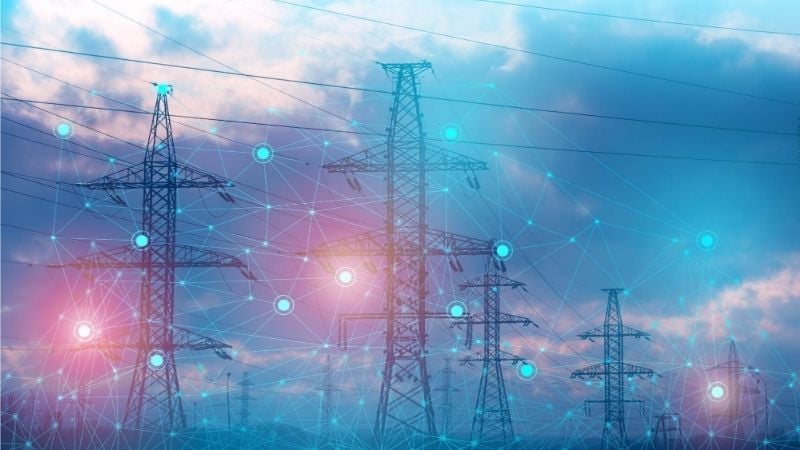
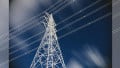
How can AI help power grids meet present and future needs? Image used courtesy of Adobe Stock
Grid Infrastructure, Demand, and Optimization
Existing infrastructure and energy transmission and distribution models are inadequate, even as utilities try to modernize.
“The energy systems are very much antiquated,” Wong said. “It is congested, it’s very old, and it’s built off of worst case scenarios.”
Grids lack the flexibility to handle the diversification and decentralization of renewable energy sources and load distribution. Utilities also struggle to process the number of grid connection requests for renewable, commercial, and industrial projects.
“We hear a lot about long waits for renewable energy systems, new solar farms, new wind farms to connect,” he remarked. “Also, the data farms, which are going around that by building their own little generation systems. But it’s not just a one-and-done thing, is it? I mean, once they’re connected, you still have to see what’s happening.”
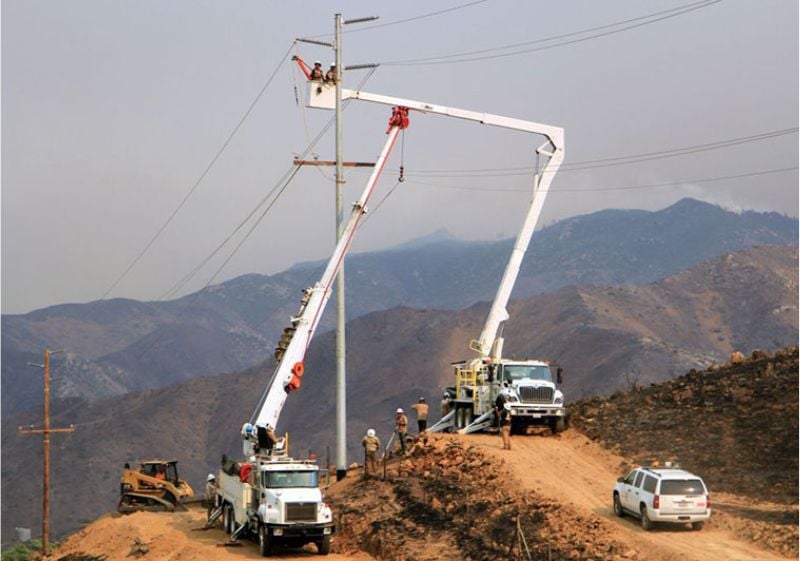
Installing new transmission lines. Image used courtesy of SCE
While building new transmission lines will be necessary in the long run, Wong said, utilities can increase capacity and efficiency now with the infrastructure they already have.
“How do we optimize the utilization of the infrastructure?” he said. “That’s really the key here. And when you need more capacity, what do we do?”
The SCE AI Case
Southern California Edison serves about 15 million people in Los Angeles and across 15 counties in Southern California, but its situation is typical of most utilities: electrification and renewable energy sources are increasing while infrastructure is aging. At the same time, SCE must deal with increased fire risks and extreme weather events.
Like most utilities, SCE had used data analysis for its grid operations and planning. However, these conventional processes are generally slow and labor-intensive, Wong said.
“The processes are very human, from collecting data from the customers to a lot of internal silos for data, to cleaning the data and running a very time-consuming analysis,” he said.
Then, the scenarios analyzed may be trial-and-error-based. “Oh, I think I should add a cable here, or what if I had a battery there?” Wong explained.
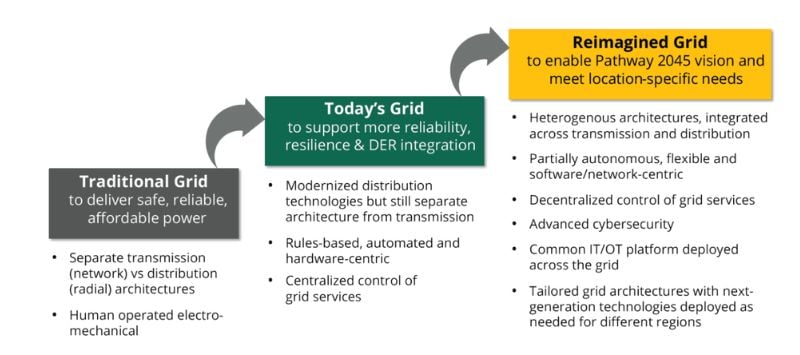
SCE’s vision for its future grid. Image used courtesy of Edison International
SCE decided the next step was to automate its analysis using ThinkLabs AI.
ThinkLabs trained the AI on SCE’s distribution and self-transmission and used the models to run an 8760 analysis (the number of hours in a 365-day year). They built the digital twin on Microsoft Azure AI Foundry and utilized Nvidia’s high-performance computing.
“Instead of a one-time snapshot analysis, we studied for every single hour for the year,” Wong explained.
First, the AI system learned thousands of potential power flow scenarios to automate the time-series analysis. Next, it simulated distribution and subtransmission network models to produce a report on potential impacts, including congestion, constraints, and adverse events.
Traditional tools might take more than a month to run an 8760 analysis. ThinkLabs’ AI processed power-flow data in less than 3 minutes. It generated an engineering report in under 90 seconds.
The report recommends solutions, such as battery storage, load flexibility, and topology optimization. Wong added that the AI also informs grid operators about optimal strategies in energy dispatch, curtailment, and other decisions in both the short- and long-term.
Physics and Scalability
Wong said ThinkAI’s digital twin is not a visualization, but a physics-informed approach. The process uses physics and math to create a traceable, verifiable dataset.
In SCE’s case, the AI focused on distribution and subtransmission. Other utilities may need to examine other aspects of their grid. The analysis is tailored to fit each utility’s needs.
“We use physics to train the AI,” Wong said. “We’re basically teaching the AI how engineering—electrical engineering—works. So we have traditional physics simulators become the trainer of the AI to learn and to copy itself.”
The training phase takes the most time because the AI needs to learn the unique infrastructure, power distribution, and the grid’s power needs. Preparing the training date can take a couple of months, but once the data is generated, the models take about 10 minutes to train.
Wong said grids are complex, and the line between planning and operations is blurring. It’s not possible to plan for 10 to 40 years and then set it aside and forget it.
“Now everything is much more orchestrated by time series,” he explained. “So a week to plan, then we need to sort of play forward by what the operations look like hourly.”
With the SCE pilot complete, Wong said ThinkLabs AI is actively working on scaling up the AI system and will collaborate with other utilities in the future.