Facebook
 Google
 GitHub
 Linkedin
Grid Infrastructure Faces the Future: Plans for 2025
Transmission expansion, advanced grid tech, and storm response are critical priorities for the new year.
The U.S. power grid faces mounting pressure to adapt to renewable energy loads, advancements in grid technology, and disruptions from extreme weather events. At the same time, transmission and distribution expansions are essential to meet rising energy demand in 2025 and beyond.
These issues stand behind key trends shaping grid infrastructure this year.
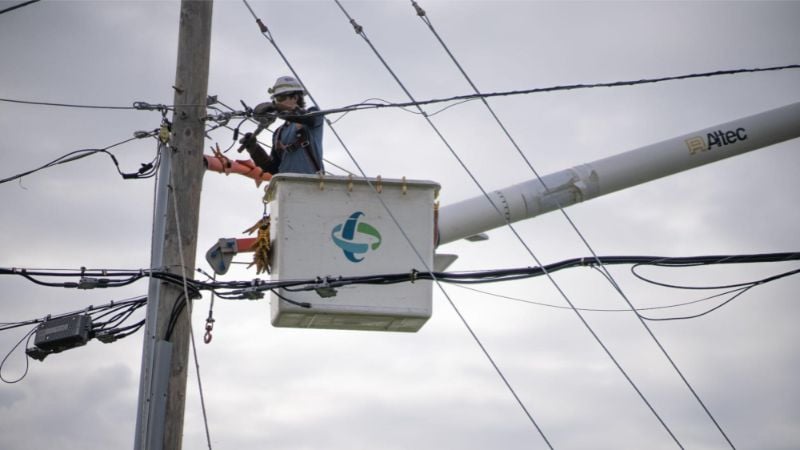
A technician works to restore a power line in Florida after Hurricane Milton. Image used courtesy of Duke Energy
2025 Capacity Growth and Transmission Expansion
Renewable energy growth will remain a critical trend in 2025. The U.S. Energy Information Administration predicts solar generation will increase by 31%, surpassing hydroelectric output for the first time. Battery storage systems are also expanding to help balance supply and demand.
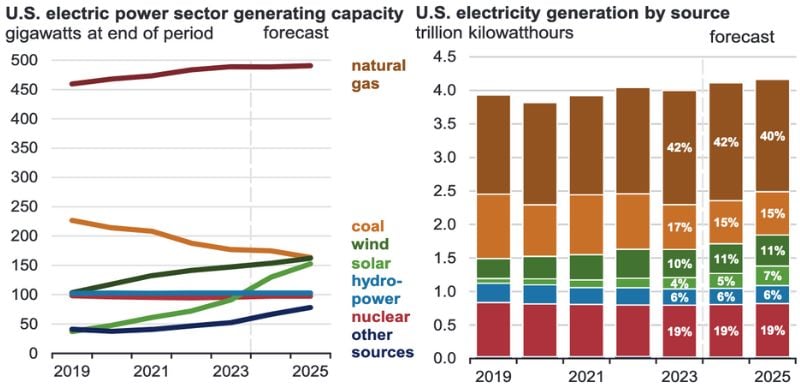
U.S. generating capacity forecast. Image used courtesy of the EIA
A significant expansion in transmission infrastructure will accompany this growth. The Department of Energy (DOE) recently awarded $1.5 billion to projects adding 7.1 GW of capacity and nearly 1,000 miles of power lines across several states. The funding will connect wind power from New England and the Southwest and improve infrastructure linking Texas to nearby states.
Given future demand and reliability requirements, the U.S. transmission system will need to double in size between 2020 and 2050, according to the DOE. Interregional transmission is expected to grow by 1.9 to 3.5 times. Several regional transmission organizations and independent system operators intend to add new capacity or upgrade existing infrastructure.
The California Independent System Operator (CAISO) has received several reconductoring proposals, bus upgrades, voltage support and transformer additions, and line replacements proposed by the state’s largest utilities. Its 20-year transmission outlook update recommended several projects to reconduct 230 kV lines, build new 500 kV substations, and add a series reactor for a 230 kV line. CAISO’s 2025 flexible capacity needs assessment also projects a notable increase in co-located and hybrid resources from 2024 to 2027.
CAISO is also preparing to connect the state’s first offshore wind projects, requiring additional transmission capacity. The California Energy Commission plans to add up to 25 GW of offshore wind on California’s coasts by 2045. CAISO will need additional transmission cables to serve wind projects along the North Coast, which currently has virtually no infrastructure to deliver offshore energy to load centers.
PJM Interconnection, which manages transmission across 13 mid-Atlantic states, anticipates 26 planned upgrades through 2028. These include rebuilding miles of power lines, replacing circuit breakers, upgrading switches, and increasing the ratings of existing lines. Grid operators are adopting dynamic line ratings to maximize existing capacity without building new lines.
PJM expects to clear about 100 GW of resources for connection by the end of 2025, a significant increase from the 62 GW approved last year. New requests to join its grid are almost exclusively renewables and battery storage. Solar represents around 40% of the 186 GW of projects requesting interconnection. Storage accounts for another 28%.
Rebuilding Transmission Infrastructure After Helene and Milton
Hurricanes Milton and Helene damaged countless transmission lines and substations across the Southeast’s bulk power system. According to the Federal Energy Regulatory Commission’s 2024-2025 winter assessment, over 50,000 utility crews worked to restore power quickly after the storms hit.
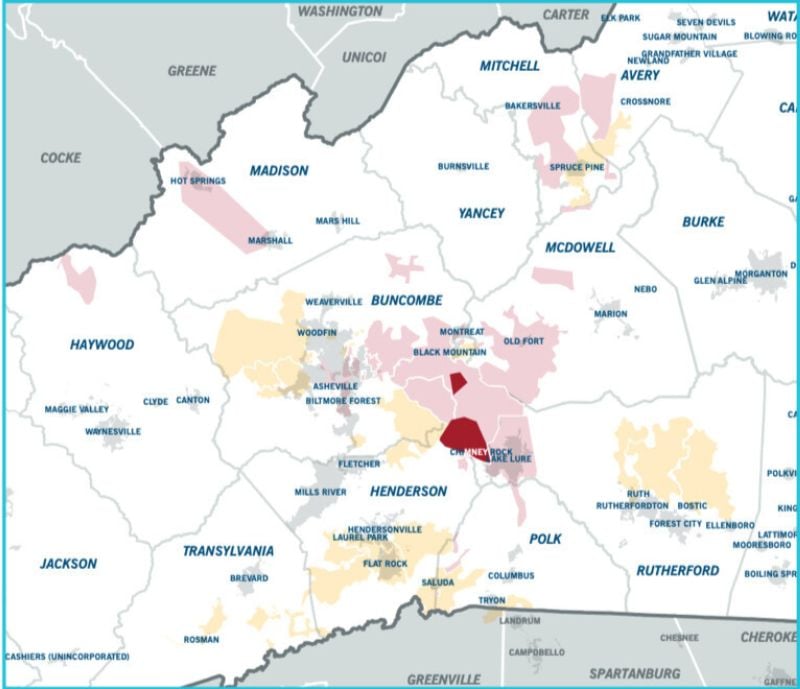

Helene damaged Duke Energy’s power lines in western North Carolina. Yellow: complex repair zone. Red: Disaster rebuild zone. Image used courtesy of Duke Energy
However, extensive road damage means some customers are entirely cut off from receiving power, and rebuilding will likely take months. Duke Energy restored power for 1.1 million customers within 48 hours of Helene hitting upstate South Carolina and western North Carolina. Still, its recovery requires a full-scale rebuild in some areas.
Hurricane Milton significantly impacted Florida’s power system. Tampa Electric reported it caused more transmission damage than any other recent storm. Florida Power & Light said Helene, Milton, and two other hurricanes caused 3 million outages in the last 14 months. Restoration took the longest for Helene (three days) and Milton (five days).
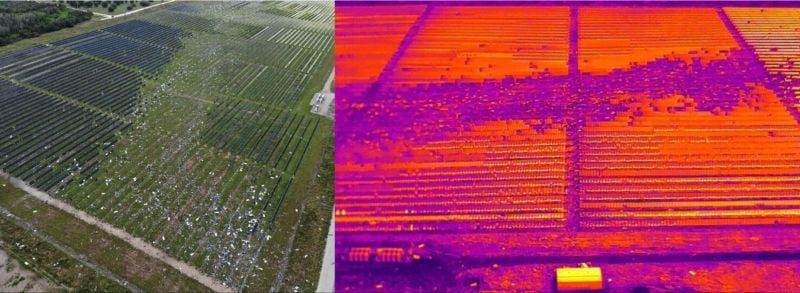
The 45-MW Lake Placid Solar Power Plant in Florida was damaged by a tornado during Hurricane Milton in October 2024. Before the storm, it powered 12,000 homes at peak production. Images used courtesy of Duke Energy
Advanced Grid Tech and Storm-Hardening
Utilities are deploying grid-enhancing technologies, such as remote sensors for real-time monitoring, voltage optimization systems to improve power quality, and advanced communication and control systems to support grid performance and efficiency. More grids are also adopting dynamic two-way power flow to accommodate distributed technologies like solar, battery storage, and electric vehicle charging.
These upgrades are already bringing tangible results. Florida Power & Light’s smart grid technology avoided 900,000 outages during hurricanes Helene, Milton, and Debby in 2024 and Idalia in 2023. Duke Energy’s self-healing technology, which identifies outage sites and reroutes power, prevented 300,000 outages and 300 million minutes of downtime in Florida after Helene and Milton. It also reduced the number of affected customers by up to 75% and often restored power in under a minute.
Storm-hardening and undergrounding activities are another critical priority for 2025, particularly in hurricane-prone states. Duke Energy Florida, which owns 12.3 GW of capacity and serves 2 million customers, reports that about half its primary power lines are buried today. However, it will continue to install underground infrastructure in practical areas. Over 40,000 poles have been hardened over the last three years, and it plans to target another 15,000 poles and structures annually moving forward.