Facebook
 Google
 GitHub
 Linkedin
FERC: Modernize Grid Interconnection Rules for AI Data Centers
Regional grid operators must defend existing interconnection policies or propose new ones as demand from large electricity users accelerates.
Large AI data centers are prompting regulators to revisit one of the electric grid's most consequential processes: interconnection. In a new ruling, the U.S. Federal Energy Regulatory Commission (FERC) has directed regional grid operators to reevaluate how large transmission-connected customers are integrated into the grid.
The commission issued a series of targeted orders requiring all six FERC-jurisdictional Regional Transmission Organizations (RTOs) and Independent System Operators (ISOs) to either defend their existing interconnection policies or propose new tariffs specifically designed for large, transmission-connected loads such as AI data centers, semiconductor manufacturing facilities, and advanced industrial plants.
Transmission towers at sunset. Image used courtesy of Pexels/by Pok Rie
Recent Interconnection Bottlenecks
Today's interconnection processes were designed for gradual load growth, long before clusters of 100- to 500-MW AI campuses began appearing across the country. According to the U.S. Energy Information Administration, electricity demand has increased by roughly 2% annually over the past five years, reversing decades of relatively modest growth and adding pressure to an already constrained transmission system.
Projects of that scale can require as much electricity as a mid-sized city, creating planning challenges that existing interconnection studies weren't designed to cover. Current interconnection procedures often evaluate these massive facilities using many of the same processes applied to conventional industrial or commercial customers.
However, large-scale projects often require significant transmission upgrades, can change regional power flows, and raise questions about whether utilities, developers, or existing ratepayers should pay for upgrade costs.
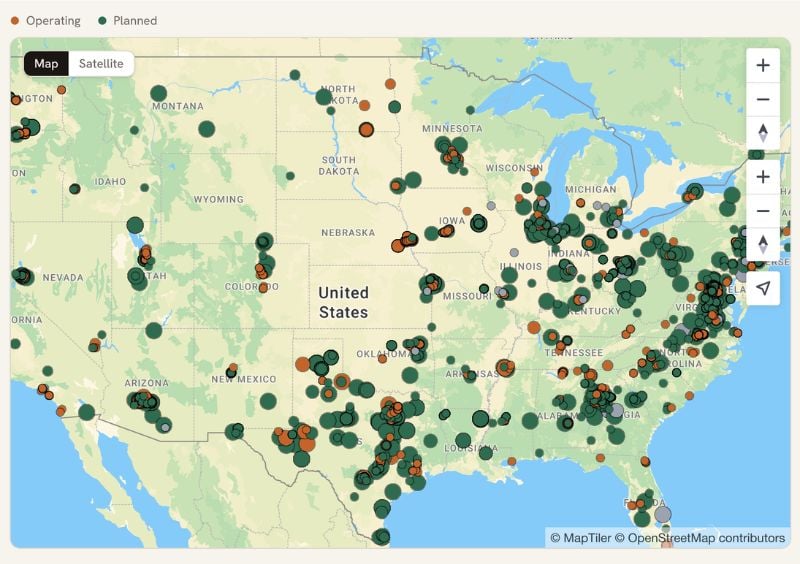
Map of planned and operating data centers across the U.S. Image used courtesy of Cleanview
At the same time, Cleanview is tracking nearly 1,600 planned U.S. data center projects totaling 367 GW of future electrical demand, compared to about 52 GW of operating capacity today. The scale of those plans is already evident in some regions, such as PJM Interconnection, where data center development accounts for around 30 GW of the projected 32 GW increase in peak demand by 2030.
FERC's action comes as regional interconnection queues continue to grow, with thousands of generation and storage projects awaiting grid connections nationwide, totaling over 2 TW of capacity. According to Lawrence Berkeley National Laboratory, projects that reached commercial operation in 2025 spent a median of more than five years moving through the interconnection process.
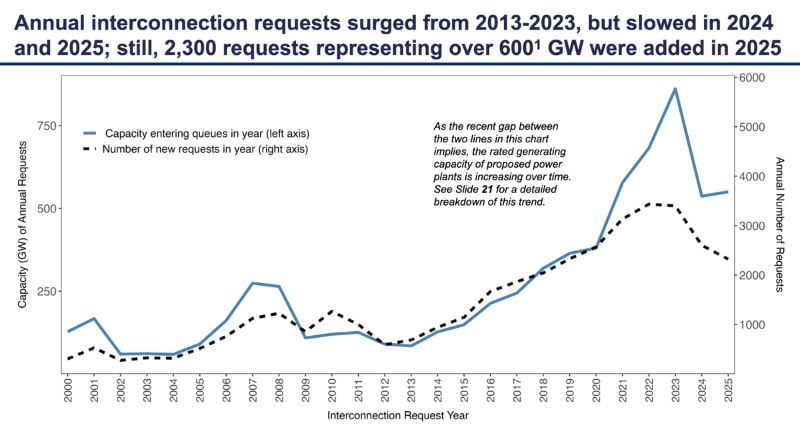
Annual interconnection requests over time. Image used courtesy of Lawrence Berkeley National Lab
FERC Seeks Consistency and Regional Flexibility
The proceeding affects electricity markets serving more than 200 million Americans across more than 30 states, according to FERC. The commission is requiring each of its six operators to demonstrate that their existing tariffs adequately address large-load interconnections, or to propose region-specific revisions.
FERC press conference. Video used courtesy of FERC
Specifically, RTOs and ISOs must review five areas, including how large load requests are studied, how transmission upgrades are planned and funded, how co-located generation should be treated, whether emerging technologies can reduce infrastructure costs, and how regional planning accounts for sustained demand growth.
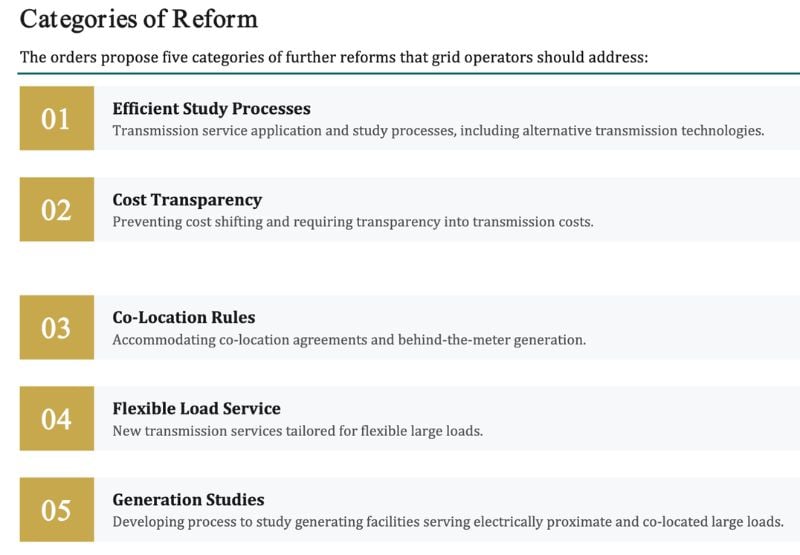
FERC's five-point plan for grid operators. Image used courtesy of FERC
One important area is co-located generation, as more hyperscale developers like Google are now pairing new data centers with dedicated natural gas plants, nuclear facilities, or renewable generation to secure reliable power.
FERC also asked grid operators to consider whether newer transmission technologies could defer or reduce the need for conventional grid upgrades when serving large new loads. These tools—such as dynamic line ratings, advanced power flow controls, and other grid-enhancing technologies—are designed to increase the capacity and efficiency of existing transmission lines before utilities invest in new infrastructure.
Within 30 days, each RTO and ISO will need to submit a report describing how it plans to maintain resource adequacy as demand grows. Within 60 days, each organization must either defend its current tariff or submit proposed revisions for large-load interconnections.