Facebook
 Google
 GitHub
 Linkedin
GET-ing More: Increasing Grid Capacity With Renewables
How can grid-enhancing technology help a strained power grid add more renewable resources without building more infrastructure?
Integrating renewable energy sources in large numbers presents challenges due to the power grid’s insufficient transmission capabilities. Rather than build costly new infrastructure, grid operators can integrate hardware and software-based grid-enhancing technologies (GETs) to improve hosting capacity so that more renewables can be quickly and inexpensively added to the grid.
Is curative redispatch the best solution for integrating renewable energy? Video used courtesy of TransnetBW
Several types of GETs can be used, but curative redispatch and dynamic line rating (DLR) are two approaches that can significantly benefit the grid.

Renewable energy sources. Image used courtesy of Adobe Stock
Increased Renewable Integration Requires More Transmission
Increasing renewables in the grid improves stability and reliability because distributed energy can be harnessed when required. However, the grid’s transmission capacity must be increased to integrate multiple variable renewable sources.
Since new power lines are costly and take around 10 years to build, system operators are turning to GETs instead. These technologies can be deployed much faster and at a lower cost, accelerating the integration of more renewable systems currently waiting for scaled-up transmission capabilities.
GETs are hardware and software technologies that increase the efficiency, capacity, and reliability of existing power lines with a lower cost and higher speed than traditional grid infrastructure. GETs comprise a range of potential solutions to maximize the electricity transmission in existing grid infrastructure. These include power flow control devices, sensors, smart technology, and analytical/algorithmic software approaches—such as topology optimization.
Curtailment Is a Bottleneck
Curtailment is a process that can reduce power production when there is too much power in the grid. This is known as generation curtailment, the most common type of curtailment. Curtailment can also reduce power consumption (load curtailment) when the grid lacks sufficient power. Energy curtailment is used to balance the supply of energy to reduce the stress on the grid and prevent blackouts. However, it reduces the amount of renewables that can be integrated into the grid.
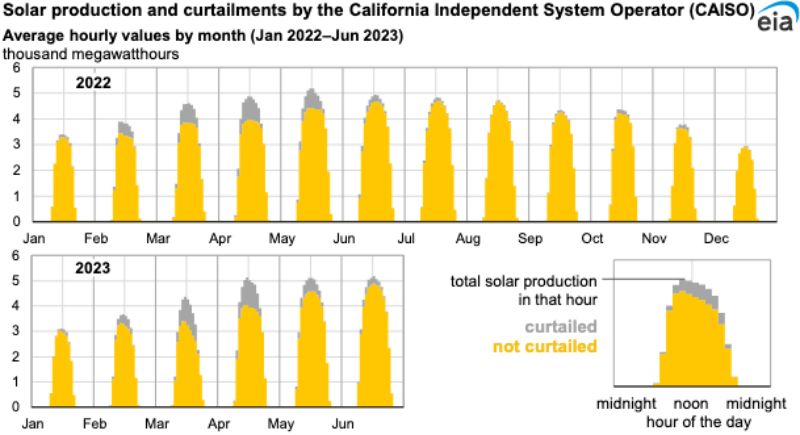
Curtailment incidents by month. Image used courtesy of Energy Information Administration
Curtailment is used in the short term to protect the grid. Still, the curtailing of renewables is an inefficient process that leads to lost power generation potential since the potential energy that could be harvested is wasted. Employing GETs can reduce the need for curtailment because they improve the transmission capabilities of power lines and increase renewable hosting.
GETs Can Increase Power Grid Capacity
Studies have shown that GETs could significantly increase the grid’s hosting capacity. For example, a European Union-funded study showed that some countries could increase their hosting capacity by up to 40%. GETs reduce curtailment by increasing the power lines’ transmission capacity, implementing new operation processes, and allowing control flows on the grid.
While different GET strategies are available, the highest potential gains could be achieved using curative redispatch and DLR. Deploying more than one GET could yield even higher hosting capacity gains. Still, the specific gains are based on the grid’s current hosting capacity and the types of renewables being integrated into the grid.
Curative Redispatch
Redispatch involves changing energy loads during energy bottlenecks to ensure that transmission capacity can be accommodated. Loads need to be redispatched upstream and downstream from the congestion point to balance the loads on the grid. This blocks out line sections to prevent loads from being too high in one area. Power plants on both sides of the bottleneck must either increase or decrease their loads based on the local load requirements.
Most redispatch operations are preventative, meaning system operators plan to perform redispatch operations based on expected load bottlenecks. However, in some cases, these bottlenecks can’t be planned, and redispatch efforts are made as a curative method to solve the bottleneck rather than trying to prevent it ahead of time.
This is particularly true in regions with many renewable sources because intermittent energy could be introduced to the grid at any time and cause unexpected bottlenecks. Moreover, renewables are in localized regions, and transporting large amounts of renewable energy across the grid down certain transmission pathways can cause unexpected bottlenecks.
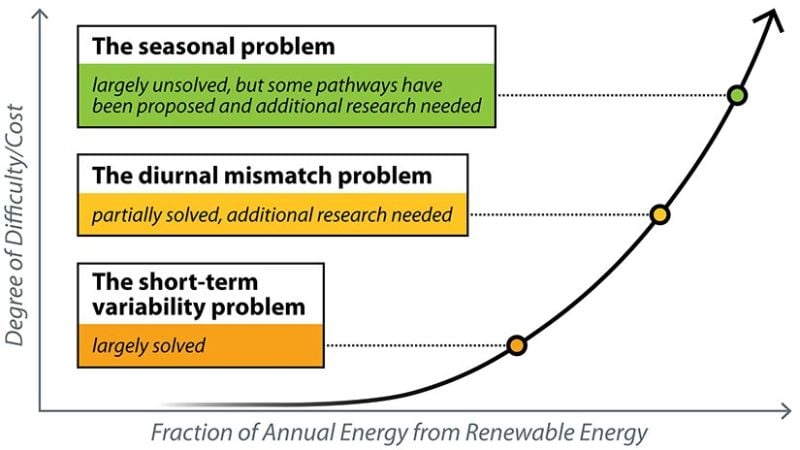
Grid-enhancing technologies could resolve intermittent renewable energy problems. Image used courtesy of National Renewable Energy Laboratory
Curative redispatch enables adjusting the grid’s load after an unexpected bottleneck to help alleviate transmission bottlenecks and improve transmission capabilities. The quicker the bottlenecks are sorted, the more renewable energy can continue to supply power to the grid.
Curative redispatch provides the greatest hosting capacity increase by reducing renewable curtailment by around two-thirds compared to preventative redispatch. Curative redispatch is important for higher renewable penetration because more localized renewables will likely cause bottlenecks. Transmission lines can be operated at higher levels, and more renewables can be introduced because curative redispatch provides a contingency plan to restore network operations should there be an issue.
Dynamic Line Rating for Wind Energy
DLR is another key GET strategy for integrating more renewables by dynamically maximizing the load on the power lines in real-time. Every transmission line has a line rating governing how much electricity can flow along that line based on the local weather conditions. DLR allows operators to safely boost the rating and line capacity based on local sensor data.
DRL is a good solution for wind-rich areas because it can provide a targeted increase in transmission capacity. DLR can increase transmission capacity to delay curtailment, leading to higher renewable penetration. However, unlike curative redispatch, no further gains can be obtained once saturation has been reached.
Increasing line transmission capacity for wind speed makes DLR ideal for wind turbine systems. DLR could reduce wind curtailment by over 50% for high-renewable integration areas. However, DLR’s effectiveness has been more subdued for solar cells, reducing solar curtailment by much lower levels (around 20%) in high-renewable integration scenarios.
Not All GET Approaches Are Created Equal
While different GETs can increase the grid’s hosting capacity, not all GET approaches are economically feasible. Using battery energy storage systems alone has only shown to have a small impact on the hosting capacity while being economically infeasible on a large scale. Additionally, flow control equipment is important on a local level, but its impact on a national level is lower than other GET strategies.