Facebook
 Google
 GitHub
 Linkedin
Just the FACTS: Increasing Transmission Capacity, Reliability
As renewable energy grows, Flexible Alternating Current Transmission Systems can increase capacity and augment voltage stability in power lines.
Modern transmission grids are increasingly difficult to manage due to rising electricity demand and the transition from reliable fossil fuel-fired plants to volatile wind and solar resources. These conditions disrupt voltage regulation in high-voltage alternating current (AC) transmission networks, which should ideally have a constant frequency and voltage.
Aging grids are another compounding issue, with most U.S. infrastructure averaging 40 years old. About 30% of the nation’s 642,000 miles of high-voltage transmission lines will need to be replaced in the next ten years.
Building new lines and substations is one way to expand U.S. transmission capacity, albeit a costly effort with long construction times, permitting regulations, and site-specific logistics considerations. Alternatively, operators could save money by retrofitting existing assets with Flexible AC Transmission Systems (FACTS), devices that control power flow to reduce line overloading. Through dynamic voltage control, FACTS tech also improves transmission stability and availability while reducing losses.
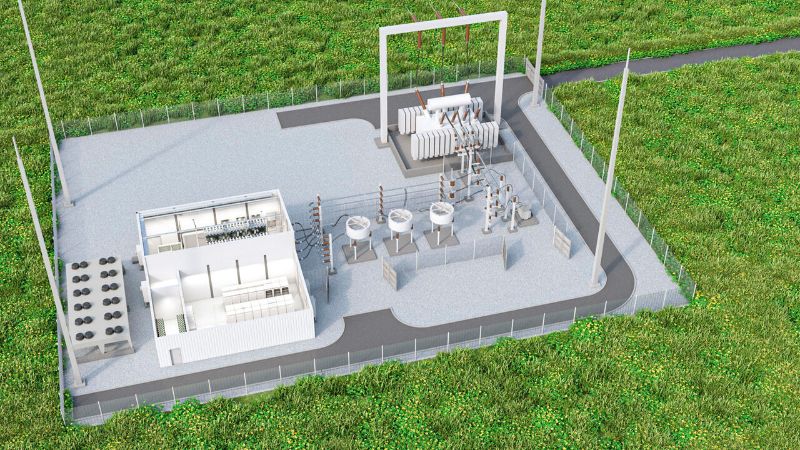
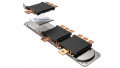
Rendering of Siemens Energy’s advanced SVC Plus STATCOM. Image used courtesy of Siemens Energy
How FACTS Benefits Transmission Systems
FACTS offer compelling benefits, primarily the ability to precisely control power flow across transmission assets.
Distributed power flow controllers (DPFCs), for example, stabilize voltage levels across all transmission lines, optimize power distribution, and improve power quality by balancing loads and reducing congestion. This is especially useful for enhancing the flexibility of renewable-heavy power grids.
Other FACTS technologies, like fixed series compensation devices, increase the real power capacity of existing long-distance AC lines. Capacitor banks are connected in series to transmission lines to compensate for inductive impedance while raising the voltage at the connection point. This method maintains a minimum voltage profile and reduces impedance, which can cause voltage drops and limit power transfer over long overhead transmission lines.
Efficiency is a significant advantage. System line losses generally average 6-10% across most U.S. grids, but this figure rises substantially after a line becomes heavily loaded. However, FACTS can reduce transmission losses by optimizing power flow.
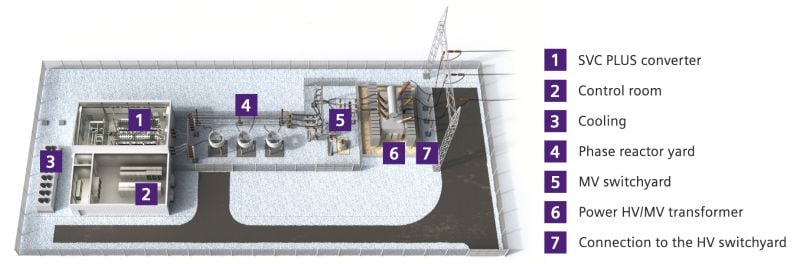
Layout of Siemens Energy’s SVC Plus, a modular multilevel STATCOM providing quick voltage and reactive power control, among other essential functions. Image used courtesy of Siemens Energy (Page 25)
FACTS may also support transmission stability through power factor correction. Static VAR compensators (SVC) provide reactive power to regulate voltage fluctuations in transient conditions. SVCs attenuate power oscillations, allow dynamic control of reactive power and improve undervoltage and harmonics issues. SVCs’ near-instant power correction marks an advancement from conventional mechanical compensation switches.
However, SVCs have some limitations, requiring significant floor space and labor. They’re also comparatively slower than static synchronous compensator (STATCOM) devices.
Like SVCs, STATCOM systems control voltage and transient stability, factors making a grid more resilient amid growing intermittent power generation from solar and wind. STATCOMs also stabilize microgrids by reducing voltage, power fluctuations, and frequency.

Components of a standard STATCOM system. Image used courtesy of GE Grid Solutions (Page 4)
To regulate voltage fluctuations, STATCOM provides dynamic reactive power support at the interconnection point by controlling the amplitude of the device’s voltage source converter (VSC) valve. In this way, the reactive output is proportional to the system voltage.
Other FACTS technologies, such as static synchronous series compensators, inject compensating voltage to regulate power flows, balance variable outputs, and mitigate power quality issues like voltage sags and swells.
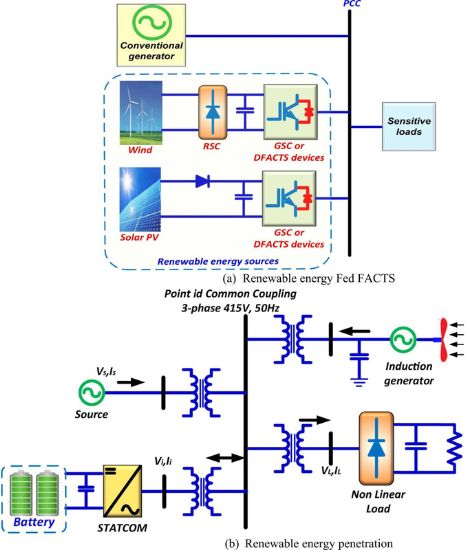
Types of FACTS devices used in renewable energy integration. Image used courtesy of the study authors
Next-Gen Grid Solutions
The latest FACTS generation is typically engineered with insulated gate bipolar transistor (IGBT) semiconductors, which feature faster switching capabilities and higher performance than incumbent thyristors and mechanical switches.
Recognizing the demand for advanced transmission controllers, leading equipment players like GE, Siemens, Hitachi, and Siemens have all jumped onto the growing FACTS market, often with custom solutions tailored to the customer’s technical requirements and fault level and load parameters.

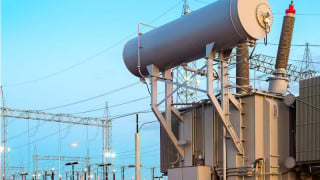
STATCOM installation at a New Zealand substation. Image used courtesy of Hitachi Energy
Overall, FACTS devices are just one solution to support smooth transmission operations in the electrification age. According to the DOE, advanced grid technologies that expand firm line capacity could accommodate an additional 20 to 100 GW of incremental peak demand.
Other upgrades could involve implementing dynamic line rating (DLR) technology to maximize loads by calculating real-time power flow and local weather conditions, thereby reducing grid congestion. The DOE recently estimated that DLR could expand effective transmission capacity by 10% to 30%.