Facebook
 Google
 GitHub
 Linkedin
NVIDIA, SCE Power Grid Modernization With AI
NVIDIA is partnering with utilities to develop AI tools for transmission and distribution grids.
Southern California Edison (SCE), a utility serving 15 million people, estimates that electric vehicles and smart buildings have led to an 80% surge in demand across its 50,000-square-mile service area. Its latest 10-year projections are 35% higher than two years ago. SCE also expects data centers and other newly connected load sources to add another 20 TWh of demand, 5% higher than the original projection.
SCE is working to add new firm resources, such as clean hydrogen and geothermal, to replace natural gas plants and maintain a consistent power supply to offset intermittent solar and wind generation. It’s also expanding its energy storage portfolio to balance peak demand. A third, less desirable solution involves upgrading power lines to accommodate more capacity.
As another way to strengthen its operations, SCE is adopting artificial intelligence tools to optimize power flow and identify equipment faults. Maximizing its existing network allows the company to defer expensive equipment upgrades. It recently announced a new partnership with chip giant NVIDIA to develop AI-powered software for vegetation and asset inspections and maintenance, load interconnection, and incident management.
NVIDIA’s AI models will digitize and automate SCE’s data management and operations—from microsecond-level grid optimization to large-scale network planning. Pilot projects are expected to launch over the next year.
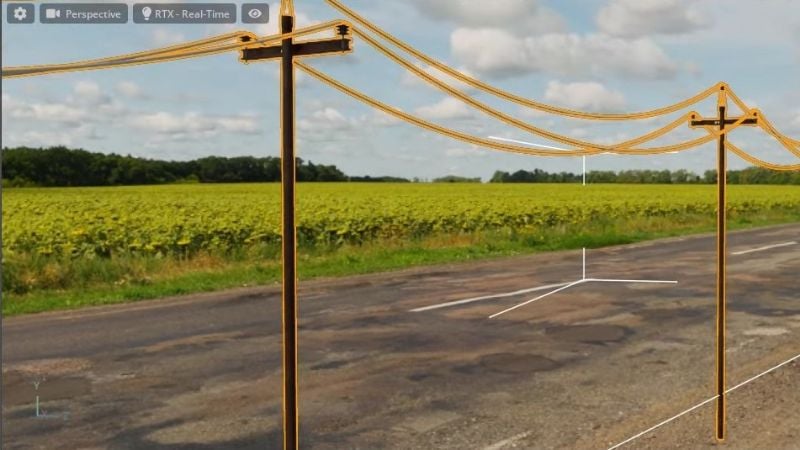
NVIDIA’s AI models are helping utilities automate their asset inspection. Image used courtesy of NVIDIA
Managing Demand Growth With AI
The U.S. power grid is not equipped for substantial load growth. Federal Energy Regulatory Commission filings show that grid operators’ five-year demand forecasts rose from 2.6% to 4.7% last year, according to GridStrategies. Grid planners expect 38 GW of additional demand through 2028, requiring large-scale generation and transmission expansions.
The California Public Utilities Commission issued a ruling earlier this year allowing renewable energy projects to gain interconnection approval if they adhere to schedules that limit how much energy is sent to the grid at different times throughout the year based on grid constraints. As a result, utilities like SCE are adopting advanced AI to calculate their real-time hosting capacity and manage additional distributed energy resources (DERs), such as EV chargers and rooftop solar panels.
AI can help utilities manage DERs and dynamic consumption patterns from EV charging—two issues prevalent in California, which dominates national EV and DER adoption. In SCE’s case, optimizing power flow can save money that would otherwise be spent on building new transmission and distribution lines. Improved operational efficiency also means SCE can focus on its ambitious target to deliver 100% clean energy by 2045. Natural gas and nuclear comprise over 30% of SCE’s resource mix today, while solar supplies 14.9%, wind 10.2%, and geothermal 5.7%.
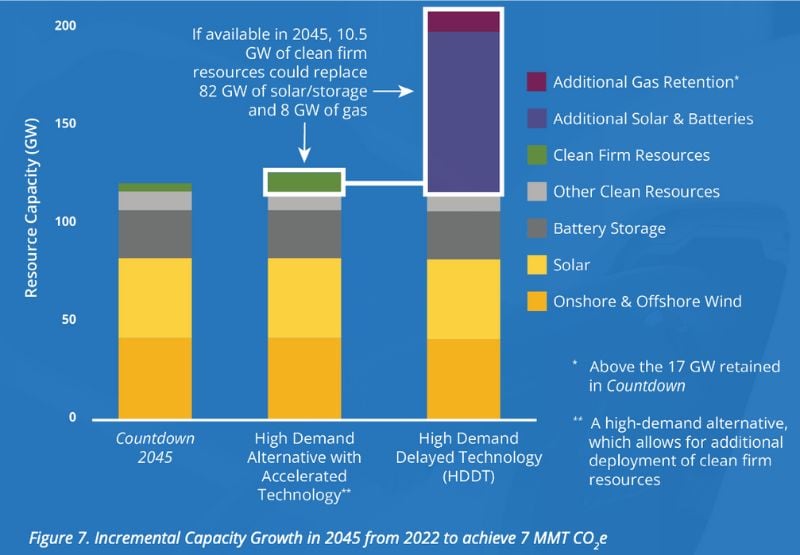
Projected capacity growth through 2045. Image used courtesy of SCE (Page 9, Figure 7)
SCE is now working with NVIDIA to enhance its operations with AI-based power flow simulations for transmission and distribution equipment. This comes after NVIDIA has expanded its AI platforms to offer new capabilities for the energy sector, such as Jetson for smart meter integration, Omniverse for digital twin modeling, or NIM microservices for generative AI.
NVIDIA’s AI Offerings for Utilities
NVIDIA works with several utilities and software providers to optimize grid operations through edge AI, which deploys AI models directly on local devices rather than the cloud. This approach can help utilities manage local transmission and distribution equipment in real time, including cross-arms, fuses, transformers, substations, and other assets.
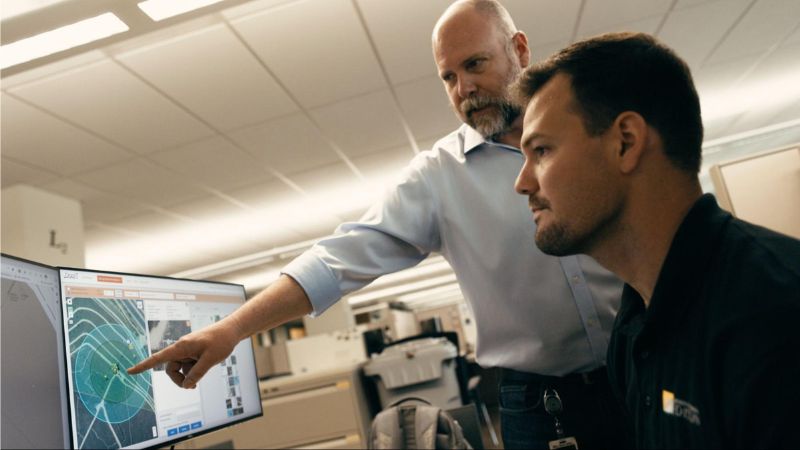
SCE uses machine learning software to keep its asset data up-to-date. Image used courtesy of SCE
Utilidata partnered with NVIDIA in 2021 to develop a distributed AI platform and customize NVIDIA’s Jetson module to convert utility meters into data collection and control points that deliver thousands of measurements per second. These insights can reduce utilities’ demand forecasting latency, hasten their response time, and improve operational efficiency. Aclara was the first company to embed Utilidata’s Jetson-enabled distributed AI platform in a smart meter earlier this year, capturing high-quality data to improve grid operations and manage DERs. Utilidata has since partnered with Deloitte to help scale their solution for distribution services.
AI can also quickly spot equipment faults using LiDAR, aerial and satellite imagery, and weather data. For example, Noteworthy AI used NVIDIA’s systems to capture images revealing wildfire risks from overgrown vegetation. The company deployed seven AI models to collect and analyze 5,000 high-resolution images of FirstEnergy’s poles, enabling the utility to expand its database by more than five times in just one month.
The Electric Power Research Institute has also worked with NVIDIA on outage scheduling tools to reduce downtime across substations, generators, transformers, and other equipment. Legacy power system modeling software lacks advanced computing for grid simulations. In contrast, NVIDIA’s next-gen capabilities let utilities model the grid as a digital twin, with transmission lines and transformers mapped as edges and other structures as nodes in a network. These models can simulate grid outages and identify emerging challenges in shifting power flow to integrate renewables and DERs.
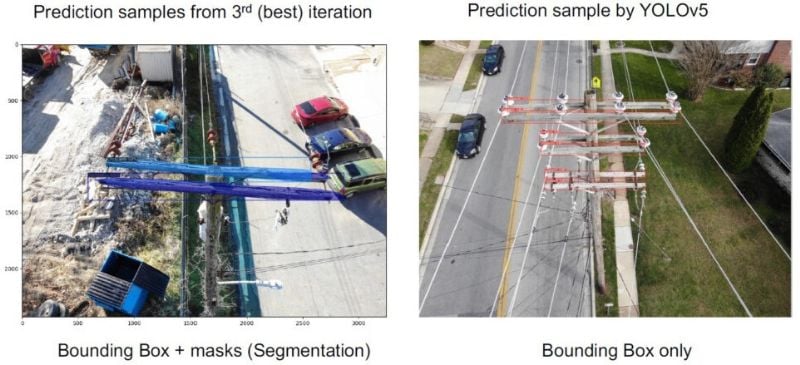
Exelon and NVIDIA used an asset detection model to identify cross-arm defects. Image used courtesy of NVIDIA
In another project, Chicago-based utility Exelon used NVIDIA’s Omniverse Replicator to generate thousands of labeled examples of grid asset faults. This data was then used to train drone inspection models.