Facebook
 Google
 GitHub
 Linkedin
Würth Unveils Tiny Inductors With Big Current Handling
Würth Elektronik has introduced eight new package sizes to complement its existing five power inductor packages.
Inductors are among the most standard components in power electronics design, yet they can also be intimidating to understand. Historically, one of the most notable challenges in inductor design is that, by nature, inductors require a decent amount of area. As modern electronics call for smaller and more compact solutions, this tradeoff has created challenges for inductor designers.
Würth Elektronik has released eight new inductor packages, each with a unique size and balance of performance specifications. Würth’s latest releases are designed to meet the challenge of designing variable-sized high-performance inductors.
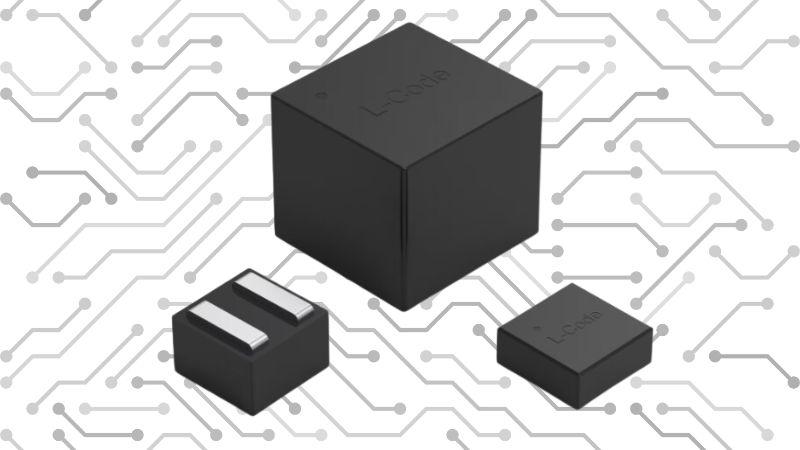
Inductors packages. Image used courtesy of Würth Elektronik
Understanding Inductors
An inductor is an electronic component that stores energy in a magnetic field. At its simplest, an inductor comprises a wire coil wrapped around a central core. They find applications in various power electronics circuits, including DC/DC converters and filters. Among all technical parameters, two of the most important ones associated with inductor design are Rdc and Isat.
_Simple_Inductor_circuit._(b)_Rising_current_profile_.jpg)
(a) Simple Inductor circuit. (b) Rising current profile. Image used courtesy of EEPower
The inductor’s DC resistance (Rdc) stems from the coil material’s inherent resistance. This resistance is directly proportional to the wire length used to construct the coil, which, in turn, is proportional to the inductor's inductance value. Consequently, higher inductance values entail greater resistance, while lower inductance values result in lower resistance. As a resistor, the Rdc generates heat and diminishes efficiency.
An inductor’s saturation current (Isat) refers to the maximum current level at which the inductor's magnetic core becomes fully magnetized, resulting in a significant decrease in inductance and the inability to store additional magnetic energy. Running an inductor beyond its saturation point is risky as it leads to a sharp decrease in inductive impedance, potentially causing an unregulated surge in current. Larger inductors with more turns and a higher core volume can typically handle higher saturation currents than smaller inductors with fewer turns and a smaller core volume.
Therefore, it remains challenging to design smaller inductors while maintaining a higher saturation current and lower DC resistance.
Würth’s Flat Wire Coil Inductors
Würth Elektronik has recently introduced eight new package sizes in its WE-XHMI SMT power inductor series, complementing the existing five-size lineup. Magnetically shielded, these compact inductors boast high current capacity, supporting up to a 56 A saturation current, and can handle high transient current spikes.
Specifically, the company has added package sizes 4020, 4030, 4040, 5020, 5030, 5050, 7030, and 7070 to its lineup to fill a gap in the existing portfolio. Qualified under AEC-Q200 standards, these inductors operate within a temperature range of -40°C to +125°C and cover an inductance range from 0.15 to 33 µH. They introduce a flat wire coil design that minimizes winding resistance, improving efficiency and effectiveness by reducing copper losses and maintaining stability even at higher frequencies amidst temperature fluctuations. According to Würth, these inductors are versatile and designed for applications ranging from DC/DC converters in power supplies to industrial computers.
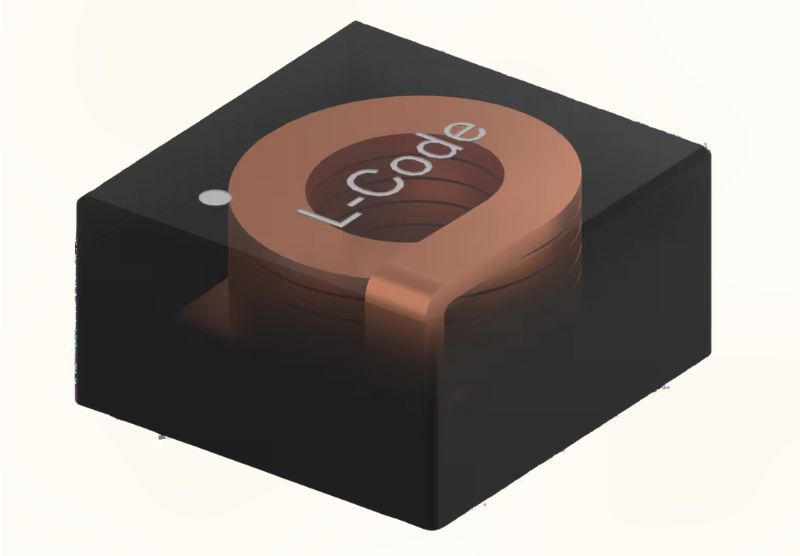
Flat wire inductor. Image used courtesy of Würth Elektronik
With the new lineup, Würth had its sights set on device miniaturization. This was achieved by transitioning from traditional round wire to flat wire shapes, allowing for enhanced current conduction efficiency at higher frequencies and mitigating the skin effect, enhancing surface area and cross-section consistency. Furthermore, the team designed inductors to feature a composite core material, resulting in reduced copper losses because the composite material has lower eddy current losses than traditional core materials like ferrite or powdered iron. Together, these advances allowed for inductors with greater efficiency and smaller sizes.
Future-Ready Electronics
With a slew of new package options entering its lineup, Würth’s inductor portfolio is now much more comprehensive than its previous 5-package offerings. These devices are currently available for purchase with no minimum order quantity.