Facebook
 Google
 GitHub
 Linkedin
Improving Current Collection With Digital Current Collector Devices
The third rail is just as essential for subways and metros as the overhead wire is for long-distance and high-speed trains since both supply electrified trains with electricity. digital current collection devices can provide real-time monitoring of the contact force between the shoe and the power rail.
This article is published by EEPower as part of an exclusive digital content partnership with Bodo’s Power Systems.
The third rail is just as essential for subways and metros as the overhead wire is for long-distance and high-speed trains since both supply electrified trains with electricity. Running along the railroad line, the third rail carries the current while the current collector collects it when sliding along the power rail. The current drawn is transferred to the rail vehicle by a collector shoe, usually made of copper-impregnated graphite. Two rugged coil springs fitted on the current collector ensure constant contact of the shoe against the power rail.
This physical contact, combined with a voltage of 750 V, the trains' often considerable speed, and unevenness on the third rail contact surface, are all responsible for the significant wear sustained by the collector shoes fitted on every train.
The shoes are generally replaced every six to twelve months. The shoe represents 70 percent of the total cost of ownership of the entire current collector device (CCD) during its lifespan.
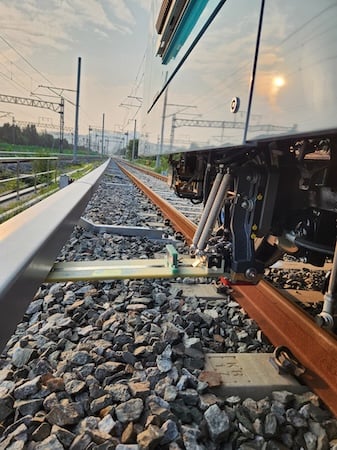
The Digital Current Collector Device (D-CCD) from Mersen. Image used courtesy of Bodo’s Power Systems [PDF]
Digital Current Collector Device
“After investing nearly four years of hard work, our project team has now devised a solution that will dramatically improve the comprehension of the CCD’s performance on duty,” said Mechatronic Engineer Bilal Naim. Mersen’s solution to the problem is the D-CCD, the Digital Current Collector Device. This device is used for real-time monitoring of the contact force between the shoe and the power rail.
The clearly visible portion of the D-CCD is a black box attached to the current collector's arm and housing the so-called MAT (Module Acquisition & Transmission). The MAT comprises the readings recorder (strain gauge and temperature sensor) and an electronic system that is in charge of processing the signals, storing the data, and providing wireless communication. The measured variables are:
- temperature rise in the current collector (if one collector of the car is off)
- force applied on the third rail by the shoe (N)
- shocks and vibrations applied to the current collector during its course
- optical sensors
The optical sensors serve as arc detection, where one can detect the peak of lights generated by arcs at the shoe vs. power rail contact.

The Digital Current Collector Device allows real-time monitoring of the contact force between the shoe and the power rail. Image used courtesy of Bodo’s Power Systems [PDF]
These data indicate the condition of the collector shoe, the collector overall, and, indirectly, the third rail.
“This information allows us to find out if the shoe is still operational or will have to be replaced shortly. It gives a clear insight into the quality of the third rail,” revealed R&D Department Manager Olivier Dosda.
Development Challenges
Developing the MAT measuring technology posed a tremendous challenge to Mersen’s engineers.
“The goal to measure the contact force with the greatest possible accuracy required us to be as close to the contact point as possible, but the voltage of 750 V also made it necessary to provide dependable insulation,” explained Dosda. “Two objectives hard to combine.”
Similarly challenging was developing an electronic module capable of working reliably in a difficult environment marked by high voltage, high levels of shocks and vibrations, and electromagnetic effects.
The engineering team's solution features specially designed strain gauge technology using thick-film strain gauges. Patented in 2018, this advanced technology detects deformations in the current collector arm during operation. Thanks to its electrical isolation properties, it can be safely applied to electrified current collectors, allowing precise characterization of impacts occurring between the current collector shoe and the electrified third rail during operation.
The MAT module is battery-powered and designed with its own data storage. These properties make it a stand-alone unit without any connection nor interference with the train and its power supply and data capacity are enough for one day of operation. Customers wanting to test-drive the system for a day and check the condition of their power rail/current collectors will be supplied with a workable solution easily integrated into Mersen's current collectors via plug-and-play.

The D-CCD in a live monitoring simulation. Image used courtesy of Bodo’s Power Systems [PDF]
Analyzing Wear Behavior
Those interested in continuously monitoring their current collectors must connect the train network to the MAT via an ethernet cable and a 24 V supply voltage. The MAT calculator's interface will transfer the data directly to the train system and extend the real-time measurement as needed.
“This long-term monitoring feature, in particular, is what creates the best prerequisites for analyzing the wear behavior of the current collectors and for drawing the appropriate conclusions,” stated Dosda. “We aim to eventually arrive at predictive maintenance, including plannable maintenance intervals, which will allow our customers to operate their trains with improved reliability and reduce total cost of ownership.”
Regarding the benefits for themselves, Mersen hopes that the data collected by the D-CCDs will help them optimize the design of their current collectors.

Mersen service offers preventive maintenance and reduced total owner cost. Image used courtesy of Bodo’s Power Systems [PDF]
High-Efficiency
As a global expert in electrical energy and advanced materials in high-tech industries, Mersen ranks among the world’s leading suppliers of current collectors for use in subways and metros. The D-CCD offers a high-efficiency solution with insight into what is happening between the 3rd rail and the carbon shoe—the stepping stone to longer shoe life.
Mersen's first customer order was from a Korean manufacturer who will build the D-CCD into trains operating in the Singapore subway system.
This article originally appeared in Bodo’s Power Systems [PDF] magazine.