Facebook
 Google
 GitHub
 Linkedin
Japan Handles Fluctuations in Renewables With Flow Batteries
The vanadium-based energy storage technology enables efficient grid-scale energy storage.
Transitioning from fossil fuels to renewable sources like wind and solar is important for reducing global carbon emissions and combating climate change. However, integrating these renewables into the power grid presents challenges.
Unlike fossil fuel power plants, renewable sources depend on weather conditions that lead to fluctuations in supply. This intermittency complicates the grid’s stability and reliability, especially during high-demand periods. The energy industry needs efficient, long-duration, and scalable solutions to maintain grid stability and support the adoption of renewables.
Japan has developed a new energy storage solution in Hokkaido using a two-story flow battery.
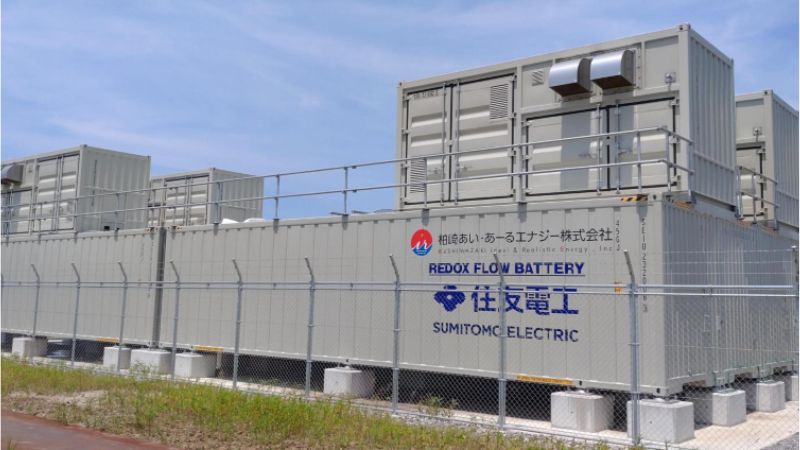
Vanadium redox flow battery. Image used courtesy of Sumitomo Electric
Why Use Flow Batteries?
Before renewables, peaker plants met energy demands during peak hours. Peaker plants are power plants designed to operate during peak electricity demand. Unlike baseload plants that run continuously, peaker plants are used intermittently to supplement the grid when energy consumption spikes, such as during hot summer afternoons. Natural gas or diesel fuel may power these plants because they can start quickly and provide energy on short notice.
Like jet engines, peaker plants burn fuel in turbines to generate electricity. While effective for managing demand fluctuations, they are highly inefficient compared to baseload plants, consuming more fuel per unit of electricity produced.
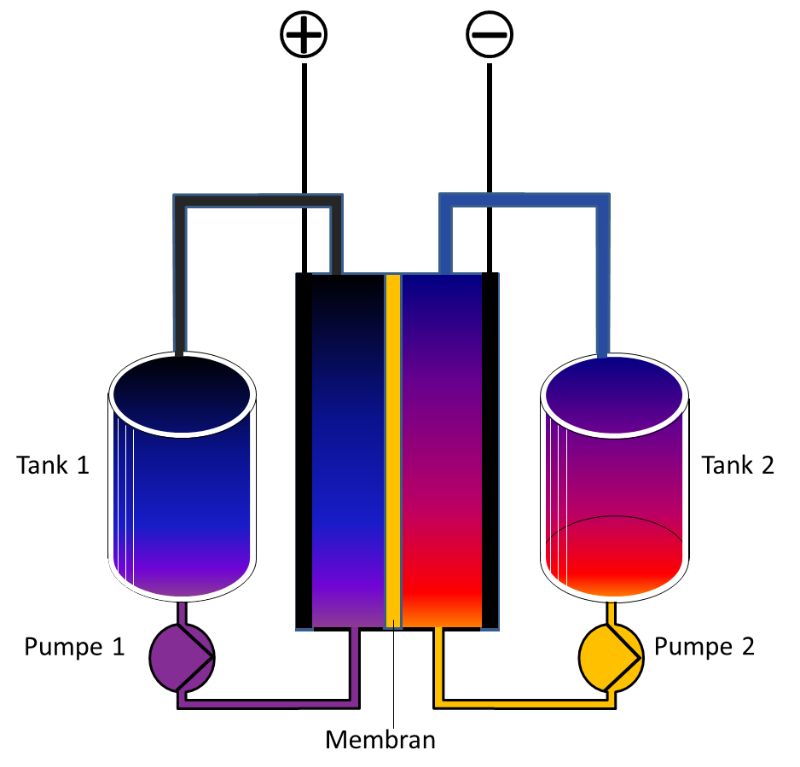
Redox flow battery. Image used courtesy of Wikimedia Commons
Flow batteries utilize liquid electrolytes that circulate through one or more electrochemical cells from external tanks. Flow batteries store and discharge energy using liquid vanadium in external tanks, unlike lithium-ion batteries.
One advantage is that they are extremely scalable. Increasing the battery's energy storage capacity is as simple as increasing the tank's electrolyte volume. At the same time, the electrochemical cells can be configured in series or parallel to adapt to the system's power output.
Because flow batteries can independently scale energy capacity and power output, many renewable energy developers are considering flow batteries as an alternative to traditional peaker plants.
Overcoming Intermittency in Japan
Hokkaido, Japan, has deployed one of the world’s largest flow battery systems to store renewable energy from wind and solar.
Hokkaido's flow battery project, spearheaded by Sumitomo Electric, consists of 130 massive tanks, each holding 10,000 gallons of vanadium-infused liquid. These tanks are arranged in pairs, with one tank storing vanadium in a positive charge state and the other in a negative charge state. The system, housed in a two-story warehouse, is meant specifically to integrate wind energy into the grid.
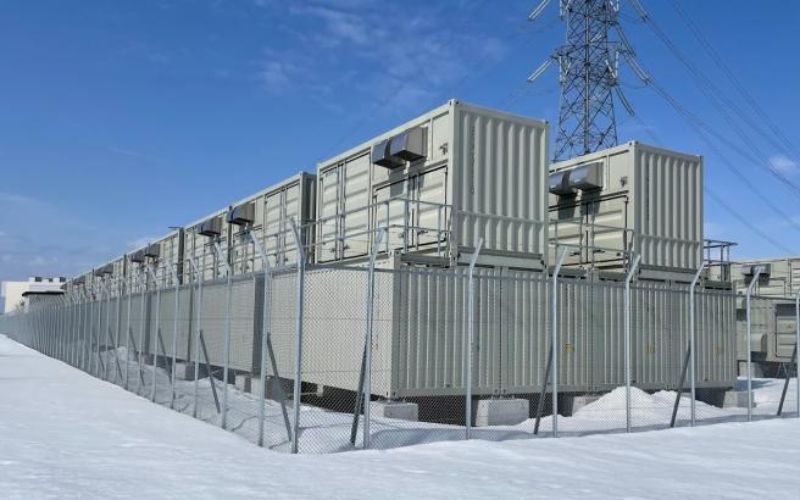
Redox flow battery system in Hokkaido. Image used courtesy of Sumitomo Electric
The project’s design will maximize scalability and efficiency. Vanadium ions in the tanks undergo chemical transformations that allow the system to charge and discharge electricity. The tanks are connected via pipelines to battery cells on the second floor, where a membrane facilitates the transfer of electrons. This movement generates an electric current that powers over 27,000 homes for four hours—a capacity comparable to lithium-ion systems but with the added advantage of modular expansion by simply increasing tank size or adding more vanadium.
Resilient Energy Future
The plant, operational since April 2022, set a global benchmark for flow battery projects at its launch. While China quickly surpassed its size with an even larger installation, Hokkaido’s system demonstrates the viability of utility-scale flow batteries in temperate climates. The success of this project has paved the way for additional wind farms on the island and further reinforced the role of flow batteries as a promising path for renewable energy infrastructure.