Facebook
 Google
 GitHub
 Linkedin
Smart Substations and Digitalization—Part 5: Future Trends
This article discusses trends in AI-assisted smart substations, including sensor density, autonomous and self-healing networks, and inverter-based resources management.
Smart substations are emerging as the programmable edge of the power system, where protective relays, sensors, and communications converge into software-defined architectures. The shift from copper wiring to time-synchronized Ethernet, from paper settings to model-based engineering, and from periodic maintenance to condition-based operations is redefining how substations are designed, commissioned, secured, and operated.
Standards such as IEC 61850 for data modeling and messaging, IEEE 1588 for precise time, and IEC 62439-3 for zero‑time network redundancy support this transition, while cybersecurity frameworks (IEC 62351 and NERC CIP) establish the guardrails. Together, these elements enable the next wave of analytics and automation.
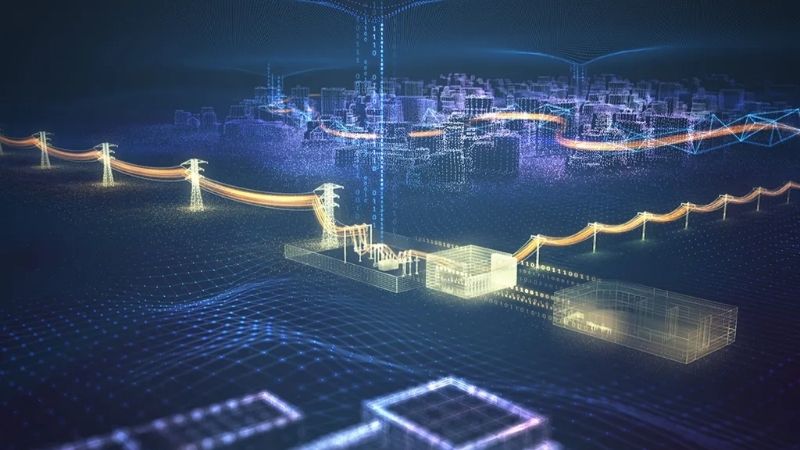
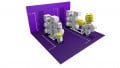
Concept of digital substation. Image used courtesy of Siemens
Increased Use of AI-Assisted Decision Support
Decision support in substations is moving from rule-centric dashboards to AI‑assisted workflows embedded in asset management, protection engineering, and operations. Several drivers are converging:
Data liquidity: Digital substations expose structured models and time-aligned streams (such as Sampled Values, GOOSE, event records, synchrophasors), creating training data for diagnostics, anomaly detection, and predictive maintenance.
Research and utility programs are developing AI models to turn imagery, thermography, acoustic/vibration signals, and IED logs into health indices and risk scores for transformers, circuit breakers, and station auxiliaries.
Practical protection and control applications: The IEEE PES Power System Relaying and Control community has documented early but increasing adoption of AI/ML for tasks such as oscillation detection, relay misoperation analytics, fault classification/localization, and adaptive settings assistance, while emphasizing explainability, lifecycle management, and rigorous validation against protection performance requirements.
Sector collaboration: Industry initiatives, such as EPRI’s Open Power AI Consortium, aim to pool datasets, benchmarks, and governance patterns so utilities can deploy AI with consistent safety, reliability, and compliance practices.
In practice, AI is not replacing deterministic protection. Rather, it is augmenting engineering and operations. Typical near‑term deployments include automated substation inspection (computer vision on fixed cameras and robots), AI-assisted asset triage that flags outliers before failures, and operator advisory tools that fuse SCADA and synchrophasor context during disturbances. These applications thrive where data are time‑synchronized and labeled, highlighting the value of a robust 61850 and PMU foundation.
Greater Sensor Density and Process‑Bus Adoption
Higher sensor density is accelerating, enabled by non‑conventional instrument transformers (LPITs), stand‑alone merging units, and distributed condition monitors. On the communications side, the process bus defined by IEC 61850‑9‑2 transports time‑aligned sampled values over Ethernet, replacing long copper runs with fiber and reducing exposure to wiring errors.
Adoption is rising due to tangible gains, such as easier factory acceptance testing, safer commissioning, live signal supervision, and reduced footprint. Field deployments have reported double‑digit reductions in project CAPEX and sizable OPEX savings over a substation lifecycle when process bus and digital instrumentation are applied.
Engineering these networks demands deterministic performance and fault tolerance. IEC 62439‑3 defines PRP and HSR for seamless switchover with zero recovery time, widely used in digital substations to maintain protection determinism during link or node failures.
The IEC TR 61850‑90‑4 network engineering guidelines provide recommendations on topology, redundancy, QoS, and clocking for substation traffic classes. Precise time, typically via IEEE 1588 PTP with GNSS‑disciplined grandmasters and boundary clocks, aligns sampled values, event logs, and synchrophasors for coherent analytics.
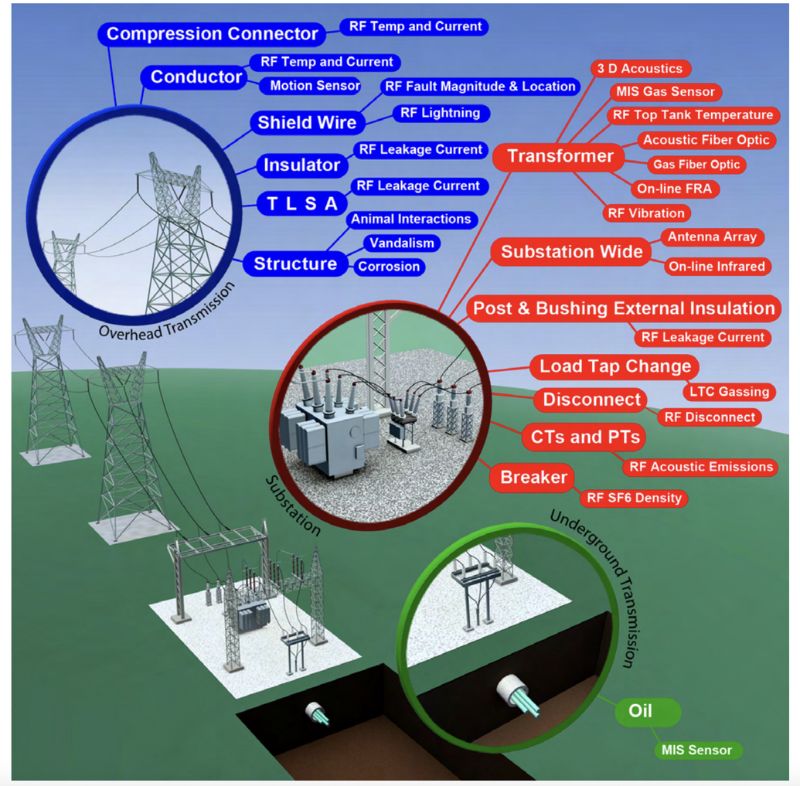
Figure 1. Various sensors for transmission and substation operations. Image used courtesy of U.S. Department of Energy
Practical integration patterns include:
- LPITs and SAMUs feeding redundant PRP/HSR LANs that carry Sampled Values and GOOSE to protection IEDs
- Station‑level switches engineered per 61850‑90‑4, with segregated VLANs and prioritized traffic to ensure trip messages meet end‑to‑end latency budgets
- Time distribution over PTP augmented with monitoring for offset, jitter, and asymmetry to maintain synchrophasor accuracy
Autonomous Substations and Self‑Healing Networks
Automation is expanding from device‑level interlocks to coordinated substation and feeder actions. In the substation, IEC 61850 enables fast peer‑to‑peer schemes, automated testing, and remote lifecycle management. Beyond the fence, self‑healing distribution leverages ADMS (Advanced Distribution Management System) functions—especially FLISR (Fault Location, Isolation, and Service Restoration)—to locate faults, isolate sections, and restore service in minutes or seconds, improving reliability indices even as topology and DER penetration grow.
The autonomy stack is diversifying:
Local autonomy: Substation schemes act on high‑fidelity local measurements to clear faults, reconfigure buses, and maintain auxiliary systems without external SCADA dependence.
System orchestration: ADMS/DERMS supervises multi‑feeder restoration, coordinates DER ride‑through and volt‑VAR support, and ensures safe switching sequences.
Field augmentation: Robotics for inspection shorten detection‑to‑repair cycles and support operations during adverse conditions, as documented in EPRI (Electric Power Research Institute) work programs
As autonomy increases, cybersecurity and safety governance must keep pace. IEC 62351 provides security profiles (such as TLS for MMS, RBAC, key management, and event logging) for IEC TC57 protocols used in digital substations, while NERC CIP (Critical Infrastructure Protection ) standards define mandatory controls for BES (Bulk Electric System) Cyber Systems, with recent efforts tightening supply‑chain risk management and clarifying categorization and reporting
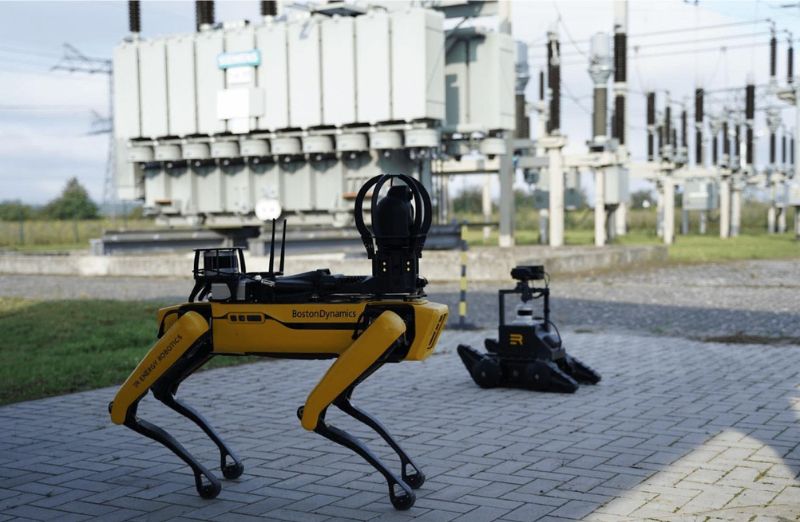
Figure 2. Robots collect high-quality inspection data, supporting the smooth functioning of critical equipment such as transformers and circuit breakers. Image used courtesy of Energy Robotics
Role in Renewable‑Heavy and Inverter‑Dominated Grids
Inverter‑based resources (IBRs) alter fault currents, inertia, and dynamic responses, challenging legacy protection and control assumptions. Unlike synchronous machines, which contribute high, largely inductive fault currents, IBRs limit and control current, often with manufacturer‑specific behavior.
Protection functions that depend on fault magnitude, polarity, or angle may misoperate or under‑reach unless adapted. IEEE PSRC (Power System Relaying and Control Committee) guidance consolidates practices such as negative‑sequence elements, voltage‑based detection, sensitive differential, and hybrid pilot schemes tuned for controlled inverter currents.
Performance issues observed during recent grid events prompted NERC actions, including new reliability standards addressing IBR behavior during faults, adopted and approved through 2025. These measures focus on accurate modeling, ride‑through, and protective action coordination to mitigate system‑wide risks posed by large IBR fleets.
Smart substations are critical in this transition for several reasons:
Measurement fidelity: PMUs and high‑rate sensors at substations offer wide‑area situational awareness, capturing oscillations, angle swings, and RoCoF with reporting rates orders of magnitude faster than traditional SCADA—typically 30 frames per second.
Time‑aligned controls: Deterministic networking, precise time, and 61850 messaging permit coordinated remedial action schemes, adaptive relaying, and topology‑aware restoration across substations.
Grid‑forming evolution: Research roadmaps from national labs outline how grid‑forming controls can provide voltage, frequency, and inertia‑like services, enabling stable operation even at very low synchronous inertia. As these capabilities mature, protection and interlocking in substations will increasingly account for transitions between grid‑following and grid‑forming modes.
In distribution, self‑healing strategies are extended to microgrids, where coordinated sectionalization and reconnection maintain critical loads during extreme events. AI‑assisted orchestration and advanced protection are key enablers for networked microgrids that must remain stable with heterogeneous distributed energy resource controls.
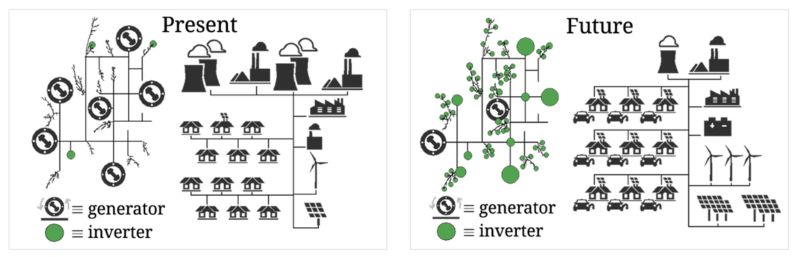
Figure 3. Traditional power systems rely heavily on synchronous generators with large rotational inertia, while future grids will include a significant share of inverter-based resources. Image used courtesy of National Laboratory of the Rockies
Putting It Together: Engineering Implications
Engineering smart substations for an IBR‑rich future suggests several practical imperatives:
Architect for determinism and resilience: Use PRP/HSR where zero‑time failover is required; design per 61850‑90‑4 with traffic segregation, bounded latency, and disciplined PTP time distribution. Validate end‑to‑end trip times with real traffic and failure injection.
Treat data as a first‑class asset: Adopt consistent data models (61850), enforce time alignment (PTP and GNSS), and retain high‑resolution records to support AI and protection forensics. Synchrophasor deployments at substations and along feeders expand visibility, essential for IBR integration.
Evolve protection philosophies: Incorporate IBR‑aware elements and settings, leverage communications‑assisted schemes, and plan for mixed portfolios that include grid‑forming resources, all while maintaining deterministic trip paths over the digital network.
Build cyber‑secure by design: Implement IEC 62351 profiles and role‑based access; align with current NERC CIP obligations, including supply‑chain requirements and incident reporting refinements. Continuous monitoring and security event logging must be integral to the substation platform.
Conclusion
Smart substations are the foundation of grid digitalization, translating standards‑based communications and precise time into operational flexibility—and translating dense, high‑quality measurements into actionable intelligence.
The near future points to broader AI‑assisted decision support, denser sensing over an IEC 61850 process bus, more autonomy at the substation edge tied to self‑healing distribution, and architectures explicitly designed for renewable‑heavy, inverter‑dominated conditions.
Engineering robustness around deterministic networking, synchronized data, IBR‑aware protection, and cybersecurity will determine how quickly these capabilities scale from pilots to fleet‑wide practice. The utilities that treat substations as programmable, secure, and data‑centric platforms will be positioned to deliver reliability and resilience as generation portfolios and system dynamics continue to evolve.