Facebook
 Google
 GitHub
 Linkedin
High-Power Automotive, Industrial MOSFETs Gain Traction
Infineon, Toshiba, and Rohm’s product releases and proven applications indicate continued growth in the high-power MOSFET market.
In the automotive industry, two trends dominate. Electrified platforms need higher efficiency at lower system losses, and compact packaging requires components that dissipate heat more effectively while sustaining high current operation. These demands have driven intense competition among silicon and wide-bandgap device makers to offer transistors with reduced conduction resistance, faster switching behavior, and robust thermal management.
Three of the industry’s largest players—Infineon, Toshiba, and Rohm—have developed high-power MOSFETs to meet these needs.
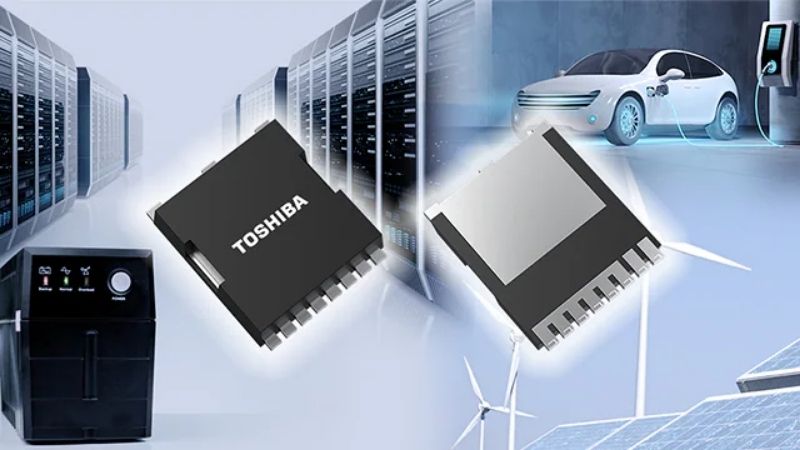
Toshiba’s 650 V SiC MOSFETs. Image used courtesy of Toshiba
Infineon’s 150V OptiMOS 6
Infineon has expanded its OptiMOS 6 family by introducing 150 V automotive MOSFETs. Built on sixth-generation OptiMOS technology, the transistors are designed with a drain-source resistance as low as 2.5 mΩ.
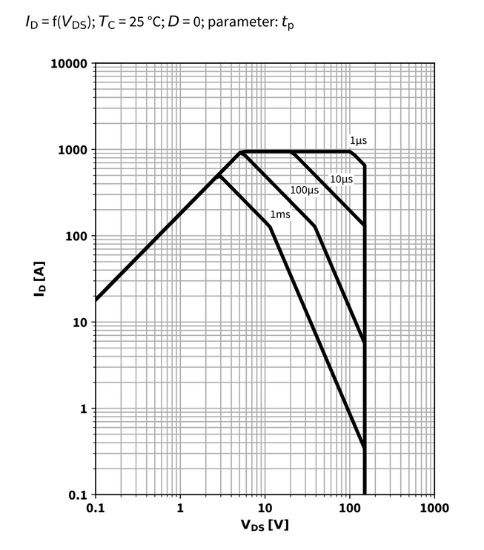
Safe operating area of the IAUTN15S6N025. Image used courtesy of Infineon
One solution in the expanded family is the IAUTN15S6N025, which achieves a drain-source resistance of 2.1 mΩ at VGS=10 V and supports a continuous drain current of 245 A, with pulsed operation up to 946 A. Its maximum power dissipation reaches 357 W at 25 °C, while thermal resistance from junction to case is only 0.42 K/W. The device also exhibits a low total gate charge of 107-139 nC and turn-on/off delays in the 26-41 ns range.
Three package options exist for the family: TOLL for compact layouts, TOLG for increased protection against thermal-mechanical stress, and TOLT with top-side cooling for high thermal load conditions. These MOSFETs are qualified to AEC-Q101 and PPAP-capable.
Toshiba’s 650 V SiC FETs
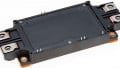
Toshiba’s newly released third-generation 650 V SiC MOSFETs use a compact TOLL package to deliver high power density and efficiency. The TOLL form factor, measuring 9.9 x 11.68 x 2.3 mm, could reduce device volume by over 80% compared to TO-247 packages and lower parasitic impedance to minimize switching losses.
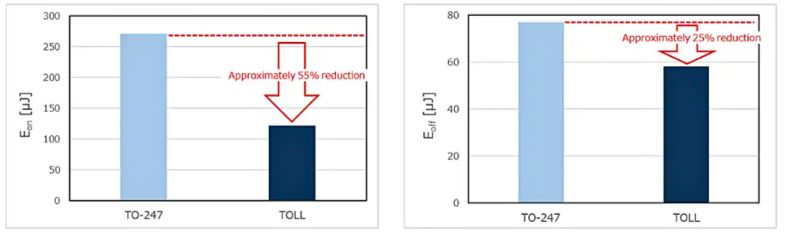
Toshiba claims its TOLL package decreases turn-on and turn-off losses. Image used courtesy of Toshiba
Devices in the series include the TW027U65C, TW048U65C, and TW083U65C, with drain currents of 57 A, 39 A, and 28 A, respectively, at 25°C. Typical RDS(on) values range from 27 mΩ to 83 mΩ at VGS = 18 V, while gate charges span 28 nC to 65 nC. Input capacitance ranges from 873 pF to 2288 pF at VDS = 400 V, and the body diode features a low forward voltage of -1.35 V. Toshiba also claims that a Kelvin-source connection further improves gate drive performance for decreased turn-on and turn-off losses compared to earlier Toshiba devices.
Schaeffler Takes on Rohm’s SiC FETs
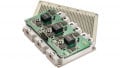
Shaeffler has selected Rohm's fourth-generation SiC MOSFETs as the basis for its new inverter brick, a high-voltage subassembly now in mass production for a Chinese automaker.
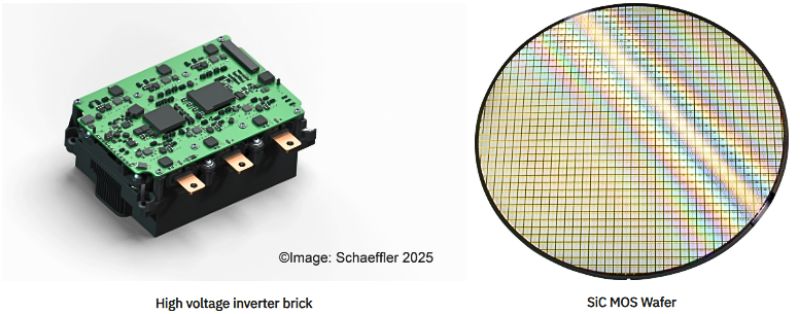
Rohm’s SiC wafers are used in Schaeffler’s inverter brick. Image used courtesy of Rohm
Designed as a compact and scalable power module, the brick integrates SiC MOSFET bare chips with a DC link capacitor, DC link, cooler, and a PWM-controlled switching stage to generate high-frequency motor drive currents. It supports battery voltages exceeding 800 V and delivers RMS currents up to 650 A for high power density and efficient electric drive control.
The architecture also incorporates a DC boost function, allowing 800 V battery systems to charge at 400 V stations without charging speed loss. Combining modularity with SiC’s intrinsic low switching loss and high thermal conductivity, the inverter brick may boost efficiency and integration flexibility for X-in-1 e-axle platforms.
What’s Next for MOSFETs?
The momentum in high-power MOSFET development gives a glimpse into automotive and industrial systems’ evolving architectures over the next decade. As electrification accelerates, designers will need transistors that manage rising current densities without compromising thermal margins or switching efficiency. This trend will likely push packaging innovation as much as semiconductor performance, with system-level integration becoming a differentiator.
At the same time, the competitive landscape between silicon and wide bandgap devices will continue to shape design choices, where tradeoffs in cost, voltage range, and manufacturability determine adoption paths. For engineers, the challenge will be less about whether new devices can deliver higher efficiency and more about how quickly these advances can be qualified and scaled into mass production.
Related Content