Facebook
 Google
 GitHub
 Linkedin
Putting Wide-Bandgap Power Transistors to The Test
Transistors are the core of power electronics. However, the beneficial properties of wide bandgap devices present challenges for accurate measurements. To fully characterize GaN and SiC transistors, understanding via static and dynamic tests are essential, with the dynamic attributes being most insightful as they mimic the application conditions. In addition to classic static and double pulse tests, a novel continuous switching dynamic test approach is proposed within a single test system.
This article is published by EEPower as part of an exclusive digital content partnership with Bodo’s Power Systems.
Introduction
The rapid advancement of power electronics has been significantly propelled by the development of Wide Bandgap (WBG) semiconductor materials, notably Gallium Nitride (GaN) and Silicon Carbide (SiC). These materials exhibit superior properties compared to traditional Silicon, including higher breakdown voltage, higher thermal conductivity, and faster switching speeds. These characteristics enable the creation of power transistors with significantly enhanced performance characteristics, unlocking higher efficiency and faster dynamic response. WBG transistors are pivotal in modern power systems, including Switched-Mode Power Supplies (SMPS), inverters, and motor drives, due to their ability to achieve near-ideal switching behavior. Power transistors have a major impact on the performance of the SMPS, namely the efficiency, power density, dynamic behavior, reliability and EMI performance. Dynamic behavior such as dynamic Rds(on), various loss mechanisms, switching and degradation over the mission profile of these WBG devices are still heavily under investigation.
The superior performance of WBG devices also introduces challenges in accurately measuring and characterizing their behavior. The extremely fast switching speeds and other unique characteristics of these devices necessitate novel testing methodologies to fully understand their capabilities and limitations, ensuring their optimal and safe operation in diverse applications.
Challenges in WBG Transistor Characterization
WBG transistors, particularly those based on GaN and SiC, switch orders of magnitude faster than their silicon counterparts. This rapid switching behavior, while beneficial for efficiency and power density, poses significant challenges for measurement systems. Traditional test setups may struggle to capture accurate data at such high speeds due to limitations in measurement bandwidth, the influence of parasitic elements in the test environment, and the inherent high-frequency noise associated with fast switching.
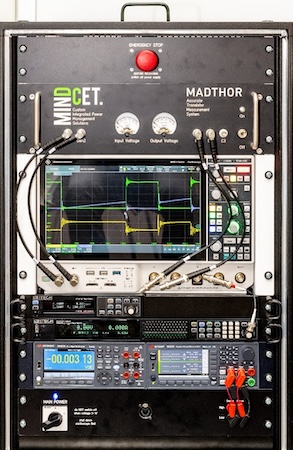
Figure 1. MADTHOR power transistor measurement system. Image used courtesy of Bodo’s Power Systems [PDF]
Furthermore, the dynamic behavior of WBG transistors, including phenomena like dynamic on-resistance (Rds(on)), gate charge characteristics, and various loss mechanisms, can be heavily influenced by temperature, voltage, and other operating conditions. Accurately characterizing these dynamic behaviors requires test methods that can replicate realistic operating conditions and capture the device’s response over a range of temperatures, switching frequencies, and load conditions. This is crucial to ensure that the device operates within safe limits and to predict its performance under various real-world scenarios.
Overcoming these challenges requires dedicated test equipment. The test-bench called MADTHOR (Figure 1) combines the classical static and double-pulse testing capabilities with the novel continuous dynamic test method.
Classic Approach: Static Transistor Testing
Static power transistor measurements characterize key DC electrical parameters such as on-state resistance (Rds(on)), threshold voltage (Vth), gate charge (Ciss/Coss/Crss), leakage currents (such as Ids and gate leakage), and more. Within the MADTHOR system, there is a dedicated static test socket with voltage bias capability up to 1200V and a strong 100A DC current capability, covering the current GaN HEMT market selection as well as many SiC and IGBT requirements.
In Figure 2, an example pulsed Rds(on) measurement of a 650V GaN HEMT (DFN package type) with a datasheet listed Rds(on) of maximum 600mΩ at a Vgs of 5V is taken at room temperature. With the increasing Ids current from 1 to 3.5A, a non-linear increase in Rds(on) from approximately 430 mΩ to 570 mΩ is observed. The pulsed measurement method is utilized to reduce self-heating of the device and thereby increases accuracy of the measurement.
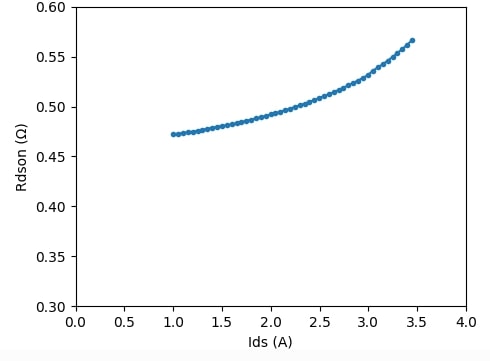
Figure 2. A pulsed Rds(on) measurement of a 650V GaN HEMT (600mΩ (max.) datasheet value). Image used courtesy of Bodo’s Power Systems [PDF]
Classic Approach: Double-Pulse Testing
Double pulse testing (DPT) is widely established in the world of power transistor testing and looks at a few phases in the switching process of a transistor: DPT involves applying two short voltage pulses to the device and measuring the resulting current and voltage waveforms. This allows for the characterization of switching losses and other dynamic parameters. When analyzing the Vgs over time of the DPT, it breaks down into the follow events:
- Turn-on, starting with zero current
- Turn-off, at a given current
- Turn-on, at a given current
- Turn-off, at a certain current, higher than the previous value
Figure 3 depicts this procedure. An inductive load is used to ramp up the current after turn-on in a controlled manner. Given an operating voltage Vbus, the maximum current values can be manipulated by choosing the on-time.
Fundamental limitations of this approach are inherent since the pulses are only shortly applied and do not allow the transistor to be tested in its realistic operating regime. Especially WBG, where temperature dependance on Rds(on) and dynamic Rds(on) play an important role in the behavior and application. Also, the third quadrant operation, subject to much higher voltage drops compared to silicon MOSFETs, cannot be measured this way. Moreover, WBG technologies involve faster switching, which makes it much more challenging to capture accurate data while keeping parasitics in the power and gate paths low. Special techniques were developed for the system, like the “strømhenge” to minimize the parasitic inductance caused by the shunt resistor.
Novel Measurement Approach: Continuous Switching
To model a WBG transistor in the most realistic way, it is pertinent to measure it under real-life operating conditions, just as seen in application. To expand on traditional testing methods, a novel approach called continuous dynamic testing has been developed. This approach, implemented in the MADTHOR system, is a revolutionary technique to mimic the typical SMPS transistor waveforms and simultaneously measure crucial parameters. The continuous switching principle is based on re-routing the double-pulse connectivity into a classical Buck converter. By creating a switching cell consisting of a half-bridge using two identical transistors, a realistic scenario is created, as depicted in Figure 4.
The continuous switching approach can bring learnings that are complementary to classical double-pulse testing:
- Loss analysis and resulting self-heating behavior
- More accurate loss breakdown: Rds(on), switching losses
- More accurate determination of dynamic Rds(on) and its evolution over multiple switching cycles with time and self-heating effects
- Measurement of the third-quadrant operation and the influence of negative gate biasing.
- Potential degradation of Rds(on) and other key parameters over longer testing periods, possibly combined with an elevated ambient temperature
By providing a more comprehensive and accurate picture of the device’s behavior, continuous dynamic testing can help engineers and researchers optimize device design, improve reliability, and ensure safe operation under a wide range of conditions.
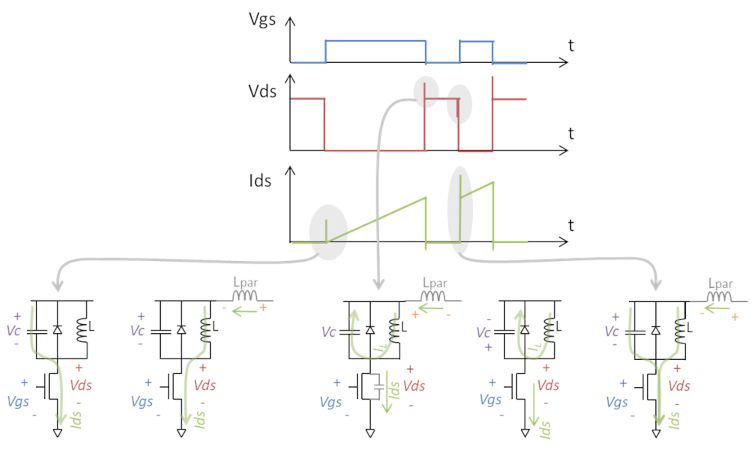
Figure 3. A breakdown of the DPT procedure and its waveforms. The real-life parasitic elements are accounted for and result in the non-ideal over- and undershoot seen in the Vds and Ids waveforms. Image used courtesy of Bodo’s Power Systems [PDF]
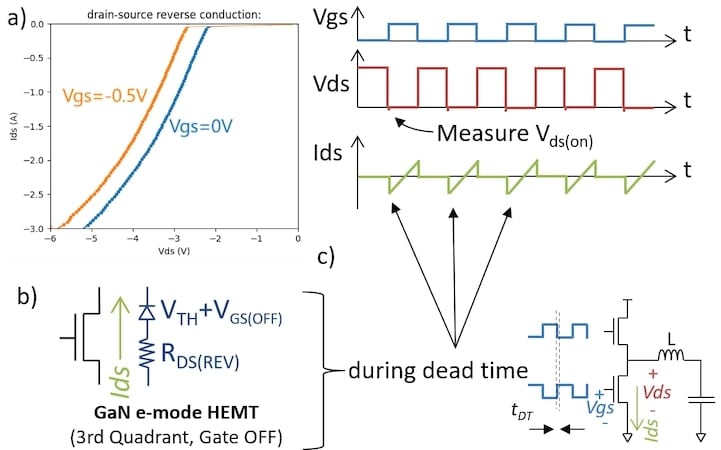
Figure 4. (a) Reverse IV trace for a GaN e-mode HEMT, demonstrating the 3rd quadrant behavior (b) current flow state based during 3rd quadrant operation of the GaN HEMT (c) continuous switching waveforms during the continuous switching principle. Image used courtesy of Bodo’s Power Systems [PDF]
Summary and Future Outlook
The development of WBG power transistors has revolutionized the field of power electronics, enabling significant improvements in efficiency, power density, and overall system performance. However, the unique characteristics of these devices necessitate novel testing methodologies to fully understand, model and optimize their usage.
The MADTHOR system (https://www.mindcet.com/measurementsystems/madthor) combines widely accepted static and double pulse testing with its continuous dynamic testing capability into a single unit. This offers a promising solution for the comprehensive characterization of WBG transistors. By replicating realistic operating conditions and providing detailed measurements of key parameters, this approach can help engineers and researchers gain a deeper understanding of WBG device behavior and accelerate the development of next-generation power electronics systems.
Please stay tuned for the next installment in this WBG transistor testing story, delving deeper into enhancement mode GaN HEMT behavior based on the insights gained via the MADTHOR.
This article originally appeared in Bodo’s Power Systems [PDF] magazine and is co-authored by David Czajkowski, Strategic Business Development Manager, Rob Smits, Measurement Systems Engineer, and Mike Wens, CEO & Managing Director, all MinDCet NV.