Facebook
 Google
 GitHub
 Linkedin
The World Considers a Nuclear-Powered Future
Nuclear power plants are making a comeback. Can they surpass renewables as the fastest-growing energy source?
Electricity demand is growing quickly, especially as artificial intelligence, data centers, and electric vehicles become more widespread. While renewables like wind and solar have lately dominated new energy sources, nuclear power is once again gaining momentum.
How long can a nuclear power plant last? Video used courtesy of the Department of Energy
An International Energy Agency (IEA) report released in January details nuclear power's ability to meet the world’s growing need for low-carbon electricity. The report indicated that innovations in nuclear energy, including small nuclear reactors, will hit an all-time high in 2025. China and Russia could lead the way.
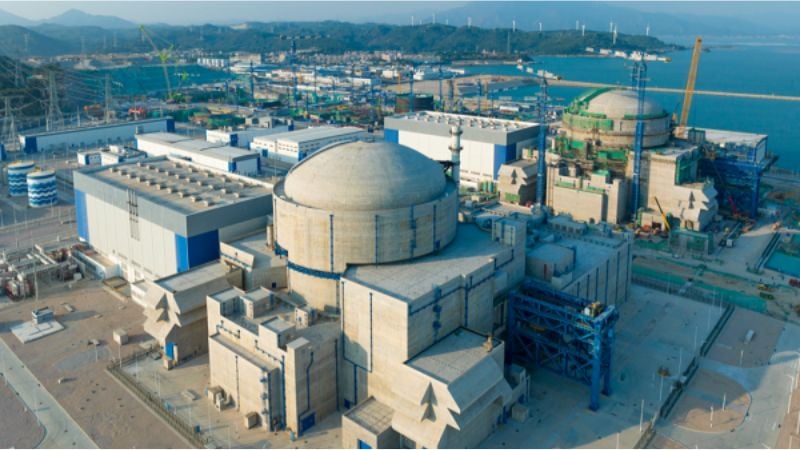
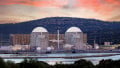
Chinese nuclear power plant. Image used courtesy of the China National Nuclear Corporation
Nuclear By the Numbers: Global Growth
Approximately 440 nuclear power reactors are operational worldwide, with a combined capacity of about 400 GWh, according to the IEA report. These reactors produce just under 10% of the world’s electricity. They are located in 40 countries, with the United States having the most reactors with 94, France second with 56, China third with 58, and Russia fourth with 29 reactors.
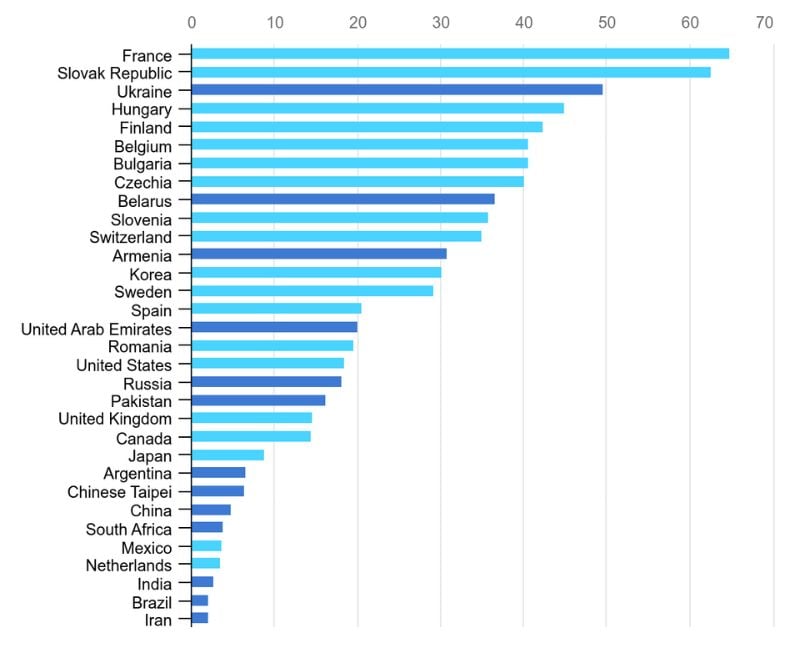
Nuclear energy generation by country, as of 2023. Image used courtesy of IEA
The World Nuclear Industry Status Report indicates that 61 nuclear power plants were under construction in 13 countries as of January 1, 2025. China leads the global expansion, with 25-29 reactors currently being built. Other countries with significant nuclear construction projects include Russia, which is building six reactors domestically and 25 units in other countries. India also has multiple reactors under construction, South Korea is building at least two reactors, and Turkey has four reactors.
Worldwide, the average age of nuclear reactors is 32 years, while the average age of U.S. reactors is just over 42 years. Despite their age, many nuclear reactors are receiving life extensions. In the U.S., most reactors have been approved to operate for up to 60 years, with some applying for additional extensions to operate for up to 80 years.
Pressurized water reactors (PWRs) represent the majority of operational nuclear reactors globally—307 PWR units worldwide account for approximately 70% of all operable reactors. PWRs use ordinary water as a coolant and moderator. The design includes a primary cooling circuit that flows through the reactor core under high pressure and a secondary circuit for steam generation. PWRs are considered to be safe with inherent safety features such as negative feedback effects that slow down fission reactions if coolant is lost.
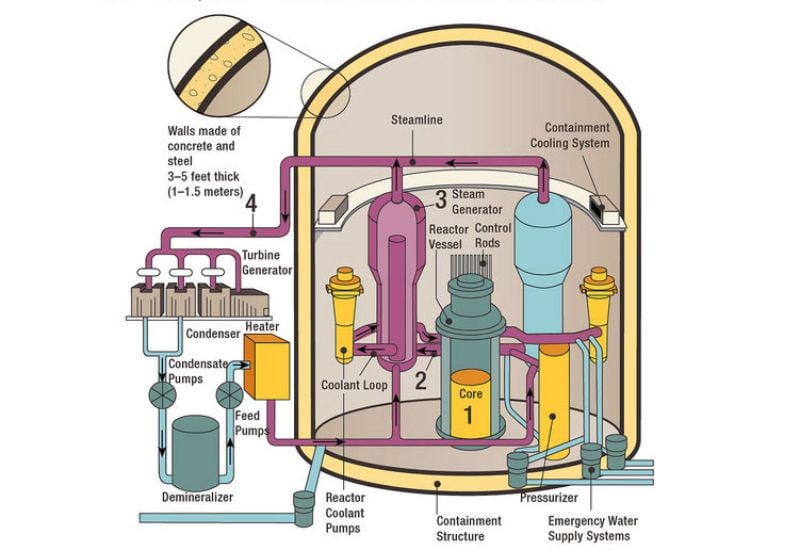
Most nuclear plants use pressurized water reactors. Image used courtesy of Nuclear Regulatory Commission
Russia and China Will Dominate Nuclear Power
The global nuclear power industry increasingly relies on Chinese and Russian nuclear reactor technology for continued growth, though their dominance is not absolute. Russia, through its state nuclear corporation Rosatom, has established a significant presence in the global nuclear market. As of 2023, 42 reactors outside Russia were operating with Russian or Soviet-designed VVER reactors across 11 countries, and Rosatom is currently involved in the construction of about 20 reactors abroad.
China has 57 operational reactors and 30 under construction, making it a global leader in nuclear energy development. The country plans to add six to eight reactors annually, increasing capacity by 5,000-8,000 MW annually. It also aims to sell 30 nuclear reactors to Belt and Road Initiative partner countries by 2030. China has developed the Hualong One, a third-generation nuclear reactor design with full proprietary intellectual property rights.
As of 2022, Russia had an 18.1% share of nuclear reactor exports, followed by the United States with 16.4% and Sweden with 16.3%. China's share of nuclear reactor exports was still relatively small at 1.5% in 2022 but is expected to grow significantly by 2030.
China’s Nuclear Goals
China has set ambitious targets for its nuclear power program. In the short term, the plan is to reach 65 GW of operational nuclear capacity by the end of 2025 and to approve and begin construction of additional coastal nuclear power projects. China’s medium-term goals (2030-2035) include an increase in nuclear power's share in the energy mix to 10% by 2035, up from about 5% in 2021. This will involve potentially reaching 145 GW of nuclear generation capacity by 2035. In the long term (2050-2060), China wants to achieve 18% of total power output from nuclear by 2060 and also to replace all 2,990 coal-fired power plants with clean energy solutions, including nuclear, by 2060.
China appears to be slightly behind on its nuclear power program targets, but it is still making significant progress. China's 14th Five-Year Plan (2021-2025) originally set a goal of 70 GW of operational nuclear capacity by 2025. As of early Q3 2024, China had 58.1 GW of active nuclear capacity. However, projections suggest China may fall short of its original 70 GW goal for 2025, with an estimated 63-65 GW expected to be online by the end of 2025.
Another goal of China’s nuclear program is to develop small modular reactors (SMR). SMRs represent an alternate approach to nuclear power generation. They offer several advantages over traditional large-scale nuclear plants. These compact, factory-built reactors are designed to provide flexible, scalable, and potentially more cost-effective nuclear energy solutions.
Small Modular Reactors
SMRs typically have an electrical output of up to 300 MWe per module, about one-third the capacity of traditional nuclear power plants. They are significantly smaller than conventional reactors, with a physical footprint of about 1/10 to 1/4 the size of traditional plants, and their modular design allows for factory fabrication of major components, which can then be transported and assembled on-site. Many SMR designs incorporate passive safety systems that rely on natural phenomena like gravity, natural circulation, and convection for cooling and shutdown. Some designs feature underground or underwater placement for enhanced protection against natural or human-made hazards. SMRs also offer longer refueling intervals, ranging from three to seven years, compared to one to two years for conventional plants.
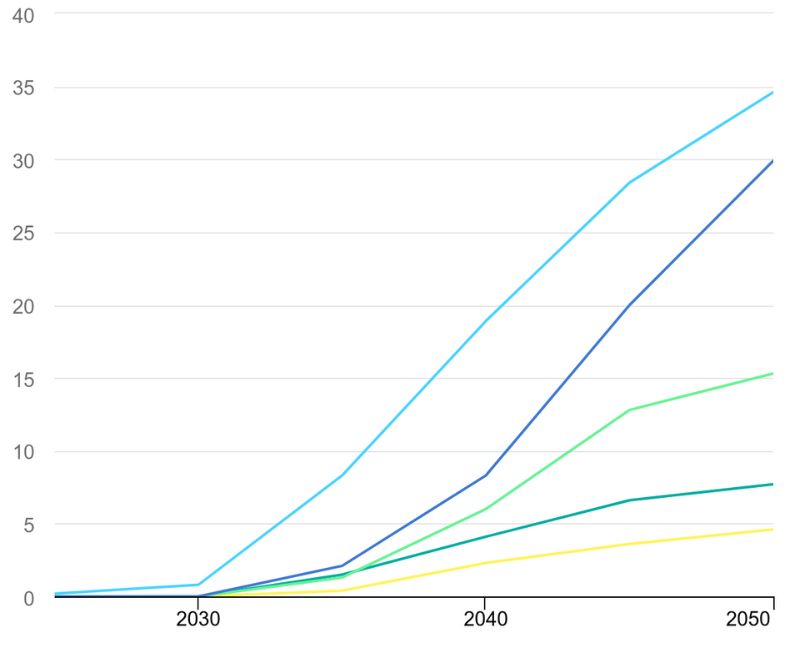

Projected SMR installations. Image used courtesy of IEA
SMRs can complement renewable energy sources, providing baseload power to balance intermittent generation. Their smaller size allows for more distributed placement within the grid, potentially reducing transmission infrastructure requirements. Advanced SMR designs may offer load-following capabilities, enhancing grid flexibility and stability.
A Small Modular Reactor Future
China is making significant progress on SMRs. Its Linglong One (ACP100) SMR is the country’s first onshore commercial modular pressurized water reactor. Construction began in 2021 and is expected to be completed in 2025. The plant will generate about 1 billion kWh annually. It is the first SMR globally to receive approval from the International Atomic Energy Agency.
China aims to deploy SMRs for various applications like electricity generation, district heating, and industrial processes. The country views SMRs as a strategy to reduce dependence on imported fossil fuels and meet climate goals.
The United States is also actively working on SMRs, with the Department of Energy (DOE) opening applications for up to $900 million to support the domestic deployment of small modular reactors. DOE previously allocated $452 million over five years through the SMR Licensing Technical Support program to support U.S. light-water reactor designs. NuScale Power has been developing a 77 MWe PWR design, which the U.S. Nuclear Regulatory Commission has certified, and the Tennessee Valley Authority is leading an $800 million bid from the DOE to accelerate SMR deployment, aiming to start commercial operations by 2033. Other U.S. companies involved in SMR development include Westinghouse, Holtec, and BWXT Advanced Technologies.
Fusion?
In contrast to commercial fission reactors, which split uranium fuel to produce energy, fusion reactors combine hydrogen isotopes to create helium atoms, releasing energy in the process. No commercial fusion reactors exist. In fact, the earliest prototypes aren’t expected until at least 2035.
Practical nuclear fusion requires solving a wide range of technical challenges before it can even be determined if fusion reactors can be built. That hasn’t held back research funding. The U.S. government allocated approximately $760 million for fusion initiatives in 2023, and an additional $415 million was authorized for a public-private partnership program for fusion development until 2027. China's fusion budget is estimated at around $1.5 billion per year, and in 2023, equity investments in Chinese fusion companies exceeded those in all other countries combined. The U.K. government committed £650 million to national research programs, including the STEP fusion power plant project. The European Union continues to invest in the ITER project in southern France, a collaboration involving over 30 countries. Private companies play an increasingly significant role, with 45 companies across 13 countries working to commercialize nuclear fusion.
For now, nuclear fusion is a dream, while building new traditional PWR fission reactors and a new generation of small modular reactors will dominate the nuclear power industry.