Facebook
 Google
 GitHub
 Linkedin
Fusion Future: From Concept to Reality
Part one of this series explored the concept of nuclear fusion. Part two focuses on the progress made in nuclear fusion research and the ongoing efforts still needed to achieve commercial viability.
Although it sounds simple, decades of research have taken place to reach the point where, last year, the fusion reaction finally reached breakeven, where the energy produced by the reaction is equal to or greater than the amount of energy used to create the fusion reaction. News of breakeven spread quickly and has helped jump-start renewed interest in fusion as a future potential game-changing energy source.
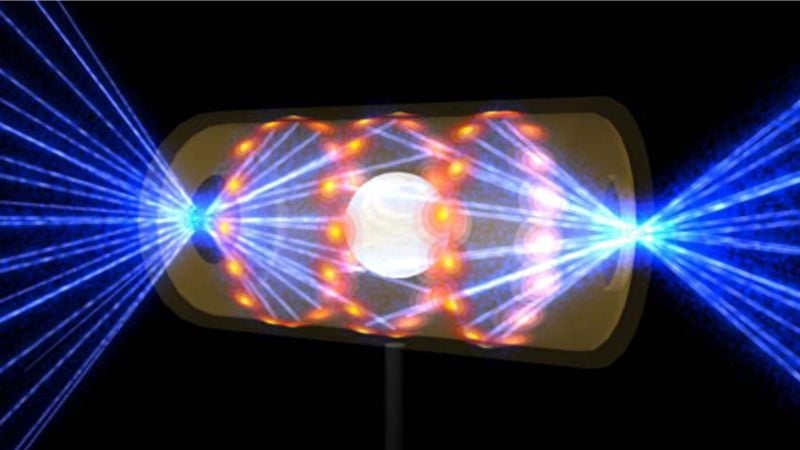
Concept of nuclear fusion. Image used courtesy of LLNL
However, much research remains to make nuclear fusion a viable energy source. Part two reviews recent achievements and assesses the technology’s future.
Fusion Breakeven With 192 Lasers
On December 5, 2022, scientists at Lawrence Livermore National Laboratory’s (LLNL) National Ignition Facility (NIF) in California achieved breakeven with a laser-powered fusion reaction. The process used 192 ultraviolet laser beams delivering 2.05 million joules (MJ) of energy to a deuterium-tritium fuel pellet. The resulting nuclear fusion reaction achieved an output of 3.15 MJ (about the energy contained in three sticks of dynamite) and thus achieved breakeven for the first time in history.
NIF’s process of creating nuclear fusion was extraordinarily complicated, reflecting just how difficult it would be to create practical fusion reactors to produce electrical power.
The 192 high-power lasers are fired at a one-millimeter diameter gold target cylinder called a hohlraum. Inside the cylinder is a high-density carbon (diamond) capsule weighing just 4.25 milligrams. The capsule contains 220 micrograms (µg) of tritium and deuterium, the fuel for the fusion reaction.
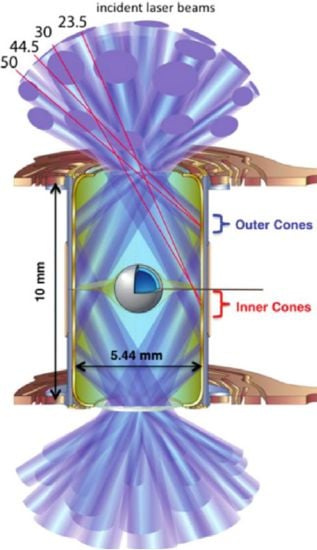
Laser target. Image used courtesy of LLNL
When hit by the ultraviolet lasers, the gold cylinder bombards the surface of the carbon capsule with x-rays, vaporizing the shell and imploding inward with a pressure (600 billion atmospheres) and temperature (151 million °C) sufficient to allow the tritium and deuterium to fuse. This creates helium and releases the fuel to significantly exceed those found in the Sun (200 billion atmospheres and 16 million °C).
These conditions were sufficient for the deuterium and tritium atoms to fuse into helium and release energy, along with one high-energy neutron and one alpha particle. The neutron escapes from the fusion reaction, but the alpha particle heats the fuel, further increasing the fusion energy output.
Video used courtesy of LLNL
Achieving uniform cylinder heating by the 192 lasers requires each laser to be accurately aimed. Any non-uniformity in the hohlraum, such as walls with uneven thicknesses, can result in asymmetric implosions, reducing the chances of the fusion reaction occurring.
Although the NIF's success has proven the concept of nuclear fusion on earth, the method to achieve fusion is wildly impractical for an industrial process to produce electrical power for the grid. A gigawatt electric power plant would consume up to 1 million gold cylinders and diamond fuel capsules daily, with up to 10 laser shots occurring each second.
Just days after news broke about NIF’s fusion energy breakeven, California-based Longview Fusion Energy Systems announced plans to build the world’s first laser fusion power plant. Longview plans to combine NIF’s laser fusion technique repeated hundreds of times per minute to deliver carbon-free sustainable energy from a commercially viable plant. In March 2024, Longview announced it had signed a contract with engineering and construction giant Fluor Corporation to design and build just such a plant, capable of producing 1600 megawatts (MW) of electricity within the coming decade.
Fusion With a Stellarator
Imploding target spheres with high-power lasers is not the only concept for creating nuclear fusion on Earth. Laser fusion energy creates pulses of fusion energy. However, if technology could be developed, steady-state energy creation would have significant advantages for a baseload powerplant operation. One concept for creating steady-state fusion energy is the stellarator.
The fields generated by external magnets control the stellarator, making it relatively stable and simple to operate. A stellarator (developed initially in 1951) could allow continuous steady-state fusion reaction operation.
Wisconsin-based TDK Ventures is assisting with funding Type One Energy, consisting of scientists from the University of Wisconsin, Oak Ridge National Lab, and Max Planck Institute for Plasma Physics. The group is developing a magnetic confinement concept using 3D printing and the application of high-temperature superconductor magnets.
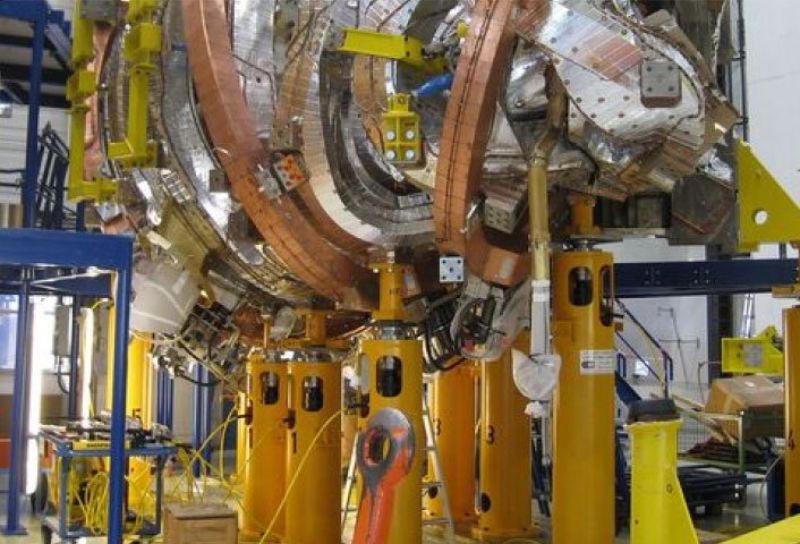
Stellarator. Image used courtesy of Type One Energy
Type One Energy’s stellarator uses shaped 3D magnetics to confine plasma gases along a twisting circular path. The stellarator’s performance is controlled by the fields generated by external magnets, making it relatively stable and simple to operate. A stellarator operates continuously, making it attractive for future power grid applications. Of course, as yet, the stellarator has not achieved energy breakeven.
Worldwide Fusion Research
Fusion energy research has gone global. For example, ITER, an international collaboration, is building the world’s largest tokamak fusion reactor in France. A tokamak holds a high-temperature plasma in a torus-shaped device to control the nuclear fusion reaction. It is considered one of the front-runners for a practical steady-state fusion reactor. With any luck, ITER will begin operation in 2025.
Scientists at the Korean Institute of Fusion Energy recently announced its Korea Superconducting Tokamak Advanced Research device was able to generate plasma temperatures of 100 million °C (seven times as hot as the core of the Sun) for a record-setting 48 seconds, beating KSTAR’s previous record of 30 seconds. The facility’s goal is to sustain temperatures of over 100 million °C for up to 300 seconds by 2026.
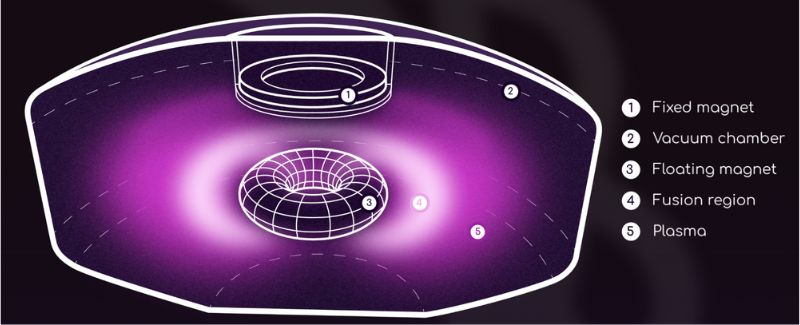
Openstar’s fusion reactor concept. Image used courtesy of Openstar Technologies
In New Zealand, Openstar Technologies Ltd. is examining controlling plasma using dipole magnets, a method that can improve plasma stability as it reaches nuclear fusion temperatures. New Zealand was the home of Sir Ernest Rutherford, who first split the atom. He named deuterium and tritium the fuels used in the nuclear fusion process.
Using AI in Nuclear Fusion
The International Atomic Energy Agency plans to use artificial intelligence (AI) to accelerate fusion research and development. By training AI on past experimental data, scientists can predict potential instabilities in the nuclear fusion plasma ahead of time, allowing an AI controller to change operating parameters much faster than a human could intervene.
A team of engineers, physicists, and data scientists from the U.S. Department of Energy’s Princeton Plasma Physics Laboratory is working on ways to use AI to control plasma problems in real time. Their initial work will provide more opportunities for dynamic fusion reaction control by controlling the plasma instabilities that have been obstacles to sustained fusion reactions.
The Clock is Ticking for Nuclear Fusion
If nuclear fusion can provide clean, carbon-free energy to the power grid, we need it sooner than later. Even though wind and solar power continue to grow, electric power generation using fossil fuels like natural gas still predominates, and it looks likely to do so far into the future, continually adding to the problems of climate change. Nuclear fusion’s challenges are enormous, and we may never be able to solve them. But the promise to eliminate carbon emissions is so great that energy from nuclear fusion is a challenge that humankind will not be able to ignore.