Facebook
 Google
 GitHub
 Linkedin
Neutrons and Nanos: Nuclear Fusion Steadily Advances
Nuclear fusion moves closer to reality as progress is made in several contributing technologies.
Powering the grid using nuclear fusion—the same energy that powers the sun—presents wide-ranging technical challenges. Billions of dollars have already been spent in pursuit of fusion energy, and many billions more will be required before nuclear fusion reaches the point where it could become commercially feasible.
However, fusion technology is advancing steadily, step by step. Here’s a roundup of the latest developments.
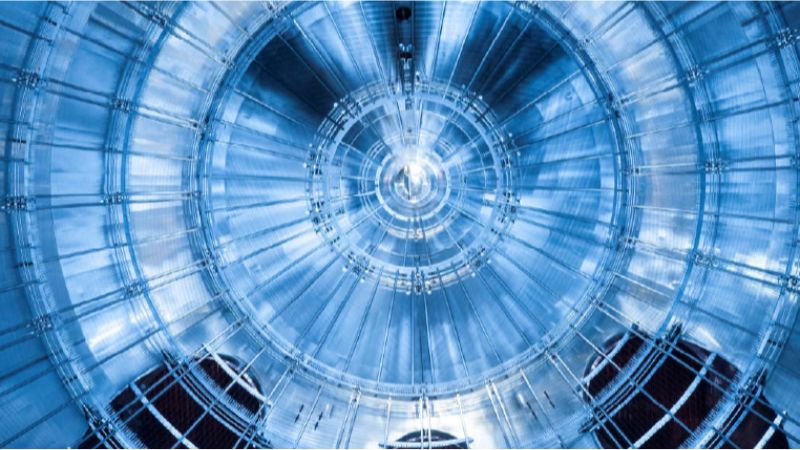
Karlsruhe Institute of Technology’s tritium laboratory. Image used courtesy of Karlsruhe Institute of Technology
Nuclear Fusion
Nuclear fusion combines two isotopes of hydrogen, deuterium and tritium, in hot plasma (roughly 100 million degrees C) inside a vacuum vessel to produce a helium atom, high-energy protons, and energy. The energy is prodigious compared to the fuel required. To understand, consider a 1,000-MW coal-fired power plant, which needs about 2.7 million tons of coal annually and produces huge carbon dioxide emissions. To generate the same 1,000 MW, a nuclear fusion plant running on hydrogen isotopes would require about 250 kilograms (kg) or about 550 pounds of fuel per year.
A major problem is containing the 100-million-degree plasma while at the same time extracting energy from the reactor to create steam to power electrical generators. One way to contain the plasma is within a powerful magnetic field. However, maintaining a stable plasma long enough for the fusion reaction to occur has been difficult.
Tritium
The hydrogen isotope deuterium is relatively common—about 1 in every 6,500 hydrogen atoms in seawater is deuterium. On the other hand, the radioactive hydrogen isotope tritium is almost unknown because it decays quickly after it is naturally formed in the Earth’s upper atmosphere. It is possible to produce additional tritium during the nuclear fusion reaction by allowing the high-energy neutrons formed during fusion to interact with lithium surrounding the plasma reaction in a blanket.
The Institute for Astroparticle Physics operates the European Tritium Laboratory Karlsruhe (TLK) as a facility for processing tritium. The TLK has a license to handle up to 40 grams of tritium and maintains a site inventory of about 30 grams. Other tritium processing facilities exist in Canada, the U.S., the U.K., and Japan.
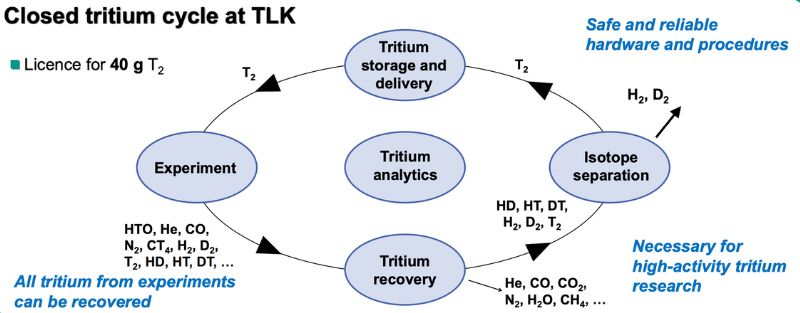
The laboratory’s tritium recovery process. Image used courtesy of TLK
High Energy Neutrons
Nuclear fusion creates neutrons with much higher energy than nuclear fission. The higher energy makes these much more kinetic, and as a result, they can interact with the atomic structure of the metal used to make the vacuum vessel. This interaction creates helium atoms that travel to and accumulate at grain boundary defects in the metal structure of the vessel. The helium ions repel one another, creating cracks in the metal structure. These cracks can compromise the strength and usability of the reactor vessel within six months.
Researchers at MIT reasoned that they could provide other areas in the reactor vessel material that would attract the helium atoms to a location where they wouldn’t do any harm. After examining more than 50,000 possibilities, the MIT team settled on a ceramic material called iron silicate that was mechanically robust, compatible with the reactor material, and resistant to radioactivity.
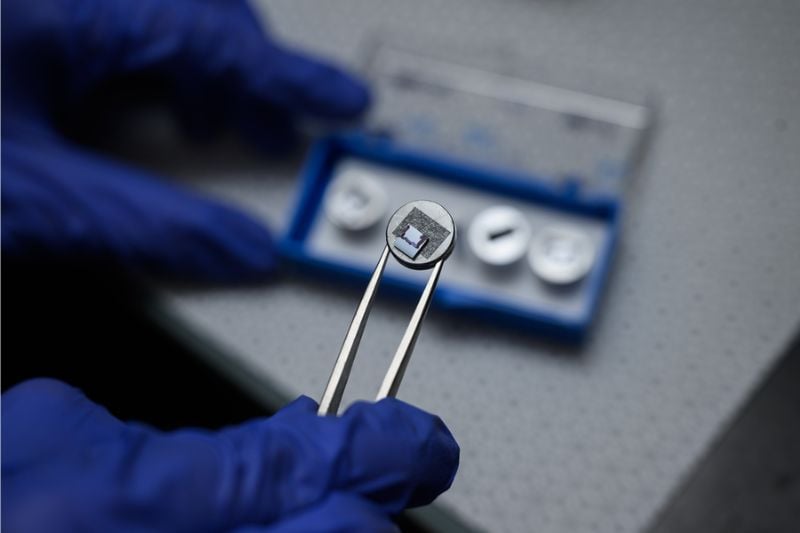
Composite material for fusion reactors. Image used courtesy of MIT
To prove the concept, the team dispersed nano-scale iron silicate particles into a sample iron reactor vessel and implanted helium ions into the structure. Using X-ray diffraction, they found helium was spread throughout the material rather than collected at the grain boundaries of the reactor material. Adding 1 percent iron silicate to the iron vessel material reduced the helium atoms’ size and distribution by 20 percent. The development could lead to a nuclear fusion reactor vessel lasting up to a decade.
Boron Protection
Another material widely used for fusion reactor vessels is tungsten. Tungsten’s melting point, 3,422°C (6,192°F), is one of the highest of any element. This allows it to withstand the extreme temperatures inside fusion reactors. Tungsten exhibits a low propensity for erosion and good radiation resistance when exposed to the high-energy plasma inside fusion reactors. Compared to other materials like carbon, tungsten has a lower tendency to absorb and retain tritium, helping to minimize radioactive contamination.
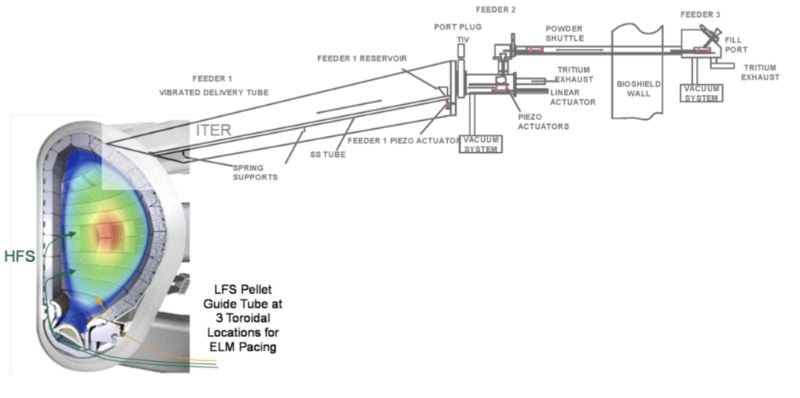
Boron power-coating system. Image used courtesy of Oak Ridge National Laboratory
Even at high temperatures, tungsten retains good mechanical strength and stability, which is crucial for structural components in the harsh fusion environment. However, pure tungsten can be brittle, so researchers are developing alloys and composites to improve ductility and other properties while maintaining tungsten's beneficial characteristics for fusion applications. Ongoing research aims to optimize tungsten-based materials to better withstand the extreme conditions in fusion reactors and improve their overall performance.
One problem with tungsten is that atoms on the reactor’s walls can break off and enter the plasma, cooling it and reducing the level of fusion reactions. Now, researchers at the U.S. Department of Energy’s Princeton Plasma Physics Laboratory (PPPL) have developed a way to coat the tungsten surface with a boron powder, forming a protective layer that prevents the tungsten atoms from escaping into the plasma. According to PPPL, the boron powder already shows promise in fusion reactors in China, Germany, and the U.S. and can be used even after the reactor is operational.
Creating the Plasma
Initiating the hydrogen isotope fusion reaction is usually accomplished using powerful lasers focused on a tiny hydrogen fuel pellet. The lasers heat and compress the pellets until the fusion reaction initiates. This requires a high degree of precision.
Photonics21, a non-profit European technology association, studies photonics, the science of generating and harnessing light. Photonics is critical to developing the high-precision components required for fusion reactors.
The group found that, beyond the high-power lasers required to initiate fusion reactions within a plasma, other photonic technologies like LiDAR, various optical sensors, and high-precision imaging will be crucial in monitoring and controlling the extreme conditions within fusion power plants.
Controlling the Plasma
Controlling the plasma that creates nuclear fusion has been a major challenge. Powerful electromagnets are used to contain the plasma at extremely high temperatures. High-temperature superconductors are vital in the construction of the magnets. The superconductors in current use suffer from energy losses from pulsed magnetic fields, a lack of thermal robustness, and a very high cost.
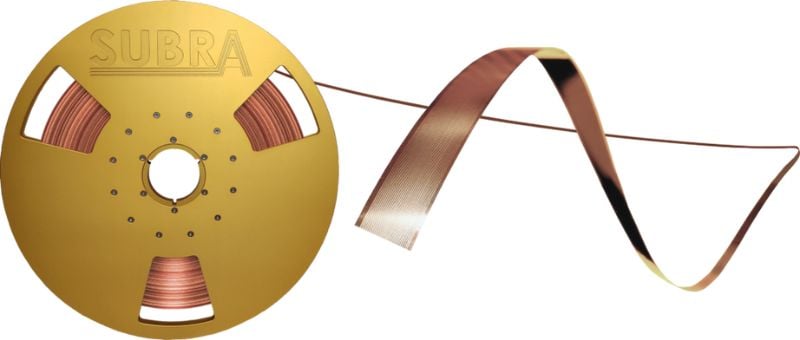
Superconductor tape. Image used courtesy of SUBRA
A Danish company, SUBRA, has launched a filamented superconductor tape that can be produced in large-scale, cost-effective production. The technology uses high-performance ceramic superconducting coatings placed in parallel stripes on metal tape. These coatings are only three micro-meters thick and just a few hundred micrometers wide. Despite their small size, they can carry 300 times the current of an equivalent copper wire with no energy losses.
Swedish company Novatron has made another step toward stable plasma confinement. The company uses axisymmetric tandem mirror (ATM) technology, which utilizes two large magnets to trap the plasma, bouncing it back and forth between them. ATM can produce high plasma pressures with relatively weak magnetic fields; however, the technology suffers from instability and poor confinement times.
Novatron is developing an ATM design that incorporates biconic cusps. These create a magnetic field that is convex from the inside and concave from the outside. This unique field structure is claimed to result in very good confinement while maintaining inherent stability. Calculations suggest a potential 100-fold improvement in energy confinement time compared to traditional magnetic mirror machines.
International Collaboration
Nuclear fusion has been far too difficult and complex for a single nation to tackle alone. To that end, the International Thermonuclear Experimental Reactor (ITER) is under construction in southern France. This collaborative effort involves 35 nations, including the United States, China, India, Japan, Korea, Russia, and the European Union. Using the hydrogen isotopes deuterium and tritium, ITER employs powerful magnetic fields to confine and heat plasma created from the fusion reaction and is expected to produce 500 MW of fusion power from 50 MW of input power. Construction of ITER began in 2013, and its first plasma experiments are expected in December 2025, with full operation expected in 2039.