Facebook
 Google
 GitHub
 Linkedin
EU Considers Bitcoin for Grid Stability
Cryptocurrency companies make the case for leveraging Bitcoin mining to stabilize Europe’s power grid.
Could Bitcoin mining stabilize Europe's power grids, especially with the increasing reliance on intermittent renewable resources? Last year, the International Energy Agency projected that wind and solar combined would surpass fossil fuel-fired generation to supply 30% of the European Union’s total electricity in 2024.
Bitcoin mining helps the Texas grid. Can it do the same in Europe? Video used courtesy of RCP Clips
Bitcoin mining can help balance fluctuations in wind and solar loads by acting as a responsive demand-side resource. Mining operators adjust their energy consumption based on electricity prices, making them flexible participants in the energy grid.
Many miners buy power on spot markets and reduce usage when electricity costs exceed revenue. This process, called curtailment, can ease grid congestion in regions like Europe with high renewable penetration and price volatility.
With more grid operators adopting this approach in the U.S., European Bitcoin industry stakeholders are looking to rally support for implementing the model. The Germany-based European Bitcoin Energy Association aims to gather peer-reviewed data to inform EU policies around energy infrastructure and Bitcoin mining. In 2025, the group plans to engage more European miners to demonstrate how mining can contribute to grid stability.
Terahash Energy, a founding member of the European Bitcoin Energy Association, has launched a few pilot projects testing the concept in Germany and Finland. Other founders include Switzerland-based mining infrastructure firm Prosperity Digital, Austria-based Bitcoin exchange Coinfinity, and the Czech Republic-based mining pool Braiins.
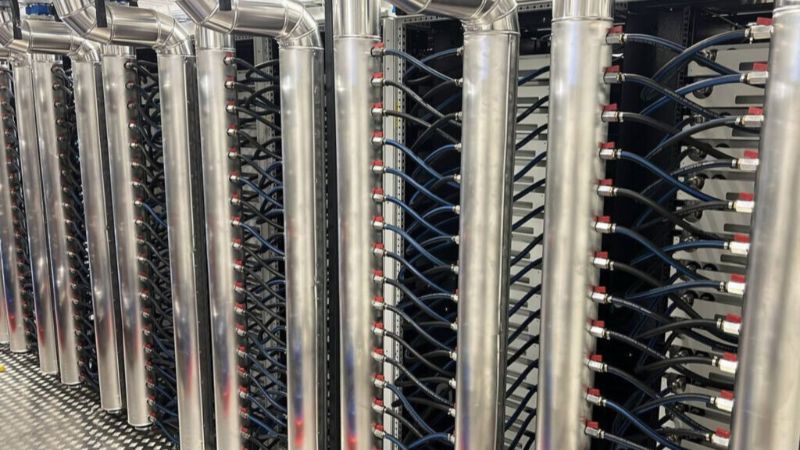
Terahash Energy’s Bitcoin mining equipment in Finland. Image used courtesy of Terahash Energy
Tapping Bitcoin Mining for Grid Support
Bitcoin mining is notoriously energy-intensive, consuming about 169 TWh annually, according to the University of Cambridge’s live index measuring Bitcoin’s network power demand. Miners verify transactions using a Proof of Work (PoW) system, where specialized mining rigs run trillions of calculations per second to solve cryptographic puzzles and enter transactions into the blockchain, earning Bitcoin for the effort. Although other cryptocurrencies besides Bitcoin have developed alternative consensus methods with reduced power requirements, PoW remains the dominant mechanism for digital currencies.
While Bitcoin’s PoW uses significant energy, it also provides a unique opportunity for power grids facing stability issues from fluctuating renewable sources like wind and solar. Unlike other industrial processes with fixed energy needs, mining rigs can ramp their operations up or down based on electricity prices and how much power is available at any given time. During periods with excess solar and wind production, miners can increase their activity. When the grid needs to shed load, miners can power down quickly, reducing demand on the system.
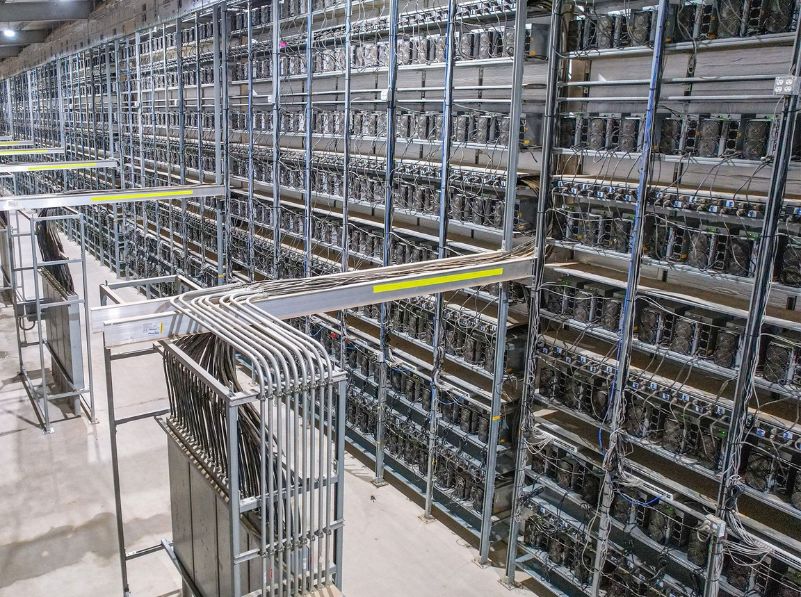
Bitcoin mining equipment at Riot Platforms’ facility in Rockdale, Texas. Image used courtesy of Riot Platforms
Bitcoin mining is already proving its value for grid management in the U.S. The Electric Reliability Council of Texas (ERCOT) leverages cryptocurrency mining to manage growing wind and solar loads in its system. Renewables generate 22% of Texas’s utility-scale electricity, more than the national average of 19.7%. Texas led the nation in wind power production in 2023, and it was the second-largest solar power producer.
ERCOT was an early adopter of new approaches to using cryptocurrency mining operations as controllable loads, where Bitcoin miners dynamically adjust their energy usage based on real-time grid conditions. This flexibility allows ERCOT to balance sudden wind and solar fluctuations more efficiently. Cryptocurrency miners are major participants in ERCOT’s Large Flexible Load program, which calls upon large industrial users to curtail their consumption during peak demand.
European Pilot Projects
With its high share of renewable energy, Europe is beginning to explore similar models. By curtailing or ramping up consumption as needed, the growing number of Bitcoin miners in the EU can help improve grid reliability and support the integration of more renewables—a key part of the EU’s 2050 target to achieve net-zero greenhouse gas emissions.
Early pilot projects aim to validate Bitcoin mining’s potential for grid operations. Terahash Energy launched the Genesis project site in Finland, combining a 1 MW renewable-powered data center and mining hardware with integrated heat recovery. The project provides heat to a community of 12,000 residents through a local district heating network. Terahash also led a project in Germany pairing its water-cooled Bitcoin mining system with solar panels at a car wash.

Terahash Energy’s Münsingen project integrates solar panels and a Bitcoin mining system. Image used courtesy of Terahash Energy
Europe’s largest telecommunications company, Germany-based Deutsche Telekom, partnered with Bankhaus Metzler on a renewable-powered Bitcoin mining project using surplus renewable energy. The Digital Monetary Photosynthesis program aims to collect field data to inform future projects in Germany.
Germany is a fitting testing ground due to its fast-paced renewable energy expansion. The country’s renewable generation grew 7.5% in 2023 to 251 TWh, per the most recent data from the Federal Network Agency. However, grid congestion led to about 10 TWh of curtailed energy due to feed-in management measures intended for network stability. Curtailment has steadily increased in recent years, from 5.8 TWh in 2021 to 7 TWh in 2022.