Facebook
 Google
 GitHub
 Linkedin
Fusion Future Accelerates With DOE Funding
The funding aims to make fusion energy commercially viable within the next decade.
After two years of planning, the U.S. Department of Energy (DOE) is giving nuclear fusion a financial boost. The DOE has established millions of dollars in funding and developed a strategy to help move nuclear fusion research forward.
The DOE has launched the Biden-Harris Administration's Bold Decadal Vision for Commercial Fusion Energy to accelerate the development and commercialization of fusion energy technology. Projects will include a pilot fusion plant and research into artificial intelligence, superconductors, and other technologies.
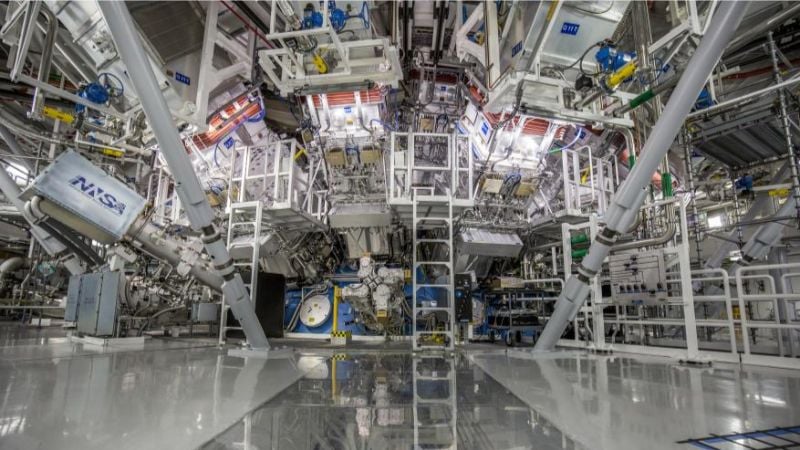
Fusion facility. Image used courtesy of Lawrence Livermore National Laboratory
What Is Nuclear Fusion?
Nuclear fusion energy occurs when two light atomic nuclei (typically isotopes of hydrogen, like deuterium and tritium) combine to form a single heavier nucleus. This reaction releases tremendous energy due to the slight difference in mass between the fused nuclei and the individual nuclei before fusion, as described by Einstein's famous equation E=mc2. This process powers the core of stars like the Sun and has the potential to provide a virtually inexhaustible clean energy source on Earth.
For fusion to occur, the fuel (deuterium and tritium) must be heated to extreme temperatures around 100 million degrees Celsius to overcome the electrostatic repulsion between the positively charged nuclei. The main byproducts of fusion are helium and a neutron flux, which induces far less radioactivity than the highly radioactive fission byproducts, resulting in a traditional uranium nuclear reactor.
Using magnetic fields to contain the intensely hot plasma that forms is a challenge. Only last year, Lawrence Livermore National Laboratory scientists reached scientific energy breakeven with their nuclear fusion experiments. Breakeven means the fusion reaction produces more energy than the energy input used to drive it. This was a big deal because, after decades of research, fusion finally looked like it might become a practical energy source.
The U.S. Vision for Fusion
The DOE’s vision was unveiled at the first-ever White House Summit on Developing a Bold Decadal Vision for Commercial Fusion Energy in March 2022. The summit brought together leaders from government, industry, academia, and other stakeholders. Their purpose was to create a comprehensive strategy to make fusion energy commercially viable within the next decade.
The newly released report, DOE Fusion Energy Strategy 2024, has three main three pillars:
- Closing the science and technology gaps to a commercially relevant fusion pilot
- Preparing the path to sustainable, equitable commercial fusion deployment
- Building and leveraging external partnerships
To help move this strategy forward, the DOE announced $50 million in funding opportunities to support research related to high-priority issues for a future fusion pilot plant, including plasma modeling and control. The DOE also has created a $46 million program to support private companies involved in fusion research and development. This funding will help address major technical and commercialization milestones needed for designing a fusion pilot plant in collaboration with national labs and universities. Along with more than $4 billion in private sector investments, the DOE funding will facilitate major advances in high-temperature superconductors, advanced materials, artificial intelligence, and other technologies needed to accelerate fusion energy.
Funding Fusion Collaboration
The DOE also announced a $180 million funding opportunity for Fusion Innovative Research Engine (FIRE) Collaboratives. These collaboratives aim to further develop the fusion innovation ecosystem by forming teams dedicated to bridging the foundational and enabling science research of the DOE's Fusion Energy Sciences (FES) program with the needs of the growing fusion industry. This includes aligning with the technology roadmaps of the Milestone-Based Fusion Development Program awardees. The FIRE Collaboratives are envisioned as dynamic hubs of innovation designed to strengthen U.S.-based manufacturing and supply chains while driving advancements in fusion energy research in collaboration with public and private entities.
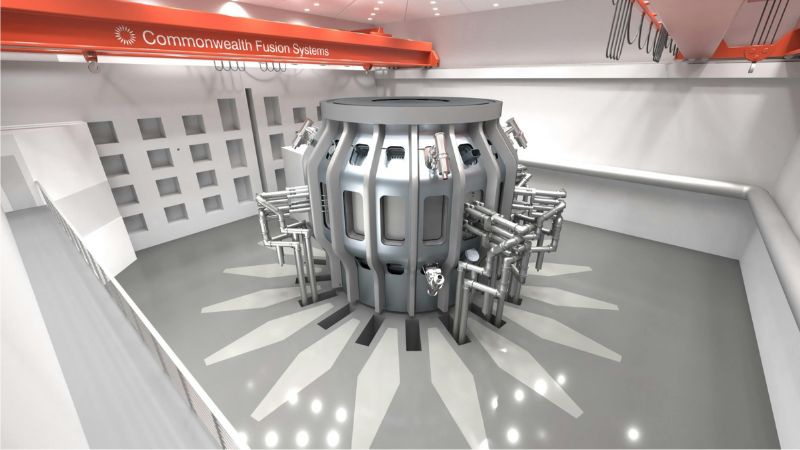
Concept of SPARC, a compact fusion device intended for commercial development. Image used courtesy of Commonwealth Fusion Systems
While acknowledging the remaining scientific and engineering challenges, the DOE and White House are optimistic that recent technical achievements across public and private fusion initiatives, combined with strategic investments and public-private partnerships, can bring fusion energy closer to reality. They wish to demonstrate a pilot plant by around 2030.
Facing Fusion Challenges
Achieving a grid-ready commercial fusion reactor may take longer, potentially until the 2040s, due to the immense technological hurdles involved. However, the consensus seems that the DOE's bold vision and funding initiatives are crucial to realizing the promise of fusion energy in the coming decades. Many believe the capital and operating costs would need to be greatly reduced compared to current experimental fusion reactor costs for fusion to become a commercially viable energy source. Overcoming the remaining scientific and engineering hurdles to enable such cost reductions remains a formidable challenge for public and private fusion initiatives.
While these challenges remain, initiatives are bringing commercial fusion energy closer to reality by demonstrating the core physics, developing key technologies, and validating design approaches for future pilot plants and reactors.