Facebook
 Google
 GitHub
 Linkedin
How Can 3D Digital Twins Make Nuclear Reactors Safer?
Researchers are leveraging new mathematical techniques and thermal models to make a commercially viable and safe nuclear microreactor.
Microreactors combat climate change by providing a clean energy alternative. They are compact, portable versions of traditional nuclear reactors designed to provide power in remote or decentralized regions. These small-scale reactors can generate up to 20 MW of electricity, adequate for powering small communities, military bases, or industries in isolated areas. They use advanced nuclear technologies to enhance efficiency, like high-assay low-enriched uranium (HALEU) fuel and innovative cooling systems.
Nuclear microreactors have significant potential benefits. Their compactness and modularity allow for scalability and flexibility in deployment. Moreover, they produce minimal greenhouse gases during operation, contributing to a reduction in carbon footprint.
Besides these advantages, microreactors face feasibility and viability challenges. Safety is a primary concern, given nuclear energy’s risks and potential accidents while handling radioactive materials. Other concerns relate to high initial costs and regulatory hurdles.
University of Michigan researchers have created a real-time 3D temperature map of a nuclear microreactor’s interior. The digital twin uses advanced sensors and data analysis to monitor potential problems and predict maintenance before issues become critical. The researchers’ plan could enhance microreactors’ safety and commercial viability.
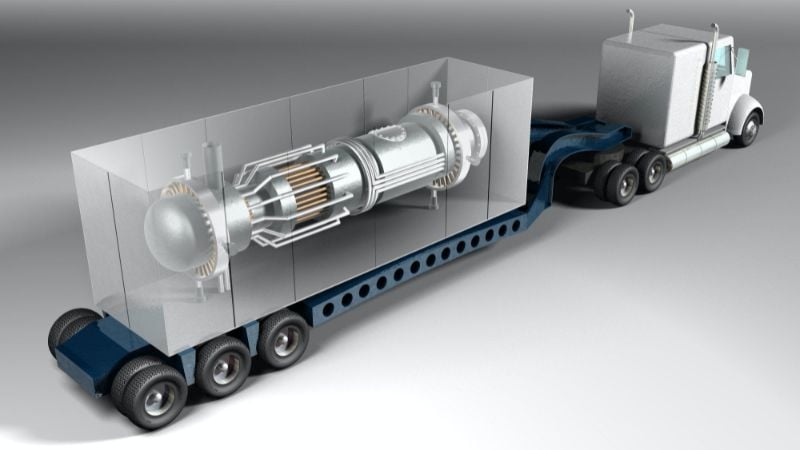
Microreactor. Image used courtesy of Idaho National Laboratory
3D Reconstruction
University of Michigan researchers aim to create a high-resolution 3D reconstruction of temperature distributions inside a heat-pipe nuclear microreactor to track aspects like material degradation, doppler feedback, and heat-pipe performance. They achieve this by using the lowest number of sensors at crucial locations and estimating temperature in areas not directly measured.
These sparse methods involve strategically placing a limited number of sensors at key locations within the reactor to reduce computational complexity and the amount of sensor data to be processed to maintain accuracy. The sensors are positioned based on prior knowledge of the reactor's thermal behavior, such as areas expected to experience significant temperature variations. In addition, interpolation methods like generalized basis functions estimate temperatures at unmeasured locations. These functions consider the spatial correlation between measured points to predict temperatures at intermediate points.

Microreactor design. Image used courtesy of Price, et al.
One potential method to achieve high-resolution reconstruction is compressed sensing. This non-parametric technique does not need any system state parametrization. Instead, it constructs a set of linear equations based on a weighted set of basis functions closely matching the measurements. Researchers believe this method could work in real-time with a reactor, but several factors must be considered. For example, the assumption that the target distribution is a linear summation of a few basis distributions can be challenging to meet in practice. If the actual distribution deviates from the model, it can impact the reconstruction accuracy and effectiveness. On the other hand, the distribution must be computationally efficient to ensure that the reconstruction can keep up with the data acquisition rate.
Published in Applied Mathematical Modelling, Michigan University researchers evaluated the non-parametric interpolation methods, like compressed sensing, using generalized basis functions. They tested these methods with physical processes such as nuclear reactions, thermodynamics, and fluid dynamics. Moreover, they leveraged high-fidelity multiphysics simulations to generate microreactor temperature distributions, which were then used to evaluate the set of basis functions. However, the approaches could not fully capture the fundamental heat transfer behavior in the reactor system.
The researchers plan to address these shortcomings using basis functions specifically created from precalculated temperature distributions for that microreactor. They believe this optimization can enhance reconstruction accuracy and make digital twin monitoring systems possible for remote operations where computation abilities are limited.