Facebook
 Google
 GitHub
 Linkedin
Solar Research Tackles Perovskite, Organic PVs, and Dust
Three separate studies advance molecular tuning for perovskites, crystallization control in organic PVs, and sensorless dust monitoring.
While silicon solar cells have long dominated the photovoltaic space, a trio of recent studies underscores how both materials innovation and system-level intelligence are reshaping the possibilities for next-generation solar deployment. These developments sketch a roadmap toward lighter, smarter, and more efficient solar systems, both in the lab and in the field.
Researchers continue to probe the fine-tuned physics and overlooked operational frictions that influence real-world PV performance with breakthroughs in an inverted perovskite device engineering, crystallization dynamics in organic cells, and a way to detect dust using only existing inverter data.
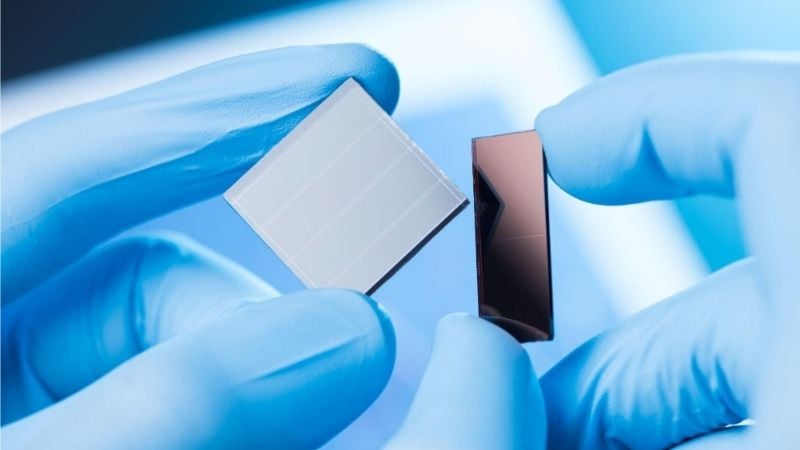
Research can improve solar cells’ performance. Image used courtesy of Adobe Stock
Molecular Design Boosts Inverted Perovskite Efficiency
At the device level, researchers in China and Switzerland propose a molecular engineering strategy that enhances the performance of inverted perovskite solar cells, a variant known for its potential compatibility with tandem stacks and flexible substrates.
Rather than focusing solely on the bulk perovskite layer, the team engineered an organic molecule that modifies the hole transport layer (HTL), improving interfacial contact and energy level alignment at the anode side. This molecule, integrated into the HTL’s polymer chain, features a rigid backbone and tailored electronic properties that suppress recombination and reduce voltage losses.
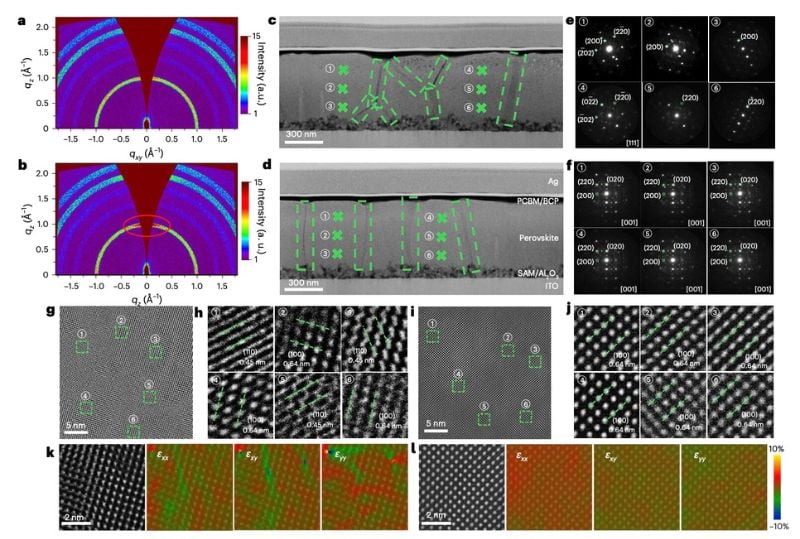
Perovskite crystal structure and orientation. Image used courtesy of Zhou et al.
After optimizing the molecular structure and its self-assembled morphology, the group reported a certified power conversion efficiency of 24.3%, representing one of the highest to date for inverted configurations. Importantly, the devices showed improved operational stability, a key challenge for perovskite adoption.
While the exact molecule and device architecture remain proprietary in the preprint, the broader strategy suggests a growing convergence between materials science and interface engineering, particularly for perovskite cells, where interfacial losses often dictate practical efficiency ceilings.
Two-Step Crystallization Enables 21% Organic PVs
A separate study tackled another long-standing challenge in organic solar cells (OSCs): achieving highly ordered molecular packing while maintaining favorable phase separation between donor and acceptor materials.
The team implemented a two-step crystallization process that first induces a partial crystallization of one component, followed by controlled solvent evaporation to drive co-crystallization. This approach enabled tighter domain control and more efficient exciton dissociation, leading to a record PCE of 21% in non-fullerene organic solar cells.
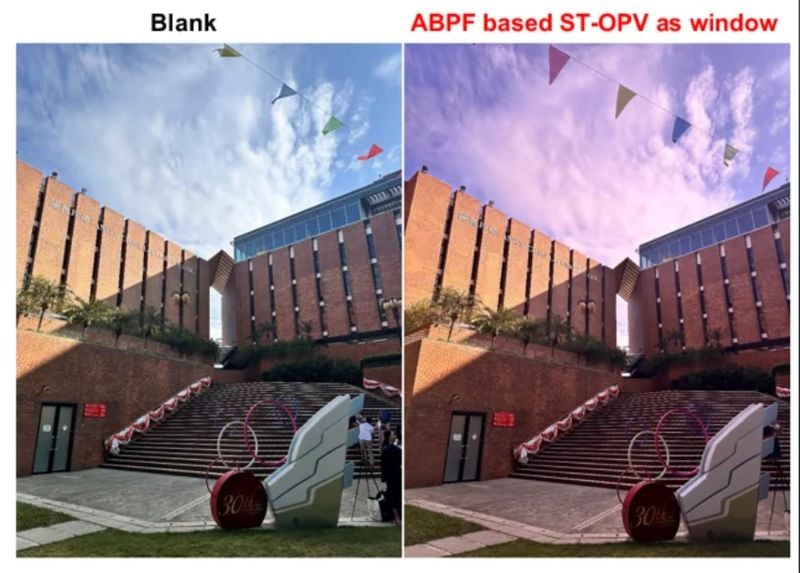
Transparent organic solar cells achieved a record light utilization efficiency of 6.05%. Image used courtesy of Yu et al.
But beyond sheer efficiency, the researchers also fabricated transparent organic devices, achieving a light utilization efficiency of 6.05%, a crucial metric for applications like solar windows or integrated building photovoltaics, where power output must balance with visible light transmission.
These findings reinforce OSCs’ unique value proposition of being mechanically flexible, semi-transparent, and fabricated with low-temperature processes that are potentially compatible with roll-to-roll manufacturing.
As silicon continues to push its asymptotic limits, these molecularly engineered organic systems offer new form factors and deployment scenarios, even if their long-term stability and scalability still trail traditional cells.
Leveraging Inverters for Rooftop PV Maintenance
Shifting from the materials frontier to real-world operations, a third study focuses on dust accumulation, a more practical yet often under-monitored factor in PV performance. While soiling is known to degrade output over time, especially in dry or industrial regions, most systems lack any active dust monitoring capability due to the cost and complexity of external sensors.
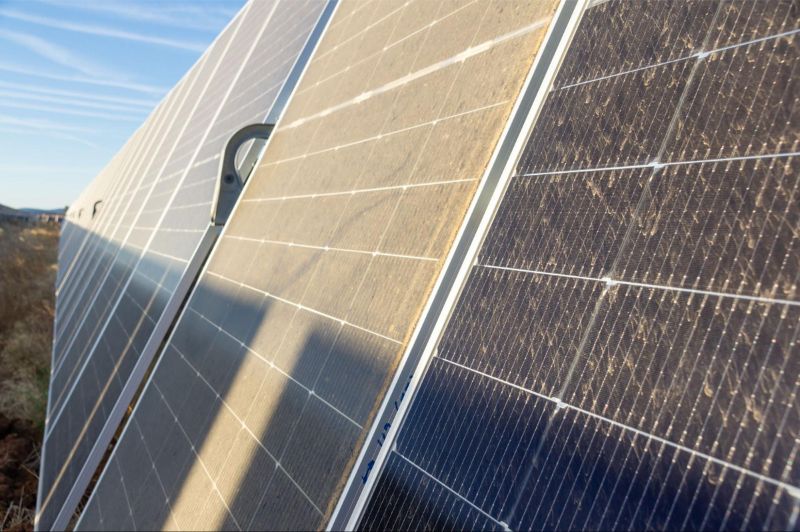
Dusty solar panels are common in solar farms. Image used courtesy of Adobe Stock
Researchers in China have developed a model-free dust detection method that uses only data from existing PV inverters. By analyzing electrical signatures, specifically the relationship between inverter output and irradiance patterns, the system can infer localized dust buildup with reported accuracy above 96%, without requiring meteorological input or physical sensors.
The algorithm works by tracking divergence in expected versus actual power curves, using short-term trends and inverter operating data to isolate soiling effects from shading or degradation. Because it runs locally on the inverter and does not rely on connectivity, it offers a low-cost retrofit pathway for legacy rooftop systems or off-grid arrays.
For solar asset owners, this could represent a potentially zero-CAPEX pathway to proactive operations and maintenance, shifting from fixed cleaning schedules to on-demand interventions based on real performance metrics.