Facebook
 Google
 GitHub
 Linkedin
Solar in Space: Organic PV Cells Hold Up
The carbon-based solar cells are less susceptible to damaging radiation in space.
High-energy protons from the sun are considered the most damaging particles in space for electronic materials. Among the devices most susceptible are photovoltaic (PV) solar cells that produce the electricity to power a satellite or spacecraft.
The International Space Center’s solar arrays. Video used courtesy of NASA
On Earth, silicon-based PV cells with efficiencies as high as 24% are commonly used, but for space applications, gallium arsenide (GaAs) PV cells, with efficiencies of around 27%, are preferred due to their resistance to proton damage. GaAs cells are heavy, inflexible, and expensive.
However, a new kind of thin, flexible, and lightweight carbon-based organic PV solar cells could outperform traditional solar cells, according to a study by the University of Michigan. In testing, organic PV cells have shown no drop in performance after up to three years of continuous exposure to proton particle radiation.
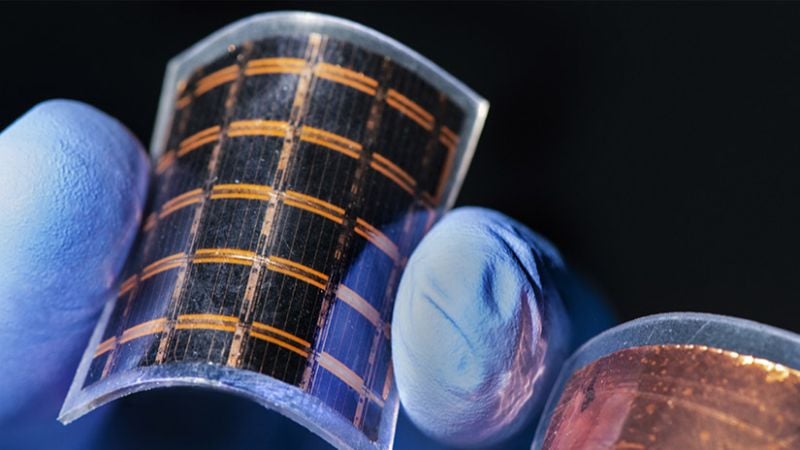
Organic solar cell with gallium arsenide. Image used courtesy of National Renewable Energy Laboratory/Dennis Schroeder
Organic Solar Cells
Organic photovoltaic (OPV) cells use carbon-based materials to convert sunlight into electricity. Unlike traditional silicon-based solar cells, organic solar cells employ organic semiconductors, either polymers or small molecules, to create a flexible, lightweight, and thin-film structure.
The organic solar cell’s structure typically includes an active layer made from organic semiconductor materials, two electrodes (an anode and cathode), a buffer layer to facilitate electron transfer, and a protective outer layer. Sandwiched between the electrodes is the active layer, which can be made of indium tin oxide for the anode and metals like aluminum or silver for the cathode.

OPV structure. Image used courtesy of NREL
An organic semiconductor absorbs sunlight, exciting electrons and creating electron-hole pairs (excitons). An electric field within the cell separates the electron-hole pairs, and the separated electrons and holes move toward their respective electrodes. This movement of charges creates an electric current that can be harnessed as electricity.
The organic solar cell’s thin-film structure allows for installation on various surfaces, including curved and irregular shapes. The cells can be manufactured using low-cost printing techniques like the roll-to-roll method. They can be integrated into a wide range of applications, from portable devices to building-integrated photovoltaics. They also use materials with low toxicity and have a reduced environmental impact compared to silicon-based solar cells.
As of 2024, organic solar cells reached certified efficiencies exceeding 19.2 percent. While this is lower than some other photovoltaic technologies, ongoing research and development in the field continue to improve their performance and potential applications.
Why Organic Solar Cells Resist Damage
Researchers at the Michigan Center for Materials Characterization focused their research on the causes at a molecular level of solar cell degradation after exposure to proton radiation.
The team found that the protons impact the molecules within the solar cell and break some of the alkyl side chains that extend from the organic molecule, leaving what they call an “electron trap.” An electron trap in a solar panel is a defect or imperfection within the semiconductor material that restricts the movement of electrons, negatively impacting the panel's performance. By grabbing onto electrons that have been freed by light hitting the cell, the electrons are prevented from flowing to the electrodes, reducing the amount of electric current that can flow.
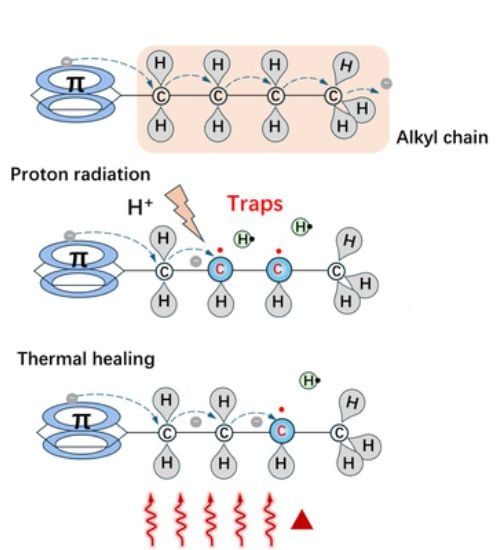
How heat affects electron traps. Image used courtesy of University of Michigan
Researchers are exploring various methods to address electron traps in organic solar cells, including healing by thermal annealing or heating the solar cell. The researchers found that when exposed to temperatures of about 100°C (212°F), the damage can be healed and the electron traps eliminated. It might also be possible to fill the electron traps with other atoms, allowing the electrons to continue flowing between the electrodes.
The susceptibility to electron traps can vary depending on the specific materials and architectures used in GaAs and organic solar cells. However, the current research trend indicates that certain organic solar cells may offer superior resistance to radiation-induced electron traps compared to GaAs cells, particularly for space applications.
With growing interest in space-based solar farms that beam electric power back to Earth, the need for solar cells impervious to proton radiation is growing. Flexible and lightweight organic PV solar cells might provide the best solution.