
 Facebook
 Google
 GitHub
 Linkedin
Hitachi Energy Commits to Flying Taxi Energy Solutions
The company has partnered with Eve Air Mobility to provide ground power infrastructure for its eVTOL aircraft.
When flying taxi technology takes off, it will need more than a long-range battery. In commercial operations, electric vertical takeoff and landing (eVTOL) aircraft will need charging infrastructure that integrates into the local power grid.
Hitachi Energy and Eve Air Mobility are planning for that future. The companies have signed a Memorandum of Understanding (MOU) to advance electrical infrastructure for urban air mobility networks. The partnership will focus on grid integration and eVTOL-specialized charging systems.

The Eve eVTOL. Image used courtesy of Eve Energy
Vertiport Grid Integration Requirements
Urban air mobility relies on vertiports, dedicated landing sites. These facilities demand high power capacity to support continuous flight operations and fast-charging cycles. Vertiports must draw substantial electricity without causing grid instability.
Local utilities must ensure adequate feeder capacity at proposed vertiport locations. Unmanaged charging spikes can cause localized voltage drops and equipment overheating.
Vertiports require specialized substations to manage large-scale power conversion from medium-voltage distribution lines. Integrating sudden power spikes into existing distribution systems requires dynamic load controls.
Local utilities can use several strategies to mitigate grid problems and equipment overheating. They can install specialized substations to manage large-scale power conversion from medium-voltage distribution lines, and deploy digital energy monitoring systems and dynamic load controls to balance power delivery between local storage units and incoming utility lines.
Dedicated High-Power Charging Systems
Under the MOU, Hitachi Energy will adapt its Grid-eMotion charging infrastructure for electric vertical takeoff and landing applications. Grid-eMotion technology is deployed globally for heavy-duty electric bus and commercial fleet operations. The charging systems feature high-power conversion modules to minimize aircraft downtime on vertiport ramps.
Learn how Hitachi Energy’s technology can benefit eVTOLs. Image used courtesy of Hitachi Energy
Advanced power electronics control current delivery while maintaining strict thermal limits. The equipment can provide continuous direct current power during the eVTOL’s intensive charging cycles. The modular system design allows operators to expand charging capacity as flight frequency increases.
To safeguard power quality, Integrated control systems prevent harmonics from entering the main grid. Digital monitoring tools evaluate real-time charger health and coordinate energy distribution across multiple aircraft bays.
Eve’s eVTOL
Eve uses a "Lift + Cruise" design that relies on eight fixed vertical rotors for takeoff and landing alongside a dedicated rear pusher propeller for forward flight. Powered by dual electric motors for built-in propulsion redundancy, the aircraft utilizes conventional fixed wings to generate lift while cruising at low urban noise levels.
The eVTOL features a human-centric cabin built for high-frequency transit, launching with a four-passenger and one-pilot configuration designed to hold standard carry-on luggage or wheelchairs, with a planned future transition to a six-passenger fully autonomous layout. Eve supports its hardware with a proprietary Urban Air Traffic Management software platform to coordinate low-altitude airspace operations and integrate with ground charging infrastructure.
The eVTOL uses aviation-grade lithium-ion battery packs with high power density and rapid thermal recovery. They deliver a 60-mile (100 km) operational flight range on a single charge. This distance covers about 99% of standard urban mobility routes, such as transfers to airport hubs. The reserve energy meets FAA and EASA aviation safety mandates.
Lifecycle Energy Storage Applications
The companies are evaluating second-life batteries from retired aircraft battery systems. These flight batteries are decommissioned when energy density falls below aviation operating standards. However, the battery packs retain sufficient capacity for stationary ground energy storage applications.
Repurposed battery packs can store surplus grid power during periods of low electricity demand. During peak flight schedules, these stationary storage systems can discharge stored power directly into charging stations.
This setup reduces direct electricity draws from municipal power lines during high-tariff periods. Ground storage mitigates localized utility grid overload without requiring costly line upgrades. This circular lifecycle usage also extends total equipment value and reduces raw material waste across the transportation sector.
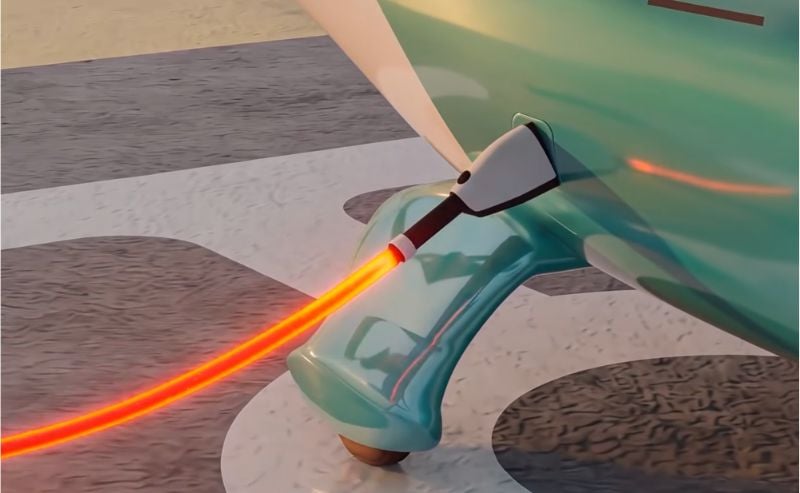
Concept of eVTOL charging. Image used courtesy of Hitachi Energy
Joint Commercial Scaling Strategy
The Hitachi Energy-Eve agreement establishes framework rules for joint business modeling and coordinated customer engagement. The companies will work together to present integrated infrastructure options to municipal authorities and vertiport operators. This coordinated planning ensures vertiports receive appropriate power connection before aircraft delivery.
Global scaling requires standardized electrical interfaces and shared operational protocols. Eve Air Mobility brings backing from Embraer and its 56-year history in aerospace manufacturing. The aircraft developer holds non-binding letters of intent for approximately 2,700 electric aircraft from global customers.
Eve targets aircraft certification and commercial entry into service by 2028.












Thanks for sharing this detailed article. The technology behind eVTOL aircraft is impressive, but I think the biggest challenge will be building a reliable power infrastructure to support large-scale operations. Fast charging, grid stability, and energy storage all need to work together for this concept to succeed. I also like the idea of reusing retired aircraft batteries for stationary energy storage because it can reduce waste and improve energy efficiency. It will be interesting to see how cities prepare their electrical networks before flying taxis become part of everyday transportation. Looking forward to seeing how this partnership develops over the next few years.