Facebook
 Google
 GitHub
 Linkedin
Research Pushes Perovskite and Solar to New Levels
Recent advancements aim to improve efficiency in harvesting renewable energy and achieving power grid resilience.
Recent advancements aim to improve efficiency in harvesting renewable energy and achieving power grid resilience.
Renewable energy places new demands on power grid stability and adaptability. As solar, wind, and battery storage gain traction, utilities must integrate these intermittent energy sources while ensuring reliability under shifting loads and unpredictable disruptions. Meanwhile, the digitization of energy infrastructure has increased cybersecurity concerns, making resilience a top priority.
Learn about research on perovskite and solar energy. Video used courtesy of Georgia Tech University
A series of research developments in solar cell technology and renewables in the modern grid are aimed at improving efficiency and reducing material costs.
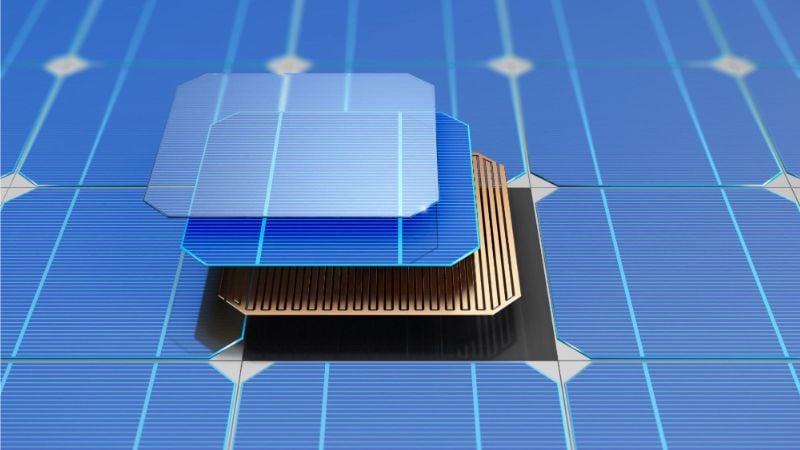
Solar cells. Image used courtesy of Adobe Stock
Grid-Edge Devices for Grid Stability
Exposing power grids to the internet has created inherent vulnerabilities to cyber attacks, and harsh weather events have increased stability risks. These facts have driven MIT researchers to develop a new framework for grid resilience.
The EUREICA (Efficient, Ultra-REsilient, IoT-Coordinated Assets) system establishes a local electricity market by leveraging distributed, grid-edge IoT devices, such as residential solar panels, batteries, electric vehicle chargers, and smart thermostats, to dynamically stabilize power networks. EUREICA utilizes an algorithm that, when detecting grid compromise, evaluates and selects trustworthy devices to determine the optimal mix of power injection and load reduction necessary to restore balance.
In simulations where power losses ranged from 5% to 40%, the algorithm successfully reestablished grid stability. The system’s architecture supports real-time wireless communication among assets and incorporates compensation mechanisms to incentivize local participation. Robust security protocols and scalable design also allow EUREICA to provide quantifiable performance metrics to help operators meet operational and regulatory demands.
Resilient Perovskite Solar Technology
Perovskite solar cells have lower production costs, more lightweight structures, and higher efficiency than silicon cells. However, their commercial viability has been hindered by poor durability caused by iodine leakage, which degrades the material over time.
University of Surrey researchers, with the National Physical Laboratory and the University of Sheffield, have recently developed a method to enhance the lifespan of perovskite cells by embedding alumina (Al₂O₃) nanoparticles into the perovskite layer. This technique promotes a more uniform crystal structure, minimizes defects, and improves electrical conductivity.
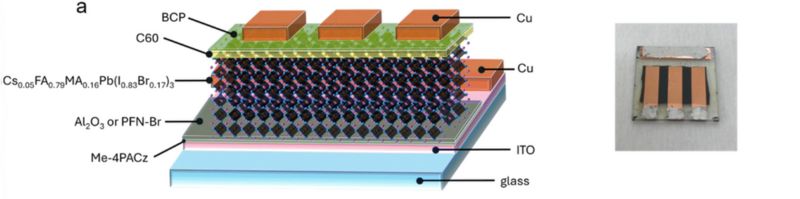
Al2O3 added to a perovskite solar cell. Image used courtesy of Perera et al
Under extreme heat and humidity conditions, the modified cells maintained high performance for over 1,530 hours, which is nearly 10 times longer than unmodified cells, which lasted only 160 hours. These quantifiable improvements in durability were achieved under simulated real-world conditions.
Stable Silicon-less Solar Cells
Georgia Tech University’s School of Materials Science and Engineering developed a stabilization technique based on vapor-phase infiltration. In this technique, the perovskite layer, sandwiched between positive and negative electrodes, is exposed to titanium gas under a light vacuum before the top electrode is applied. This process embeds titanium into the top layer to reinforce the structure and markedly improve its resilience to high temperatures and other environmental stressors.
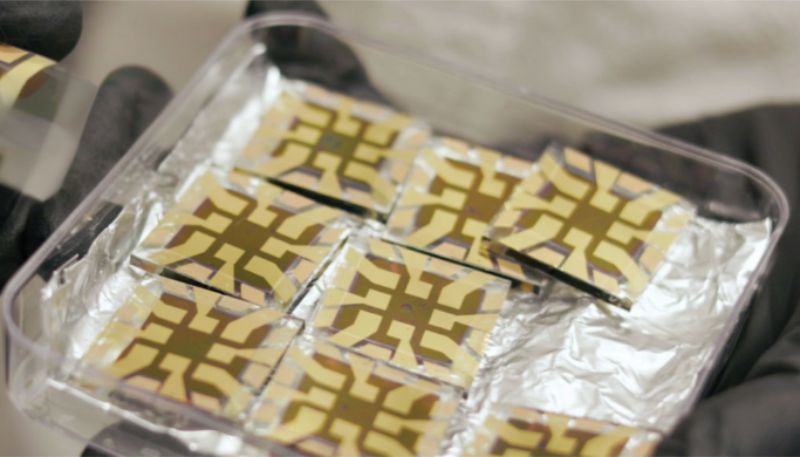
No-silicon solar panel research. Image used courtesy of Georgia Tech University
Quantitative tests indicate that this modification prolongs the operational life of perovskite cells. The enhanced architecture mitigates degradation and preserves the high efficiency of perovskite materials.
A Resilient Future
As the world’s power infrastructure changes, advances such as intelligent, distributed assets and new materials in renewable generation become necessary. Researchers are working on promising research showing improvements in cost, efficiency, and grid resiliency. The next phase of development will likely focus on scaling these solutions for real-world applications, and the widespread availability of these technologies will depend on further validation, manufacturing scalability, and regulatory approvals.