Facebook
 Google
 GitHub
 Linkedin
Wind for Solar: Device Cleans Solar Panels Autonomously
Korean scientists pioneer an innovative technique leveraging wind power to enhance solar energy efficiency.
Dust and other contaminants accumulating on solar panel surfaces can compromise efficiency. The challenge lies in maintaining optimal performance over time, as dirt buildup reduces sunlight absorption, decreasing energy production. Regular cleaning is necessary to mitigate these effects, but it can be labor-intensive and costly, especially for large-scale solar installations.
South Korean researchers have created a device to improve solar power generation by preventing dust and other pollutants from settling on the panels.

Clean and dirty solar panels. Image used courtesy of Adobe Stock
Solar Panel Efficiency
Solar panels offer cost-effective, carbon-free energy by converting sunlight into electricity. Their efficiency hinges on the photovoltaic (PV) cell quality, which determines the percentage of solar energy converted into usable power. Recent advancements have pushed average efficiency from 15% to around 20%, with high-efficiency panels reaching nearly 23%.
However, real-world factors like the solar cell's temperature, sun irradiance level, weather conditions, and panel cleanliness affect performance.
When dust accumulates on the panel surface, it creates a barrier blocking sunlight from reaching the PV cells, reducing the amount of energy generated. Similarly, contaminants such as bird droppings, pollen, and debris can further obstruct sunlight and diminish panel performance. Regular maintenance and cleaning maximize solar panel energy production.
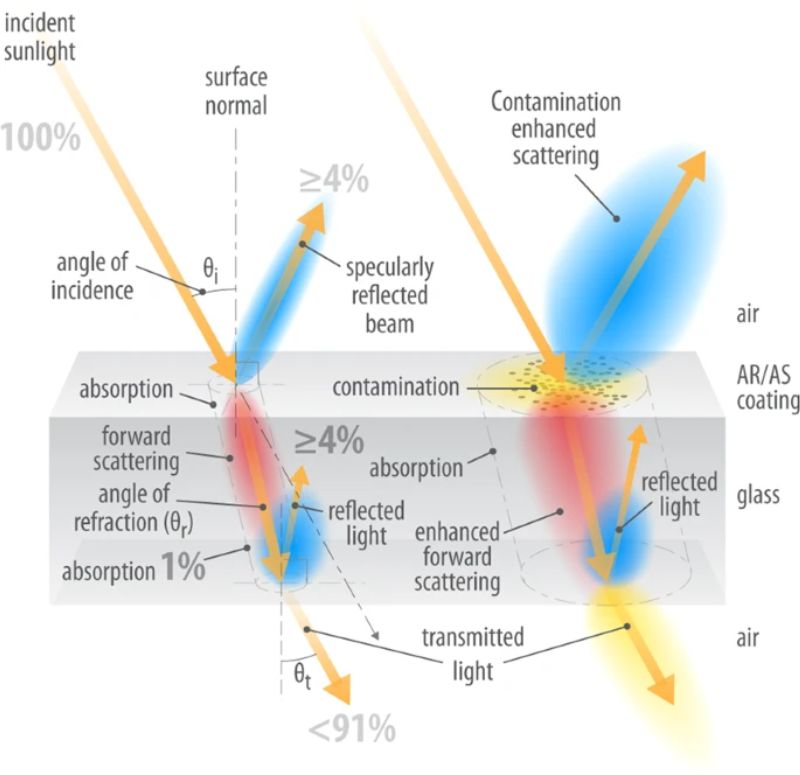
Effects of contaminants on solar panel surface. Image used courtesy of Nature (Al Hicks/NREL)
Unfortunately, performing maintenance becomes notably challenging in desert regions and remote installations. Furthermore, routine cleaning can incur high costs, pose logistical challenges, and, depending on the installation location, present safety risks.
Automating the cleaning process could address these issues.
Wind-Powered Solar Panels
A research team at Daegu Gyeongbuk Institute of Science and Technology (DGIST), South Korea, has introduced a solution for enhancing solar power generation by maintaining clean panels. The team developed a self-cleaning device that harnesses wind power to maintain solar panel cleanliness autonomously.
The team’s device combines a wind-powered energy harvesting system with an electrodynamic screen (EDS), which removes contaminants through high-voltage electric fields that repel the dust particles from the panel. Previously, EDS required a separate electric supply to generate high-voltage electric fields. The DGIST solution, on the other hand, incorporates a triboelectric nanogenerator (TENG) to generate electricity from wind friction, producing up to 2,300 volts by rotating the rotor depending on wind speed.
Using the TENG-based EDS method, the solar cell could autonomously clean dust and contaminants from a cell, restoring solar cell efficiency by at least 90% after cleaning. The team also discovered a direct relationship between TENG power output and solar panel performance, indicating that stronger cleaning led to greater power absorption.
From Dust to Dawn
The DGIST research presents a necessary solution for renewable energy. By using one renewable energy source to boost another, the team’s novel and elegant solution can help achieve greater PV efficiency, decrease intermittency, and accelerate the transition to a cleaner, greener energy landscape.