Facebook
 Google
 GitHub
 Linkedin
SunZia: Largest Wind Farm in U.S. Comes Online in New Mexico
With a whopping 3,650 MW of wind generation capacity, the SunZia wind farm in New Mexico becomes the largest renewable energy project in U.S. history
In 2025, the combined generation of electricity from wind power and utility-scale solar accounted for 17% of net U.S. generation, totaling 760,000 GWh. SunZia, the largest renewable energy project in the U.S., will significantly boost that percentage.
The Pattern Energy Group project in New Mexico, where wind energy is abundant, comprises 916 turbines with a total generating capacity of 3,650 MW during the summer months. SunZia’s capacity rivals that of the next two largest wind farms, Alta Wind in California (1,098 MW) and Great Plains in Texas (1,027 MW).
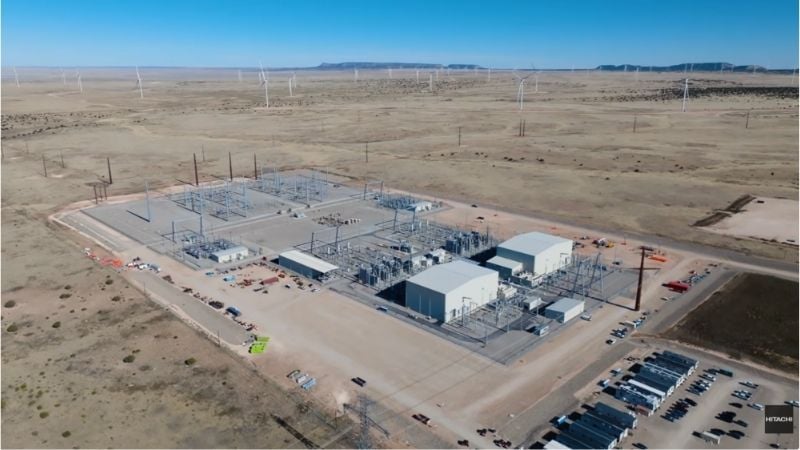
SunZia energy infrastructure and wind turbines. Image used courtesy of Hitachi Energy
Transmission and Power
The power generated at SunZia will feed the grids in Arizona and the Western U.S., providing electricity for about 3 million people. A key component of the project is its 550-mile high-voltage direct current (HVDC) transmission line, one of the largest in the country.
Developed by Hitachi Energy, the system uses converter stations at each end to convert electricity for long-distance transmission and then back to alternating current for delivery to the grid. This allows 3,000 MW of electricity to travel hundreds of miles with minimal energy loss.
The large-scale transmission system supports the growing energy needs in the Western U.S. while increasing grid resilience and reliability. SunZia’s size and scale increase the reliability of renewable energy supply in areas of high demand.
The transmission line is a ±525 kV bipolar HVDC link, making it the largest voltage-source (VSC), converter-based HVDC installation in the U.S. and among the largest globally. The VSC system uses advanced power electronics to control voltage and power flow. It will also help balance the “duck curve” phenomenon, which occurs when renewable energy generation drops in the evening but demand remains high.
Learn more about the HVDC transmission system. Video used courtesy of Hitachi Energy
With the SunZia Wind Project fully operational, New Mexico’s installed wind capacity has nearly doubled from 3,997 MW to 7,647 MW. Wind now accounts for 45 percent of the state’s generating capacity, with solar and natural gas each accounting for 19 percent of the state’s capacity mix.
A Community Win
One unfortunate side effect of large-scale renewable energy projects can be the significant impacts on the land and surrounding communities. Pattern Energy stated it sought to reduce those impacts by engaging local stakeholders throughout the planning and development of the SunZia project. The company plans to continue its engagement.
According to Pattern Energy’s Commitment to Local Communities and Environmental Stewardship document, key initiatives included incorporating feedback from local communities, minimizing FAA lighting on transmission towers to support dark sky efforts, and supporting conservation organizations in the Middle Rio Grande Valley.
Pattern also worked with conservation groups and wildlife experts to reduce environmental impacts. The company protected 1,000 acres along the Rio Grande for conservation, restored thousands of acres of wildlife habitat in Arizona, tested UV-illuminated transmission lines to make them more visible to birds, and funded research on sandhill crane flight behavior and declining upland bird populations to help inform future transmission line design and habitat conservation.
With the project now operational, Pattern Energy says the facility will invest more than $20 billion into surrounding New Mexico and Arizona communities. That includes approximately $1.3 billion in payments to local governments, schools, counties, and private landowners. The company has also secured long-term power purchase agreements with multiple utilities and public institutions, ensuring the project's electricity will be delivered to customers as generation comes online.