Facebook
 Google
 GitHub
 Linkedin
Maximizing Solar: Strategies for System Design and Efficiency
This article demonstrates how to capitalize on and maximize the efficiency of solar energy systems.
Renewable energy is becoming increasingly popular and even replacing other sources. Solar power is increasing from commercial to residential use, but just installing these systems will not maximize efficient energy production. Energy output must be maximized, and system design is vital.
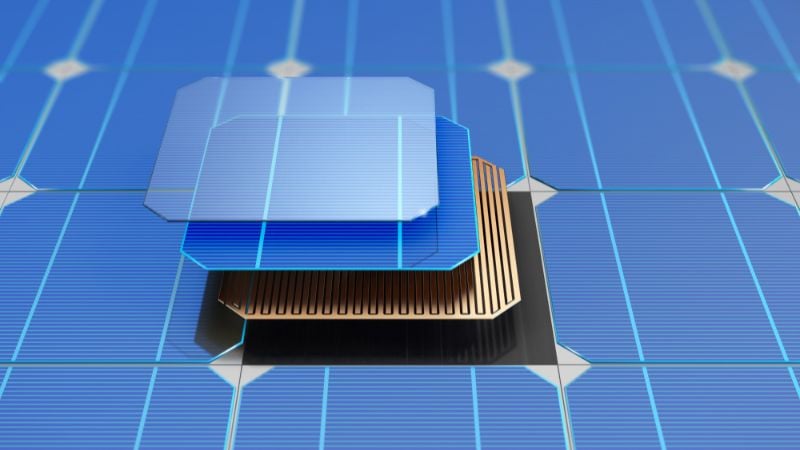
Image used courtesy of Adobe Stock
Solar Energy Systems Overview
Solar energy systems are designed to convert radiation from the sun to electricity, consisting of a solar panel, rechargeable batteries, and inverters. A solar panel has photovoltaic (PV) cells made of silicon as a semiconducting material that converts the sun’s radiation into electrical energy. This panel is mounted on rooftops or raised structures to receive enough sunlight. The sun’s energy is converted to a direct current (DC), which an inverter system later converts to alternating current (AC). Batteries store the absorbed energy.

Figure 1. A solar energy system's components include an inverter, charge controller, solar panel, and battery. Image used courtesy of Bob Odhiambo
System Design for Maximum Efficiency
The system design is vital when ensuring maximum efficiency for solar energy systems. Some crucial planning techniques are used for optimal energy production, and considerations include the following.
Solar Panel Sizing
Sizing the solar panel array is vital for maximum efficiency in the system design process. Careful calculations must be made to ensure the array meets the application demands while utilizing the available space and reducing system losses.
The first consideration in sizing solar panel arrays is determining energy demand. This demand is provided in kilowatt-hours (kWh) and assumes the wattage and usage time to analyze the energy consumption patterns.
The kWh calculation involves multiplying the wattage by the hours it’s used per day and summing up the results for all appliances.
For example, consider a refrigerator with a 200-watt power rating that works continuously for 24 hours daily. The energy consumption of the device is expressed as:
$$200~\text{w}\times24\text~{hr}=4800~\text{Wh}$$
4,800 Wh can be converted to kWh by dividing it by 1,000, resulting in 4.8 kWh. A similar approach can be used for other appliances.
After determining the energy demand, the peak sun hours and the efficiency of the solar panel must be evaluated. This peak sun hour is when the sun's intensity is at its peak. The solar converted into electrical energy is called solar panel efficiency.
To calculate the power efficiency of the solar panel:
$$\text{Solar panel efficiency} = \frac {\text{Usable energy output}}{\text{Total solar power input}}\times100$$
The electricity the solar panel generates is the usable power output, while the total solar power input is the power received from the sun by the panel.
With the use of these values, the solar panel array can be calculated by:
$$\text{Solar panel capacity}=\frac {\text{Energy demand}}{\text{Peak sun hours}\times\text{Solar panel efficiency}}$$
Example calculation: A solar panel receiving 1000 W/m2 of solar irradiance with an area of 1 m2. Calculate the total solar power input and the solar panel efficiency if the usable power is 800 watts.
$$\text{Total solar power input} = (1\times1000) = 1000~ \text{watts}$$
To calculate the solar panel’s efficiency, substitute the usable power output and the total solar power input into the formula:
$$\text{Solar panel efficiency}= \frac{\text{Usable energy output}}{\text{Total solar power input}} \times 100$$
$$\text{Solar panel efficiency}= \frac{800}{1000} \times 100$$
$$\text{Solar panel efficiency}=80\%$$
In this solar panel, only 80% of the solar energy is converted to usable electricity.
Solar Panel Orientation
Solar panel orientation is vital to consider when maximizing the panel's efficiency. The ideal orientation can be adjusted depending on the installation site’s latitude and season.
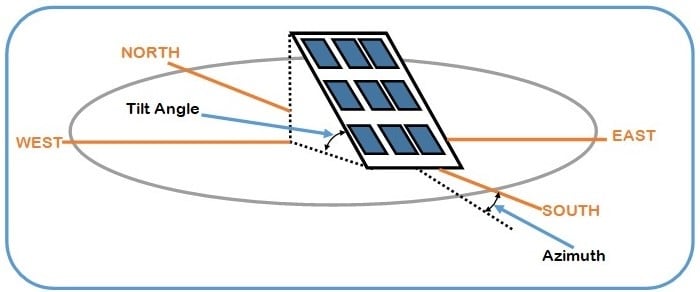
Figure 2. The solar panel’s tilt angle and azimuth are used to maximize panel efficiency. Image used courtesy of Bob Odhiambo
Azimuth is the angular measurement of the orientation of solar installation about the true north. It is vital to consider this angle as it determines the level of sunlight received during the day. The tilt is the angle of panel installation relative to the ground.
To calculate the optimal tilt angle:
$$\text{Tilt angle}=\text{Latitude}+ \left( 0.4\times Average~ daily~ declination \right)$$
This declination angle changes throughout the year due to the elliptical pattern of the Earth’s orbit of the sun and tilt of the Earth’s axis. The average solar declination for a day can be evaluated to an approximate value using:
$$\text{Average daily solar declination}= 23.45\times \sin[\frac{(2\times\pi\times\text{Day of the year}-81)}{365}]$$
where days are counted from January 1.
Example calculation: The installation site of a solar panel has a latitude of 35 degrees on day 180 of the year. Calculate the panel’s solar average declination tilt angle in one day by using:
$$\text{Average daily solar declination}= 23.45\times \sin[\frac{\left(2\times\pi\times\left( 180-81\right)\right)}{365}]=14.68~degrees$$
$$\text{Tilt angle}=35+\left( 0.41\times14.68\right) = 40.01~\text{degrees}$$
The tilt angle should be 40.01 degrees for maximum solar efficiency.
Inverter Oversizing Factor
Inverter oversizing factor is crucial in maximizing solar energy efficiency. This is the ratio of the maximum direct current (DC) output to the maximum output of the inverter’s alternating current (AC). This oversizing of the inverter can result in an increased DC-to-AC ratio.
To evaluate the oversizing factor of an inverter in a solar energy system, an analysis of the system's characteristics and the energy produced must be done. The inverter oversizing factor can be calculated by dividing the maximum DC power output by the maximum AC power output. The maximum DC power output is the sum of power in the panel's array, which forms the panel's total rating, whereas the AC output can be obtained from the inverter's datasheet.
Example calculation: A solar panel array with a total power capacity of 10 kW has a maximum power rating of 400 W for each panel. Determine the number of panels. Assuming an inverter's maximum AC power output is 8 kW, calculate the inverter's oversizing factor.
$$\text{Number of panels}=\text{Total power capacity}\div\text{maximum power rating}$$
$$=12~\text{kW}\div400~\text{W}$$
$$=12000~ \text{W}\div400~\text{W}$$
$$=30~\text{panels}$$
The oversizing of the inverter can be calculated using:
$$\text{Inverter oversizing factor}=10~\text{Kw}\div 8~\text{Kw}=1.25$$
The inverter oversizing factor is 1.25, within the 1.1 to 1.3 range recommended for most solar panels.
Maximizing Solar Energy System Efficiency
As the demand for renewable energy keeps increasing, PV systems are becoming increasingly common in domestic and industrial setups. However, not all systems are optimized to produce more efficient maximum energy output. With this in mind, power engineers must ensure they get the most out of their PV systems by considering solar panel sizing and orientation and inverter sizing for PV efficiency and increased energy output that meets consumption demand.