Facebook
 Google
 GitHub
 Linkedin
Modern AC Electric System Blackouts Hypothesis
Growing renewable power sources—PV, WECS, EV charging—are changing the electric power system. This article investigates recent Southern European blackouts possibly caused by smart power converter transients and control circuit issues.
This article is published by EEPower as part of an exclusive digital content partnership with Bodo’s Power Systems.
Blackouts are appearing worldwide. Generally, blackouts in Europe are rare. However, recently an Iberian blackout appeared. Inhabitants from the Iberian Peninsula were surprised. It was a rare event. Life in numerous cities without electricity was unrecognizable. Traffic lights were out of order; trains stopped on their journeys across the country. Shops and supermarkets were closed in the dark. Cities without street lights become undesirable places. Mobile and internet connections were unreliable [1].
The cause for such an extraordinary event was not known. However, renewables were first to blame, but the official reason was unknown. Today, several months later, the situation is not better. Some obvious reason is still missing. It is not unknown that a similar event occurred in Southeastern Europe a few months earlier [2].
In this case, the obvious reason seems to be unknown again. Officially, that was hot; however, there were many hotter days that year. So, it seems that some reason is still hidden from the scientific community. In the meantime, the number of power converters (especially photovoltaic inverters) in the electric power system is increasing, and the same trend can be recorded in all European countries.
According to one recent hypothesis, the reason for this blackout was the synchronized action of a large number of power converters. According to the hypothesis, both single-phase and three-phase inverters could contribute to this event. Sudden changes of phase-angle or power could create a change in temporary power. Simulations could be used in order to show average temporary power.
Image used courtesy of Adobe Stock
Temporary Overload – Contribution to Fatal Event
According to the mentioned hypothesis, a temporary power demand appears in the electric power system. This occurrence has been hidden since voltages and currents are not within their boundaries.
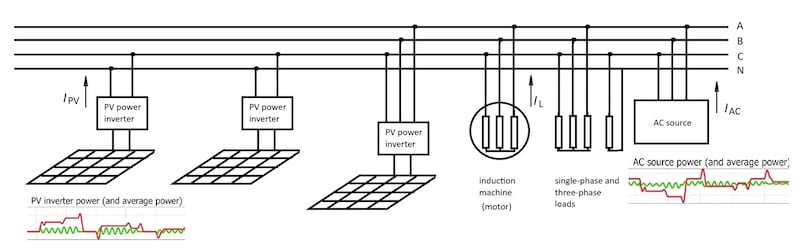
Figure 1. Simplified model of a power electric system. Image used courtesy of Bodo’s Power Systems [PDF]
Typically, single-phase and three-phase power inverters generate constant power. However, if some change in solar radiation appears, this power is not going to be constant anymore. According to simulations, power surges appear. It has been known that modern power inverters have “very good” performance. That means, they are generating a sine wave current. However, its amplitude and phase could be changed (Figure 2).
Current THD could obtain values less than THD<3%. Besides, transients are very fast, which means that the transient finishes in the same half-cycle of the sine wave electric network voltage when the disturbance appears. This means that modern power inverters could be simulated as an ideal sine wave current source (Figure 2).
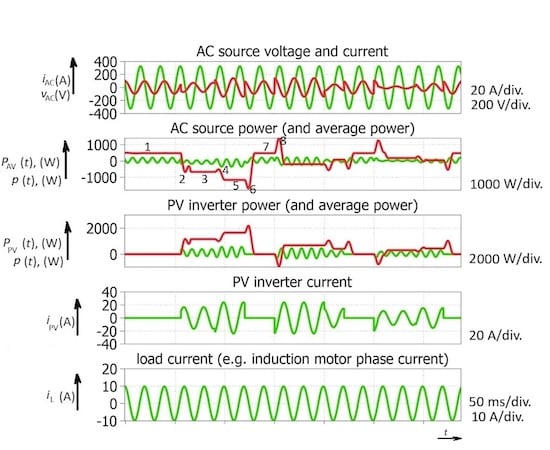
Figure 2. Simulated waveforms of single-phase voltage (vAC), AC source current (iAC), AC source temporary and temporary average power (PAV), PV inverter temporary and temporary average power (PPV), PV inverter current (iPV), and load current (iL) in the frame of a simplified power electric system model. Image used courtesy of Bodo’s Power Systems [PDF]
According to Figure 2. Several intervals could be identified with different values of power source (system) current (iAC) and power source (system) power (PAV). According to the hypothesis, intervals with increased power could be dangerous for the electric power system because additional demand for electric power appears.
- The AC power source is supplying the load with constant power (PAV=PL=500W). Power inverters are not switched ON, and their currents equal zero, iPV=0.
- One power inverter has been turned ON. Depending on its phase shift, referring to the AC power source (vAC), different power surges could appear.
- The AC power source is receiving power. That means a motor-generator could be used, or even a bidirectional power converter connected to batteries.
- AC power source current (iPV) has been increased, which results in a power surge marked with number 4.
- In a steady state, the PV inverter brings more power to the electric power system. That means the AC source would receive 1 kW compared to 500 W in interval 3.
- In one moment, solar radiation has been dramatically decreased, or the PV inverter(s) are turning OFF. In that moment, a change of temporary average power appears.
- 7. AC source power during the interval 7 equals the AC source power during the interval marked with number 1. That means the AC source is supplying the load with 500W.
- 8. After the appearance of solar radiation, or after turning on the PV inverter, a power surge appears again. In this case, an AC source with increased power could be interpreted as the power demand, which could reach the power of the entire system. That means after the 500 W load, a temporary power demand of 1000 W could appear.
This type of overload in the system could be dangerous for system stability if a large number of power converters are synchronized. Theoretically, the PV inverter is generating a sine-wave current; frequent changes in its amplitude and even phase shift make a completely different appearance (Figure 2). In case the large number of PV inverters is synchronized, an event known as “black swan” could appear.
Such an event could result in a temporary power demand that could not be supplied in real time. As a consequence, a blackout could appear [3]. It doesn’t mean that this particular event could result in mas - sive blackout, as the Iberian blackout in 2025; however, this event could give a significant contribution to the massive loss of power.
According the past experience [3] blackouts are conse - quence of series of critical events rather than one event. Change of temporary power is not appearing only in photovoltaic (PV) inverters, bidirectional power converters used as chargers for electric vehicles, or different types of power converters could be a source of the described power surges.
For this hypothesis, single-phase systems [4] are more important than the same occurrences in three-phase systems. Theoretically, this type of imbalance introduced by different phases could be compensated in a three-phase system; however, asymmetry in driver circuits could prevent such an occurrence.
So, both single-phase and three-phase PV and other (smart) inverters could be a source of overload in the electric power system. According to the hypothesis, the number of PV inverters in such an event could be larger or smaller, depending on how many devices are synchronized. It could be a few devices or even all devices in some region.
Conclusion
It has been shown that PV inverters, by their action, could produce power surges in the system. In case a large number of power inverters are synchronized (synchronized turning ON-OFF), or some atmospheric event occurs, a large amount of additional power demand could appear. This state could be described as a generation of strong currents that are not in phase with the system voltage.
According to the presented hypothesis, this event could contribute to a massive blackout, as in the recent Iberian blackout. However, final evidence that this hypothesis is correct should come from Spain in the form of a forensic series of events.
References
[1] Spain declares state of emergency as power blackout chaos continues | BBC News https://www.youtube.com/watch?v=rXKP72NdxwA
[2] Power outage hits Balkan states as heat overloads system, minister says | Reuters
[3] N. Sharma, A. Acharya, I. Jacob, S. Ya - mujala, V. Gupta, and R. Bhakar, „Major Blackouts of the Decade: Underlying Causes, Recommendations and Arising Challenges,” 2021 9th IEEE International Conference on Power Systems (ICPS), Kharagpur, India, 2021, pp. 1-6, doi: 10.1109/ICPS52420.2021.9670166.
[4] S. Sladic, M. De Santis, E. Zivic, W. Gierna - cki Smart PV Power Inverter for Emerging Solar Technologies: Case Study Perovskite Solar Cells, Smart PV Power Inverter for Emerging Solar Technologies: Case Study Perovskite Solar Cells | IEEE Conference Publication | IEEE Xplore (https://ieeexplore.ieee.org/document/11131844) Proceedings of MIPRO, IEEE Croatian section, 2-6 June, Opatija, Croatia 2025
This article originally appeared in Bodo’s Power Systems [PDF] magazine.