Facebook
 Google
 GitHub
 Linkedin
Solar Shines as Quantum Dots, Perovskite Tech Advances
Solar photovoltaics are on track to become the leading renewable energy source by 2029, and three innovations are bringing the heat.
Solar photovoltaic (PV) technology leads all power generation technologies in policy support and investment, supporting a rapid rise in deployment. From 2018 to 2023, global solar PV capacity tripled, marking an unprecedented surge in growth.
This momentum is expected to continue, with solar PV projected to drive 80% of global renewable capacity expansion through 2030. Both utility-scale solar farms and the increasing adoption of rooftop systems in commercial and residential settings will drive the growth. By 2029, solar PV is poised to overtake wind and hydropower to become the world’s largest renewable energy source.
Three recent developments in solar PV technology could help keep this momentum going.
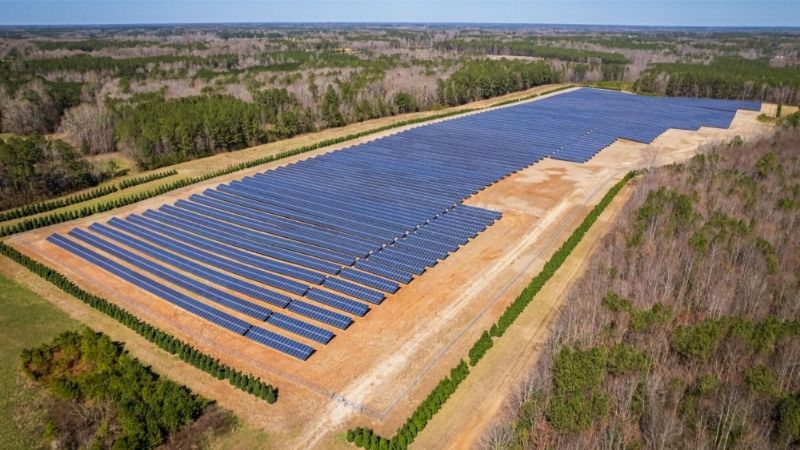
Solar farm in North Carolina. Image used courtesy of Pexels/Mark Stebnicki
Quantum Dots Boost Solar Efficiency
First Solar has partnered with UbiQD to integrate quantum dots (QD) into its thin-film solar modules. These tiny, light-sensitive particles enhance color and light manipulation, boosting efficiency. The collaboration marks an early step in commercial QD adoption, improving light absorption and spectral response, ultimately increasing energy output in utility-scale solar projects.

Quantum dot nanotechnology. Image used courtesy of UbiQD
UbiQD has acquired BlueDot Photonics to enhance its solar PV technology. BlueDot’s enhanced perovskite materials could boost crystalline silicon module output by 16%. The technology is especially effective in bifacial panels, which generate power from both sides by capturing direct sunlight on the front and reflected light from the ground on the rear. UbiQD claims its QD can more than double light conversion efficiency for certain wavelengths and colors.
When employed at utility-scale, even small efficiency gains in bifacial solar panels can lead to meaningful increases in energy output. UbiQD says only minimal adjustments are necessary to the manufacturing process to integrate the QD technology.
Together, First Solar and UbiQD plan to scale production of the QD technology to over 100 metric tons annually with a new facility in New Mexico, which has already been piloted in windows and agriculture use, and is now backed by $20 million in funding.
Record-Setting Minimodules
The U.S. Department of Energy’s National Renewable Energy Laboratory (NREL) and CubicPV, a Massachusetts-based perovskite-silicon tandem manufacturer, have partnered to achieve a certified 24% efficiency for a perovskite minimodule. This surpasses the previous 23.9% benchmark that an international collaboration with NREL established. It builds on earlier lab results showing 23% efficiency, in a 6 cm2 minimodule, with minimal degradation. The breakthrough marks a major milestone for perovskite solar innovation in the US.
NREL and CubicPV researchers jointly developed the perovskite minimodule, leveraging complementary expertise to drive the innovation. While CubicPV specializes in tandem solar devices that layer perovskites over silicon, NREL advances the tandem technology’s manufacturing, durability, and efficiency.
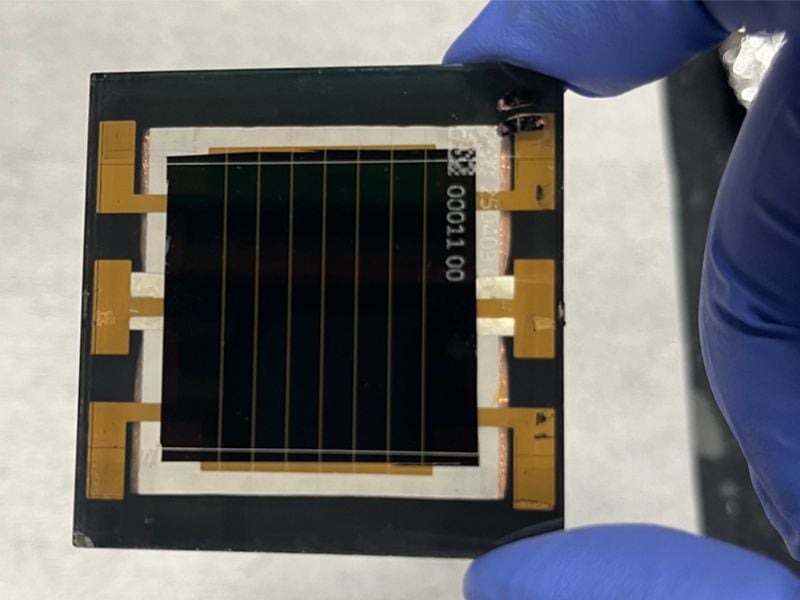
The record-breaking perovskite minimodule. Image used courtesy of NREL
Tandem perovskite-silicon solar cells present a promising path beyond the efficiency limits of conventional silicon technologies. As module prices continue to drop, system costs are increasingly driven by efficiency, making tandem an attractive solution. To support the minimodule’s commercialization, CubicPV is advancing stability testing through multiple outdoor installations and high-throughput indoor stress testing. These efforts aim to generate robust data, helping customers better predict long-term field performance and accelerating the pathway toward durable, high-efficiency, and commercially viable tandem solar products.
You’ve Heard of Tandem—Now Try Hybrid Tandem
Last up in recent solar technology advancements is a step-function advancement on traditional perovskite-silicon solar cells.
Caelux has completed its first commercial shipment of Active Glass, a perovskite-coated glass designed to enhance conventional silicon solar modules without integrating the perovskites into the initial manufacturing process—essentially a hybrid tandem solar module. The module boasts a 30% increase in power density with 20% lower project costs.
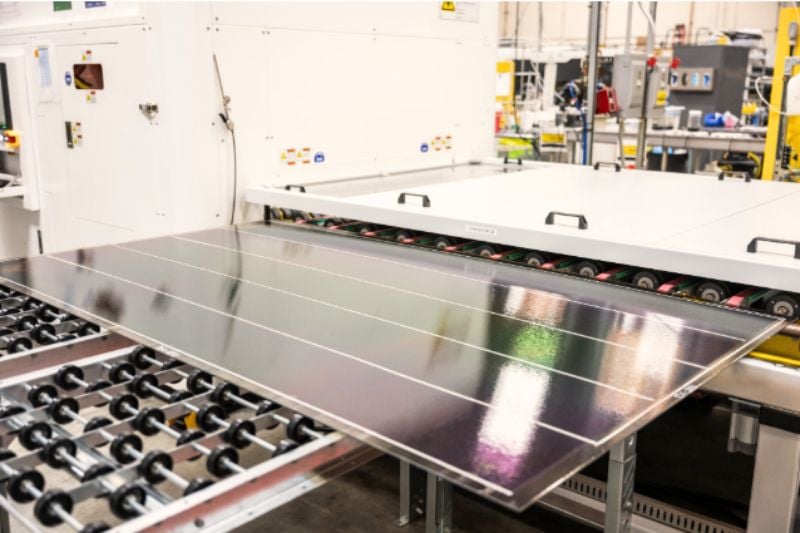
Caelux’s perovskite Active Glass. Image used courtesy of Caelux
By applying perovskites to the glass rather than the cell, Active Glass avoids durability concerns traditionally linked to perovskite materials. Using two terminals in the cell avoids theoretical limits on efficiency.
However, not all experts are convinced of perovskites’ role in large-scale solar deployment. While perovskites will have applications, it is likely they will remain a niche technology, rather than becoming a cornerstone of the global energy transition. Yet despite ongoing skepticism, interest in perovskite technology remains strong.