Facebook
 Google
 GitHub
 Linkedin
Solar Device Embraces the Heat for Better Performance
Researchers found rising temperatures can enhance energy storage in integrated solar devices, turning long-term performance liability into a design advantage.
Solar panels have long battled heat as a performance killer, concerned that the panels lose efficiency in hotter conditions as electron mobility drops and resistance rises. However, Loughborough University research challenges that foundational assumption, uncovering how elevated temperatures can improve energy storage performance in next-generation integrated solar systems.
The study in The Journal of Chemical Physics reveals that certain photoelectrochemical (PEC) flow cells perform better at higher temperatures, thanks to faster ion transport and improved electrolyte conductivity.

How does heat affect solar panels? Image used courtesy of Adobe Stock
Turning Heat into an Asset
The research explores a solar device that doesn’t just generate electricity but stores it electrochemically, eliminating the need for separate battery systems. By measuring output and current flow across a temperature range, the researchers discovered a sweet spot near 45°C where performance improvements plateau.
Standard photovoltaic (PV) modules suffer from thermal degradation, with output falling as cell temperatures rise, typically by about 0.5% per °C. This reality has driven decades of cooling strategies, from forced-air systems to expensive thermal backplanes. But PEC flow cells, which use sunlight to drive electrochemical reactions that store energy directly in chemical bonds, follow different rules.
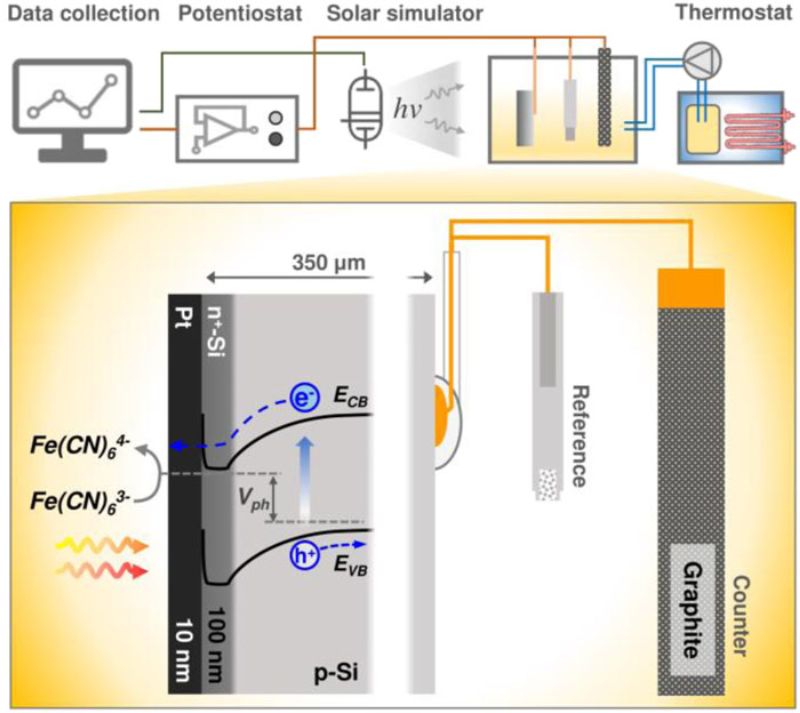
The researchers’ PEC model. Image used courtesy of Salvado-Recarey and Bae
In this study, the team examined silicon-based PEC cells with platinum-coated photocathodes and flowing electrolytes. As temperatures increased from ambient up to ~60°C, the cells demonstrated improved current densities and faster charge transfer, all without changing the incident light level.
A New Paradigm for Solar-Storage Integration
The researchers’ practical implications findings could be wide-reaching. For one, engineers designing integrated solar-storage devices like rooftop PEC modules or off-grid flow cell arrays could begin to tune materials and system architectures for higher operating temperatures. By removing the need for cooling infrastructure, total system cost and complexity could be significantly reduced.
Second, it opens the door to climate-aligned deployment strategies. In traditionally “difficult” regions—think desert regions or urban environments with high solar gain—systems built to operate optimally at 40-50°C could outperform conventional PV battery setups in both cost and reliability. This could prove critical for off-grid or microgrid applications where energy density and infrastructure simplicity are paramount.
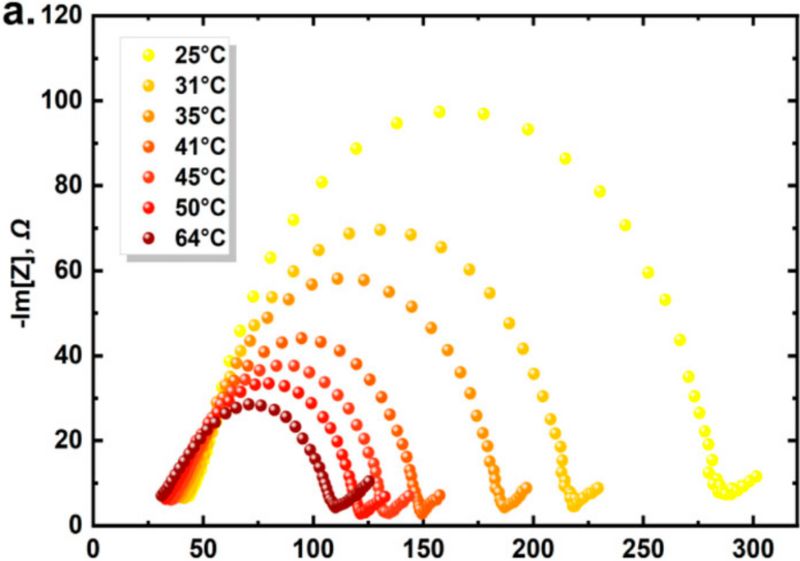
Effect of temperature on the charge transfer impedance. Image used courtesy of Salvado-Recarey and Bae
Third, the study suggests a fundamental rethinking of solar degradation. While conventional modules still degrade under thermal stress, hybrid systems like PEC cells might exhibit performance enhancements under controlled thermal conditions. That positions them as ideal candidates for next-gen renewable infrastructure, especially in systems that co-locate generation and storage within a single form factor.
While the study focused on controlled lab setups, the results give a clear thermodynamic target. Performance peaked around 45°C, with diminishing returns above that point, thereby guiding future work toward thermal optimization rather than thermal suppression. That could influence material selection (e.g., electrolyte formulation, catalyst surfaces), enclosure design (thermal insulation vs. conduction), and system-level controls (e.g., passive thermal regulation instead of active cooling).
The researchers believe that adopting this concept broadly could transform solar energy into a more dispatchable resource, where generation and storage are no longer decoupled. Instead of sending energy to a separate battery or grid interface, PEC cells could store it locally and release it on demand, offering a cleaner, quieter, and more compact alternative to traditional solar and battery architectures.