Facebook
 Google
 GitHub
 Linkedin
Nanos for Cathodes: Making EV Batteries Better
Integrals Power will manufacture nano-enhanced cathodes for better performance and safety in electric vehicle batteries.
The lithium-ion battery (Li-ion), which powers most electric vehicles, constantly evolves. Engineers tinker with every component to maximize performance and increase battery efficiency. They consider how new materials and minuscule changes can prolong battery life and ease battery reuse and recycling.
Lithium-phosphate batteries. Video used courtesy of Integrals Power
Integrals Power, a U.K. battery manufacturing company, has created a fully operational pilot plant to produce lithium iron phosphate (LFP) and lithium manganese iron phosphate (LMFP) nanomaterials with 30% more storage capacity than conventional Li-ion materials. These nanomaterials also have greater long-term potential to retain battery capacity and can perform well under extreme conditions such as high heat.

Lithium battery materials. Image used courtesy of Integrals Power
Conventional Cathode Materials
Improving battery chemistry is delicate work. One innovation to increase rate potential and efficiency might compromise stability. Another improvement to stabilize battery chemistry might compromise energy density.
Engineers constantly manage these variables while improving Li-ions. High energy density materials, such as lithium cobalt oxide, offer substantial energy storage capacity but suffer from notable safety concerns. They are prone to thermal runaway, leading to potential short circuits and fires, posing serious risks in practical applications.
Additionally, while lithium nickel manganese cobalt oxide and lithium nickel cobalt aluminum oxide cathodes provide a balanced energy density and stability performance, they face challenges related to resource availability and environmental impact from nickel and cobalt mining and processing. Furthermore, lithium iron phosphate cathodes, known for their safety and long cycle life, exhibit lower energy density, limiting their usage in high-demand applications. Balancing these trade-offs to develop cathode materials optimizing safety, performance, and environmental sustainability remains a critical challenge in advancing Li-ion battery technology.

LFP cathode. Image used courtesy of Integrals Power
Nanomaterial Technology Advantages
Integrals Power has developed proprietary advanced cathode active materials that can boost energy capacity by 30%, an incredible leap compared to the marginal improvements often achieved when adjusting battery chemistry.
Nanomaterials can improve lithium-ion movement while maintaining low costs and boosting energy capacity. Nanomaterials have a significantly higher surface area-to-volume ratio compared to their bulk counterparts. This increased surface area facilitates faster lithium ion diffusion and enhances the electrochemical reaction rates, improving battery charge performance and discharge rates.
Integrals Power uses cutting-edge X-ray diffusion technology to assess the material’s purity and study the molecule’s lattice structure, which is crucial for maintaining high performance once applied to operating battery cells.
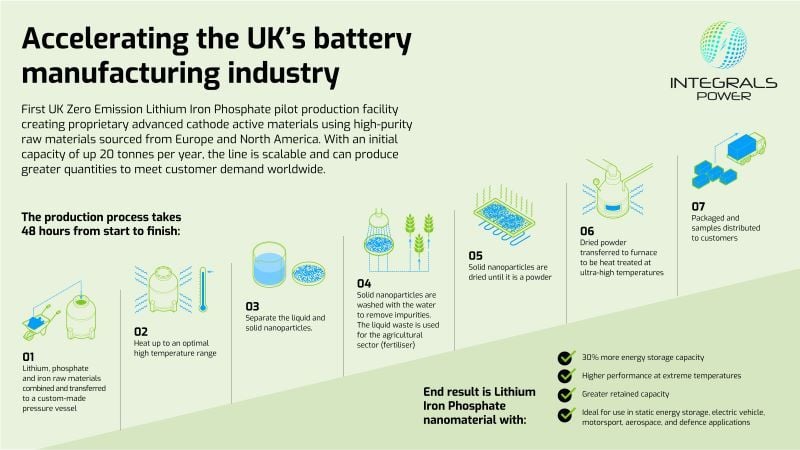
Integrals Power 7-step manufacturing process. Image used courtesy of Integrals Power
Integrals Power’s Pilot Plant
Integrals Power’s pilot facility in Milton Keynes, near London, could produce 20 tonnes annually, enough for 250 EVs. Its modular design supports fast upscaling. The seven-stage manufacturing process transforms raw materials into customer-ready samples in 48 hours.
These LFP and LMFP nanomaterials transcend one single application or sector. The facility can manufacture different grades of LFP and LMFP nanomaterials suitable for EV batteries, off-grid energy storage, and defense and aerospace applications.
Building battery manufacturing infrastructure within the U.K. mitigates risks of supply chain disruptions. Integrals Power is diversifying the international cathode material market, currently dominated by China, which creates 90% of the cathode active materials available.
These critical steps will help the U.K. reach its clean energy goals and provide an innovative path forward for other manufacturers worldwide.