Facebook
 Google
 GitHub
 Linkedin
NERC Warns AI Data Centers Threaten Grid Reliability
North America’s grid watchdog has issued a Level 3 alert—the most serious—over reliability risks posed by computational load.
The North American Electric Reliability Corporation (NERC) has issued its highest alert, Level 3, for energy reliability. The alert focuses on computational loads such as AI training centers, cryptocurrency miners, and large data centers.
The alert follows customer-initiated large-load reductions and significant oscillations, including events where more than 1,000 MW of computational load dropped from the bulk power system in seconds, removing demand on a timescale comparable to a large generator trip. NERC, which works with six regional entities across the North American bulk power system, says these sudden disconnections can unfold faster than conventional operators can respond.
Data center‑driven load growth is accelerating quickly. NERC’s 2025 Long‑Term Reliability Assessment estimates North America's electricity demand will surge over the next decade, reaching levels not seen in more than 20 years. Summer peak demand is expected to grow by more than 224 GW—far above last year’s projection—while winter peak demand is forecast to rise even more significantly, increasing by about 245 GW.
Much of this anticipated growth is tied to the rapid expansion of AI-focused data centers and broader digital infrastructure.
As data centers proliferate, can electricity keep flowing? Image used courtesy of Pexels/Ilo Frey
Level 3 Outlines 'Essential Actions'
The Level 3 alert directs transmission planners, planning coordinators, transmission owners, balancing authorities, reliability coordinators, and transmission operators to take “Essential Actions” around how these energy loads are modeled, studied, commissioned, monitored, protected, and operated.
Large compute campuses can behave differently from conventional industrial loads. Their UPS systems, power-electronic interfaces, cooling drives, customer protection schemes, and backup-generation controls can rapidly reduce, disconnect, or restore demand during short voltage or frequency disturbances on a timescale that planning models and operating procedures may not fully capture.
NERC cited AI training, cryptocurrency mining, and traditional data center uses as examples of computational load, and said responses to its 2025 Level 2 alert showed entities generally lacked adequate processes for this load class.
The Level 3 alert requires specific responses—Essential Actions—from grid entities.
NERC’s first Essential Action focuses on the modeling inputs planners need before studying computational loads in the bulk power system. The alert directs transmission planners and planning coordinators to collect more granular operational and electrical performance data from computational-load customers, including:
- Minimum and maximum MW demand
- Power factor
- Ramp rates
- IT versus non-IT load composition
- UPS configuration
- Protection settings
- Voltage and frequency trip behavior
- Reconnection timing
- Cooling-load drive behavior
- Whether on-site generation or storage can operate parallel with the grid
It also calls for modeling computational load separately from other industrial demand, with IT load distinguished from supporting systems such as cooling. For a baseline, NERC points to the Power Electronic Reconnecting and Ceasing (PERC1) model, or an equivalent or better model, while leaving room for more detailed approaches where needed.
NERC’s other Essential Actions target the operational and protection gaps that can turn large computational loads into a reliability concern:
- Recurring studies of voltage
- Frequency and stability impacts
- Updated “qualified change” triggers when facilities expand or shift from one computational use to another
- Commissioning practices that verify as-built performance
- Protection and ride-through coordination for normally cleared faults
- Dynamic fault recording at computational-load facilities
- Direct operating communications between grid operators and computational-load customers
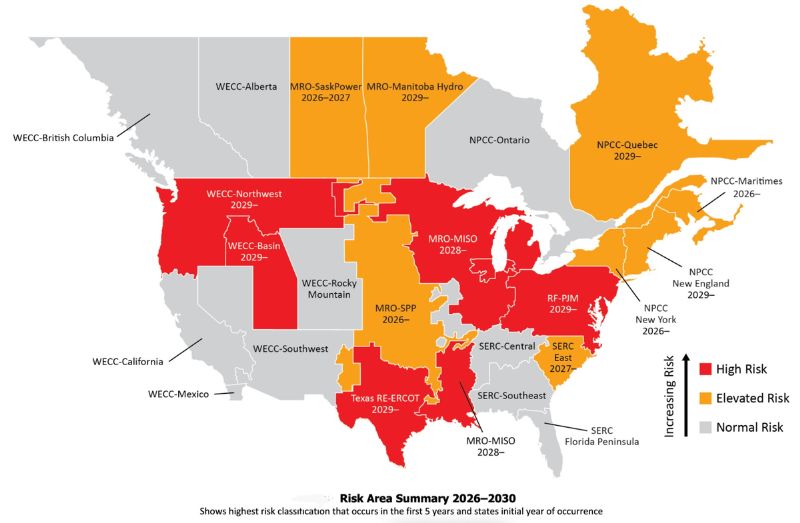
NERC's analysis of regional risk timelines, based on the 2025 Long-Term Reliability Assessment. Image used courtesy of NERC
Grid Events Trigger Alert
The Level 3 alert is based on recent operating experience. In a January 2025 incident review, NERC described a 230-kV transmission-line fault in the Eastern Interconnection that coincided with roughly 1,500 MW of customer-initiated load reduction from data center-type facilities. Data center controls that responded to voltage disturbances reduced load on the customer side. Frequency and voltage rose, and operators had to act to restore normal operating conditions.
The event remained manageable, but it exposed larger planning gaps around customer-initiated large-load reduction behavior, where rapid computational-load disconnection can create the opposite imbalance of a generator trip by suddenly leaving generation in excess of demand. At a larger scale, or with poorly coordinated reconnection, that behavior can impact voltage control, frequency response, contingency analysis, and operator response time.
NERC says it's developing a Computational Load Entity category that would apply to facilities with aggregate loads of at least 20 MW, connected at 60 kV, and containing more than 1 MW of IT load.
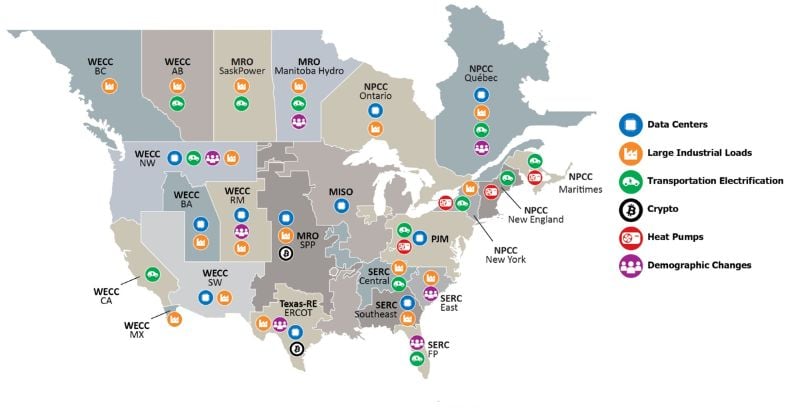
Demand trends across the North American bulk power system. Image used courtesy of NERC
Breakdown of the Three Alert Levels
A Level 3 NERC alert is the highest alert category the organization issues.
- Level 1 is an "Industry Advisory," intended to inform registered entities about a potential reliability issue and requiring no response.
- Level 2 is a "Recommendation to Industry," suggesting specific actions and requiring recipients to respond as directed.
- Level 3 is an "Essential Action," reserved for issues NERC considers critical to bulk power reliability. Unlike Level 1 and Level 2 alerts, a Level 3 alert also requires approval from NERC's Board of Trustees before issuance.
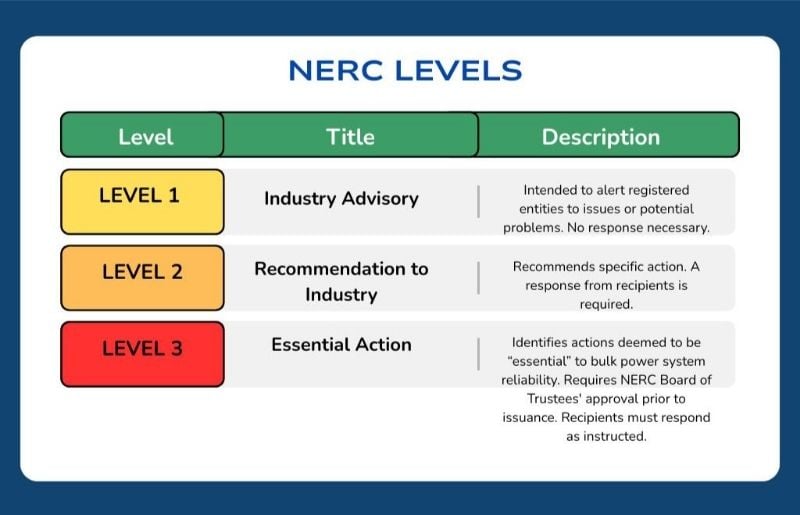
NERC levels. Based on information from NERC. Adapted from image used courtesy of Canva
Although the alert doesn't create a new enforceable reliability standard on its own—failing to implement the Essential Actions won't result in penalties—entities are still required to comply with existing standards.
However, the alert also carries procedural obligations: recipients had to acknowledge it by May 11, and must report their implementation status by Aug. 3. NERC says it will aggregate U.S. responses into an anonymized report for the Federal Energy Regulatory Commission, while the results may also inform future standards development and registration requirements for large computational loads.