Facebook
 Google
 GitHub
 Linkedin
Is Hydrogen the Future of Emissions-Free Heating?
Hyting’s emissions-free hydrogen heating system is designed for industrial buildings and processes.
The shift to renewable and lower-carbon heating fuels is growing. In the latest data, the European Union reported that using renewable energy for heating and cooling has increased by nearly 25%. Still, the International Energy Agency states that a faster shift to less carbon-intensive sources, such as heat pumps, is necessary to meet zero emissions goals.
Hyting, a heating technology startup, believes hydrogen could accelerate this transition. It has developed a hydrogen-based heating system certified as completely carbon-free. EEPower spoke to Hyting CEO Tim Hannig about the system and the future of emissions-free heating.
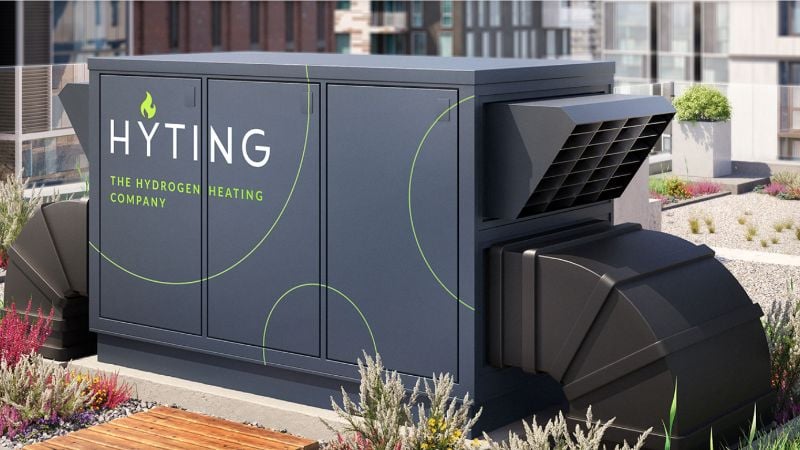
Hydrogen heating system. Image used courtesy of Hyting
How Hydrogen Heating Works
The two major hydrogen-fueled heating systems are the hydrogen boiler and the heat pump. Hydrogen boilers use a blend of natural gas and up to 20% hydrogen to power a traditional boiler. The hydrogen heat pump uses a hydrogen fuel cell to replace the electricity or natural gas powering a heat pump. Both methods contribute to decarbonization efforts.
Hyting’s hydrogen heating process relies on flameless oxidation (FLOX), first developed in the 1990s. In typical FLOX systems, fuel is mixed with air in a combustion chamber. Exhaust gases are continually recirculated back into the chamber, which causes combustion at temperatures so high (1,550°F/850°C) that flames aren’t created.
In Hyting’s flameless oxidation process, hydrogen mixes with oxygen from the air. The company has developed a proprietary catalytic reactor that stimulates the hydrogen to react with oxygen. When the molecules split, the process releases heat. Unlike conventional hydrogen heating sources, it doesn’t release NOx emissions or particulate matter. The only byproduct is water.
“Usually, FLOX burners are used to create relatively high temperatures,” Hannig said. By contrast, Hyting’s system eliminates fire risk.
“We premix air and hydrogen in a nonflammable combustion chamber,” he said. “We put only 3% hydrogen into the air, and that gas cannot burn. It’s inherently safe.”
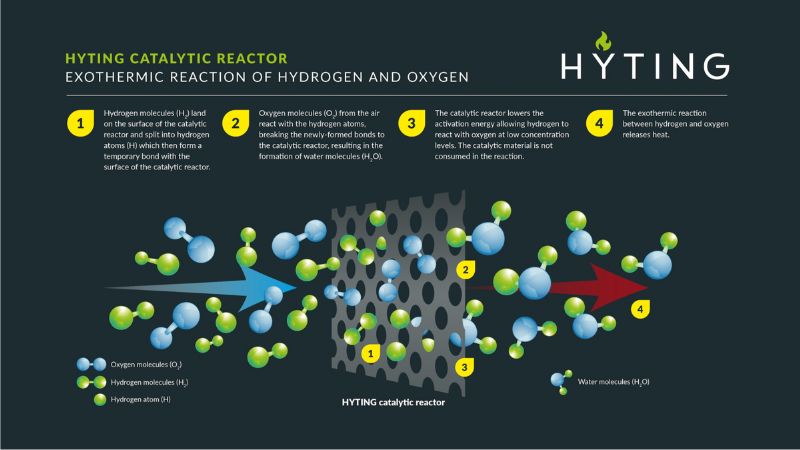
Hyting’s catalytic reactor. Image used courtesy of Hyting
The lower temperatures Hyting uses also lead to lower emissions.
“In the catalytic chamber, the temperature increases to 580°F,” Hannig explained. “That’s a relatively low temperature for a burner. The beauty of this is, at that temperature, you get no NO emissions.”
Carbon-Free Certification
Independent tests confirm that Hyting’s hydrogen heating system is carbon-free. Wöhler Technik GmbH, a global emissions testing specialist, evaluated a prototype with a mobile exhaust gas analyzer, the Wöhler A 550.

Wöhler A 550 combustion analyzer. Image used courtesy of Wöhler
The A 450 is a handheld measurement device that analyzes various combustion systems, such as gas, oil, flue gas, and solid fuel fireplaces. It integrates CO, NO, and O2 sensors. After reading a new or existing sample, it sends results by Bluetooth or LAN to a smartphone app.
Wöhler’s test found no CO2-, CO- or NOx emissions in the hydrogen heating system.
Hannig said the company was confident their system was emissions-free, but since the technology is new, they wanted independent evidence.
“It’s always good if you have a third-party authority that proves it,” he said.
Implementing Hydrogen Heat
Hyting designed its Airflox air handling unit for industrial and commercial spaces in hybrid systems using heat pumps. As a primary heat source or for support during peak load or backup situations, it is compatible with a building’s existing ventilation system. The Airflox units are available with 10 kW or 50 KW heating capacity. Several units can be used together to generate up to 300 kW of heat.
The system can be used as a primary heating system or to heat industrial processes and is easily retrofitted into existing ventilation systems.
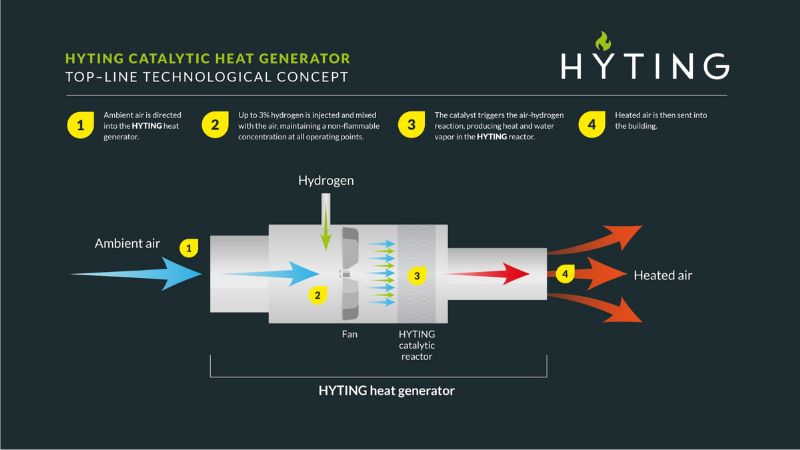
Hydrogen-fueled heat generator. Image used courtesy of Hyting
With a short heat-up time, the system outputs heat at 114% of its net caloric value. Every 1 kg of hydrogen generates 37.4 kWh of thermal energy, more than other hydrogen heating systems.
Hannig explained that while the design is new, it uses already available components, reduces costs, and is compatible with any available hydrogen.
Future of Hydrogen Heat
Hydrogen is a promising fuel but has limitations. While hydrogen may be carbon-free, producing hydrogen through the most common methods, reforming or electrolysis, almost always relies on electricity derived from fossil fuels.
Green hydrogen, produced using renewable energy, would make any hydrogen-fueled system completely carbon-free. Several companies are making green hydrogen in small quantities using solar, wind, or biogas, striving to achieve a cost-effective, commercial scale in the near future.
Hannig observed that the hydrogen industry is moving toward green hydrogen in the long run.
“It’s not an overnight explosion, but a gradual transition,” he said.