Facebook
 Google
 GitHub
 Linkedin
Futuristic Flight Takes Off With Battery, Hydrogen
Electric- and hydrogen-powered aircraft soar with four successful demonstrations.
Electric vertical takeoff and landing (eVTOL) technology development is accelerating across the United States. Several companies recently demonstrated flights with hydrogen fuel cell- and battery-powered aircraft.
Find out how a hydrogen-powered eVTOL flew more than 500 miles. Video used courtesy of Joby Aviation
From short-range air taxis to military reconnaissance to sea gliding, here are four electric and hydrogen demonstrations worth tracking.
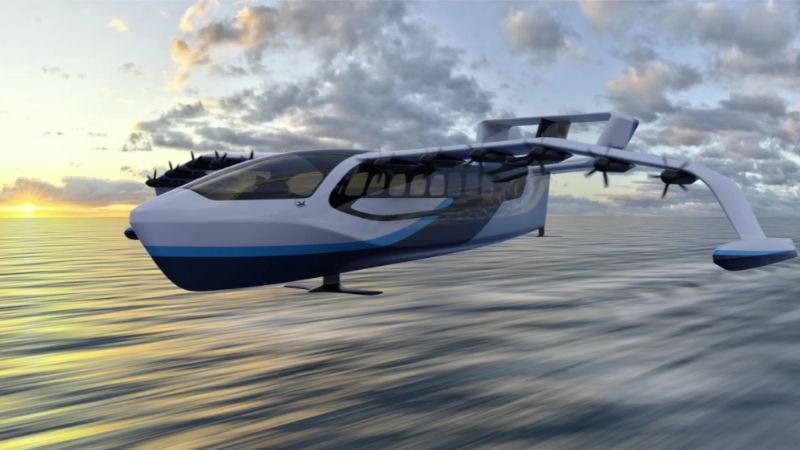
The Viceroy, an all-electric seaglider. Image used courtesy of Regent Craft
Electric Seaglider Prototype Greenlit for Full-Scale Testing
Regent Craft will run a full-scale prototype testing of its Viceroy all-electric seaglider on Rhode Island waterways. The company will begin trials with human flyers later this year, with the first flight scheduled for early 2025.
The Viceroy can hold 12 passengers or a 3,500-pound payload. It cruises at 180 mph with distributed blown wing propulsion, enabling low-speed TOL with eight electric motors. The controlled hydrofoil retracts after takeoff and releases when landing to reach the terminal dock.
With existing battery technology, a single charge lasts about 180 miles, though next-gen batteries could unlock 500-mile routes. As a Type A wing-in-ground hydrofoiling aircraft, Viceroy hovers within one wingspan (about 30 feet) of the water’s surface to maximize safety and aerodynamic efficiency. It is 30 DB quieter than helicopters or aircraft.
Seagliders. Video used courtesy of Regent Craft
The U.S. Coast Guard approved a navigational safety risk assessment of the Viceroy. Regent Craft has agreed with the Marine Corps Warfighting Lab to demonstrate its seaglider for defense missions. Seagliders can be launched in large military aircraft or ship air decks for high-speed logistics tasks in the Indo-Pacific.
Regent Craft performed the world’s first all-electric seaglider flight in 2022, demonstrating float, foil, and fly functions with a quarter-scale prototype. Today, the company has secured over 600 seaglider orders from airlines and ferry operators. It has also attracted investments from Lockheed Martin, Japan Airlines, and Founders Fund.
Hydrogen Fuel Cell-Powered Uncrewed Aircraft
At a Virginia airfield, Boeing subsidiary Aurora Flight Sciences completed an endurance test of its hydrogen fuel cell-powered small uncrewed aircraft, SKIRON-XLE. After hauling 54 pounds for seven hours, the aircraft returned with two depleted 5-liter hydrogen tanks.
The hybrid platform is designed for long-range reconnaissance, combining eVTOL with fixed-wing forward flight. The rotors support lifting and descending in VTOL, while the fixed-wing setup supports extended range. It’s equipped with a lithium polymer auxiliary battery.
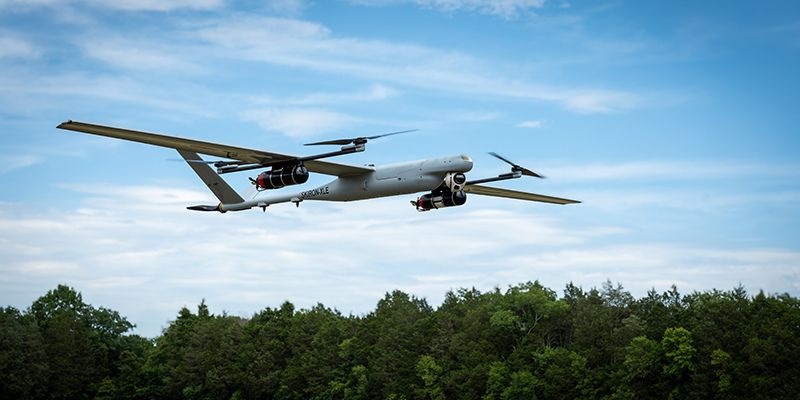
Aurora Flight Sciences’ hydrogen fuel cell-powered eVTOL aircraft. Image used courtesy of Aurora Flight Sciences
SKIRON-XLE expands upon Aurora Flight Sciences’ electric variant SKIRON-X, offering an eight-mile range and three-hour flight endurance. The company unveiled the extended-range, fuel cell-powered version in June.
SKIRON-XLE has payload mounting sites in its nose, under-wing, and belly. The demo flight included technology from several suppliers, including a fuel cell from U.K.-based Intelligent Energy and a high-resolution electro-optical/infrared (EO/IR) camera payload from Oregon-based Trillium Engineering. SKYRON-XLE also features a ground control station with software from Kutta Technologies, a 2.4G 10W radio, and a tracking antenna with a 46-mile command and control range.
Liquid Hydrogen-Powered Air Taxi
H2FLY, a Joby Aviation subsidiary, demonstrated its hydrogen-electric VTOL aircraft in a 523-mile emissions-free flight in California, releasing only water as a byproduct. Liquid hydrogen supplied most of the energy for the operation, which landed with 10% of the fuel load remaining. A hydrogen fuel cell powers the aircraft’s six electric motors, providing a boost during TOL maneuvers.
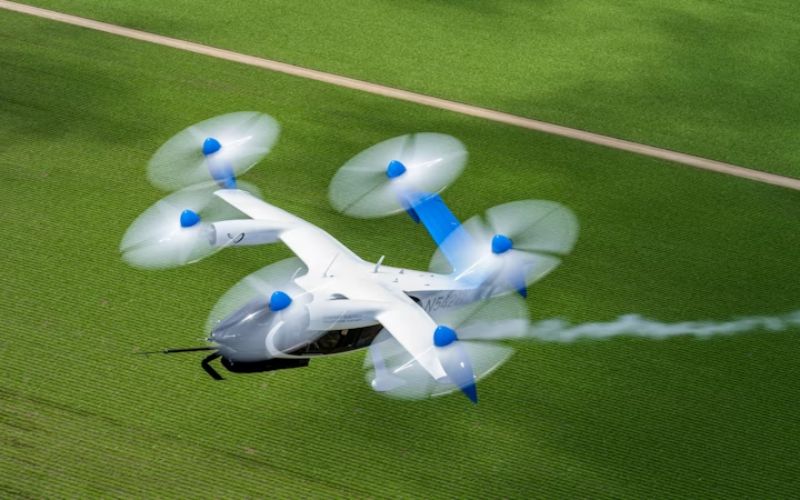
H2FLY’s hydrogen-electric air taxi flew over 520 miles in a VTOL demo. Image used courtesy of Joby Aviation
Before the demo, a battery-electric version of the aircraft performed over 25,000 miles of testing as part of Joby’s certification activities with the Federal Aviation Administration. The hydrogen-converted variant uses the same basic airframe and stores up to 88 pounds of liquid hydrogen in a vacuum-jacketed tank at around -252°C. Liquid hydrogen’s energy density makes it more advantageous than gasoline for weight-limited applications.
H2FLY demonstrated its liquid hydrogen-powered system last year in a piloted flight, a world-first milestone. The low tank weight and volume doubled its range, proving mid to long-range flying viability.
Hybrid-Electric Short TOL Demo
Virginia-based Electra Aero demonstrated its hybrid-electric EL-2 Goldfinch at NASA’s Langley Research Center, marking the facility’s first piloted electric flight. Designed for short TOL (STOL) operations, the aircraft flew 120 miles from Electra’s site in Northern Virginia to Hampton.
The flight demonstrated the distributed electric propulsion system’s blown lift capability for TOL within 150 feet. This feature blows air over the wing and flaps to maximize the lift at slow 35 mph speeds. Blowing is reduced during climb and cruise, and the flaps are stowed away.
The hybrid-electric propulsion system combines a turbogenerator for cruising and battery packs connected to electric motors for TOL. Pilots can recharge the battery mid-flight with the turbogenerator or on the ground with charging stations.
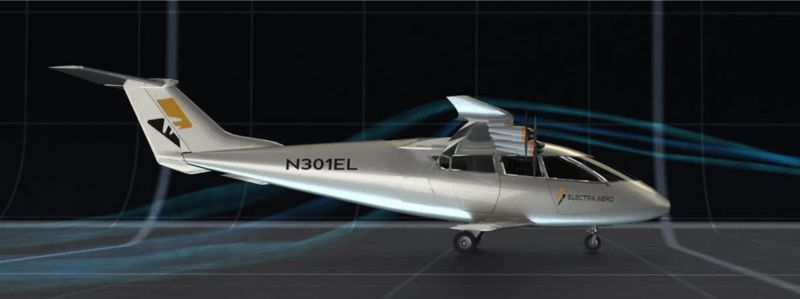
Electra Aero’s hybrid-electric aircraft. Image used courtesy of Electra Aero
Ultimately, Electra Aero aims to jumpstart 35-minute flights between Northern Virginia and Hampton Roads, which are a 2.5-hour drive apart (about 165 miles). The aircraft could replace short- and medium-distance drives up to 500 miles and carry nine passengers or a 2,500-pound cargo.