Facebook
 Google
 GitHub
 Linkedin
Is Supercritical Carbon Dioxide the Future of Power Generation?
The Southwest Research Institute has developed a supercritical carbon dioxide power plant that will be fully operational in 2025.
Electric vehicles are taking over the road, smart appliances have entered the home, and AI has transformed how data can solve myriad modern problems. All these exciting developments are dramatically increasing the need for power. The Department of Energy estimates that current grid capacity will need to double in coming years to manage the growing power load. The demand must be met by building out grid infrastructure and adding new power sources.
Supercritical carbon dioxide (sCO2), which behaves like a liquid and a gas under high pressure and temperature, offers significant promise as a thermal agent for generating electricity.
Supercritical carbon dioxide explained. Video used courtesy of Sandia National Laboratories
The Supercritical Transformational Electric Power (STEP) pilot plant at the Southwest Research Institute (SwRI), San Antonio, is leading the use of sCO2 as a power source. The plant recently generated electricity for the first time and will enter its final development phase to reach full energy output in 2025 by producing 10 MWe per hour.
Plants like this can outperform traditional steam power plants and offer a considerably reduced carbon footprint, making sCO2-sourced electricity ideal for increased efficiency and reduced environmental stress.

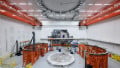
The sCO2 turbine used at the STEP pilot plant. Image used courtesy of the Southwest Research Institute
Conventional Steam Power Plants and Low Thermal Efficiency
Traditional electricity sources will not be enough to support future demands. Alternative power sources are now necessary, and researchers are exploring novel power sources like supercritical carbon dioxide (sCO₂) because conventional steam power plants face several limitations and challenges.
Traditional steam cycles, relying on water to generate steam, operate under efficiency constraints due to lower operating temperatures and pressures. These limitations result in lower thermal efficiency, requiring more fuel to produce the same electricity. The average thermal efficiency of a steam power plant is 29%, mostly due to the condenser’s significant heat loss.
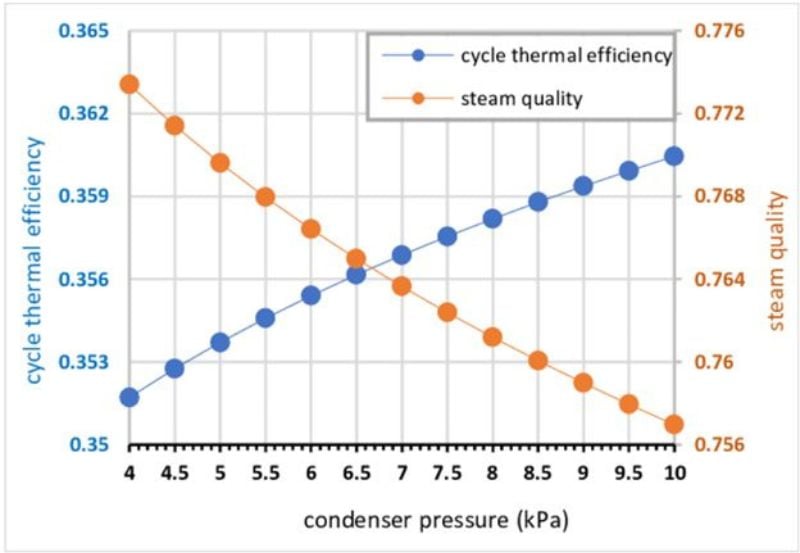
Condenser pressure impact on steam quality. Image used courtesy of ResearchGate
In addition to efficiency limitations, steam turbines and related equipment are large and complex, leading to higher costs and maintenance requirements.
Environmental concerns are another significant challenge. Conventional steam power plants typically burn fossil fuels, causing greenhouse gas emissions and contributing to climate change. These plants also use substantial amounts of water, posing issues in water-scarce regions.
Supercritical Carbon Dioxide and Thermal Efficiency
The STEP plant is pioneering a chapter in power generation by increasing conventional power plants’ efficiency while simultaneously reducing the plants’ carbon footprints.
At very high temperatures and high pressure, carbon dioxide takes on both liquid and gas properties and becomes “supercritical.” The advantage from a power generation perspective is that sCO₂’s thermal conductivity increases significantly compared to water-based heat transfer.
When heated, sCO₂ expands rapidly and is powerful enough to drive a turbine. The turbine is connected to a generator, and when it spins, it generates electricity. After passing through the turbine, the sCO₂ is cooled down, compressed, and then sent back to be heated again in an endlessly repeating cycle.
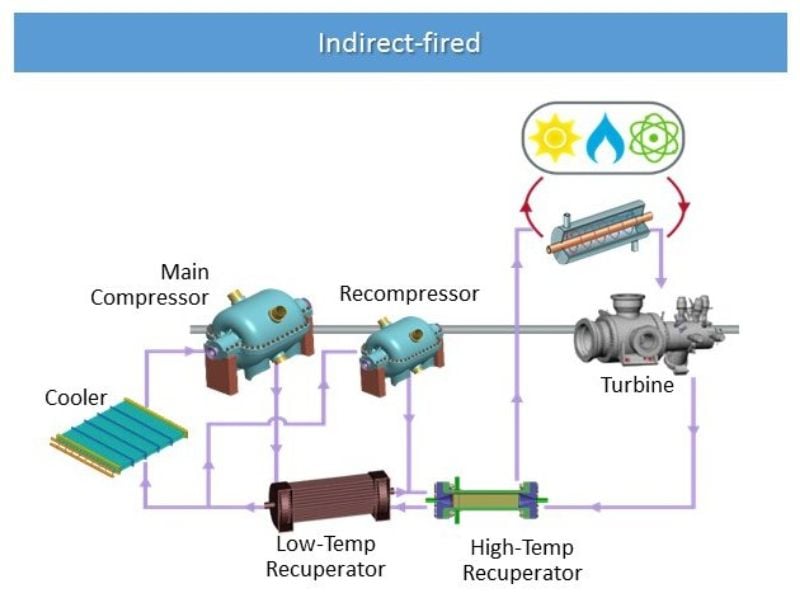
Supercritical carbon dioxide power Brayton cycle diagram. Image used courtesy of DOE
The STEP plant reached a milestone when the turbine hit a full speed of 27,000 rpm at an operating temperature of 260°C. The researchers plan to continue increasing the temperature by another 240°C to reach 500°C, generating 5 MWe of power. The improvement margin in using supercritical carbon dioxide cycles is significant, reliably increasing efficiency by 10% compared to conventional steam power.
Perhaps even more surprising is how this system economizes on space, waste, and equipment costs. A sCO₂ desk-sized turbine can power 10,000 homes, according to the SwRI. Overall, the STEP plant machinery is about one-tenth the size of conventional power plant equipment. This reduction drastically cuts material and manufacturing costs and dramatically reduces maintenance, labor, and expenses.
Even though conventional steam power plants have offered reliable power generation for decades, the future depends on innovations like those in development at the STEP power plant. Every marginal increase in power generation efficiency will be critical in facing an electrified future to reach net zero carbon emissions.