Facebook
 Google
 GitHub
 Linkedin
Hope for Hydrogen: 4 Research Projects Advancing Progress
Researchers are exploring methods to generate, store, and utilize hydrogen for a low-carbon economy.
Hydrogen has been lauded as a promising alternative to fossil fuels but comes with notable challenges. For example, current hydrogen production methods often use fossil fuels, which emit carbon and counter the benefits that hydrogen is supposed to bring. Further, storage and transport issues and efficiency and cost concerns have been roadblocks to widespread use.
Can engineers make hydrogen using seawater? Video used courtesy of MIT
However, numerous breakthroughs are occurring in generating, storing, and utilizing hydrogen. Four research developments aim to breathe new life into the concept of hydrogen power.
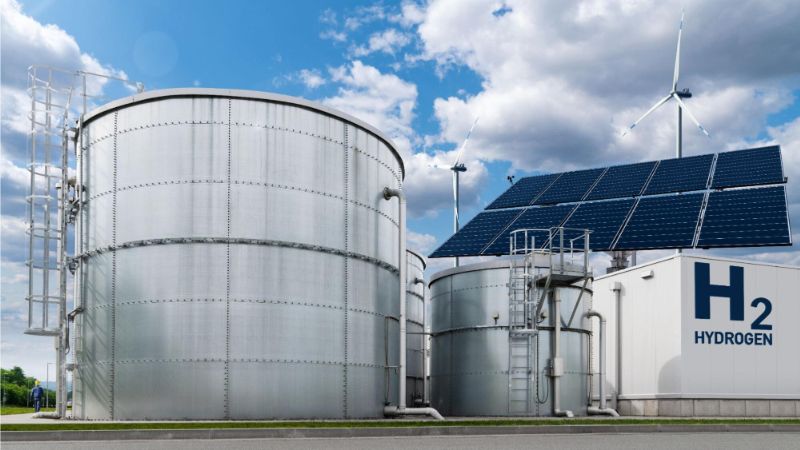
Green hydrogen is made using renewable energy. Image used courtesy of Adobe Stock
AI Unlocks Underground Hydrogen Storage Potential
Storing hydrogen gas underground enables large-scale storage and ensures energy security. However, underground hydrogen storage faces challenges due to complex geological conditions. Cushion gases are mainly used to maintain pressure in storage systems and prevent the escape of the stored hydrogen. Los Alamos National Laboratory scientists developed a deep neural network model to simulate and optimize this process.
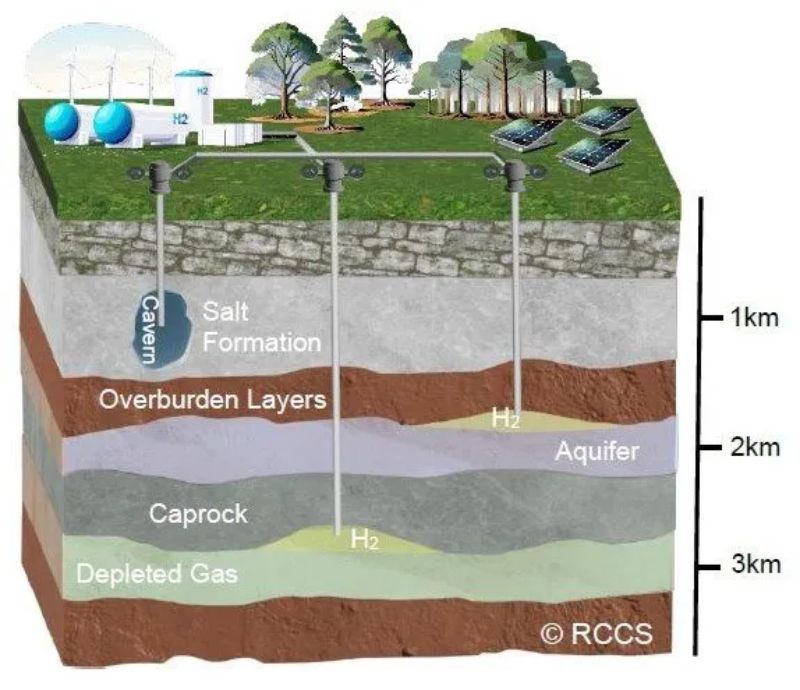
Underground storage of hydrogen gas. Image used courtesy of IDRIC
In their paper, the researchers described how the newly developed model analyzes multiple geological and operational parameters, including various cushion gas scenarios (methane, carbon dioxide, or nitrogen), to maximize hydrogen recoverability and purity. The model accounts for diverse underground reservoirs, such as depleted reservoirs and deep saline aquifers, and considers hydrogen's unique properties.
Ultimately, the research provides insights into storage performance over cycles, the advantages of various reservoir types, and the impact of cushion gases on storage efficiency. The research also led to developing the OPERATE-H2 software, the industry’s first software using machine learning to optimize hydrogen storage across various conditions.
Green Hydrogen Production Using Microwaves
Hydrogen production often negatively impacts the environment. For example, steam methane reforming, a common method of hydrogen production, releases carbon dioxide as it extracts hydrogen from natural gas.
Researchers from the Technical University of Valencia have addressed this challenge by developing materials to enhance hydrogen production from water using microwave radiation. Their paper describes the novel process, which utilizes redox cycles in cerium oxide-based materials doped with various elements (La, Nd, Gd, Y, Er, and Yb) to separate hydrogen from oxygen. The microwave-induced electromagnetic field facilitates electron transfer between atoms, enabling electrification of the process.
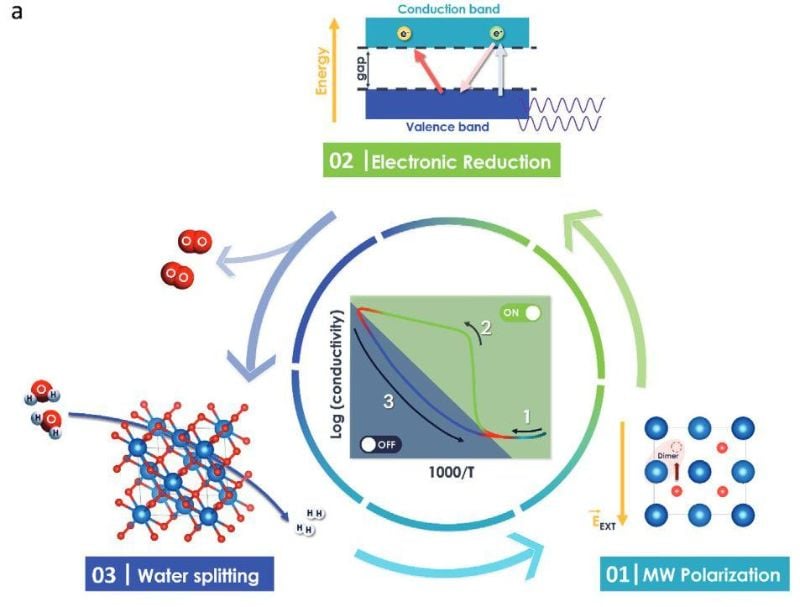
Microwave-driven hydrogen production. Image used courtesy of Saldana et al.
The team designed microwave cavities to precisely control the radiation process and optimize its performance and efficiency. Ultimately, the research found that the materials exhibit strong stability and allow for controlled, rapid oxygen extraction through pulsed processes. Some of the major advantages of this new method include a contactless energy supply and a significant reduction in operating temperature from 1300°C to 400°C.
Transforming Solid Acids into Energy Solutions
Proton conductors facilitate hydrogen generation by enabling efficient proton transfer in fuel cells or electrolyzers. This, in turn, enhances the electrochemical reactions needed to split water or convert fuels into hydrogen. MIT engineers have developed a method to identify promising proton-conducting materials.
As described in the research paper, the MIT team approached the challenge through a combination of ab initio molecular dynamics simulations, analysis of phonon spectra, and atomic structure calculations. Using computer simulations, they analyzed solid acids. They identified key traits for fast proton conduction: the ability of protons to hop between oxygen atoms and the flexibility of the polyanion group sublattice. They identified key descriptors such as donor-hydrogen bond lengths, the acidity of polyanion groups, and the vibrational frequencies of the cation framework.
By quantifying these characteristics, they screened vast databases and discovered six new candidate materials predicted to outperform existing solid acid proton conductors. These materials exhibit higher conductivity at temperatures below 200°C, potentially enabling efficient fuel cells, electrolyzers, and proton batteries.
Caffeinated Clean Energy with Seawater Fuel Revolution
Finally, MIT engineers have recently developed a sustainable method for producing hydrogen fuel using aluminum, seawater, and caffeine.
Their research paper shows the process involves pretreating aluminum pellets with a gallium-indium alloy to remove the oxide layer. This allows the aluminum to react with seawater and generate hydrogen. Adding a small amount of imidazole, an active ingredient in caffeine, significantly accelerates the reaction, reducing time to 5 minutes compared to 2 hours without it.
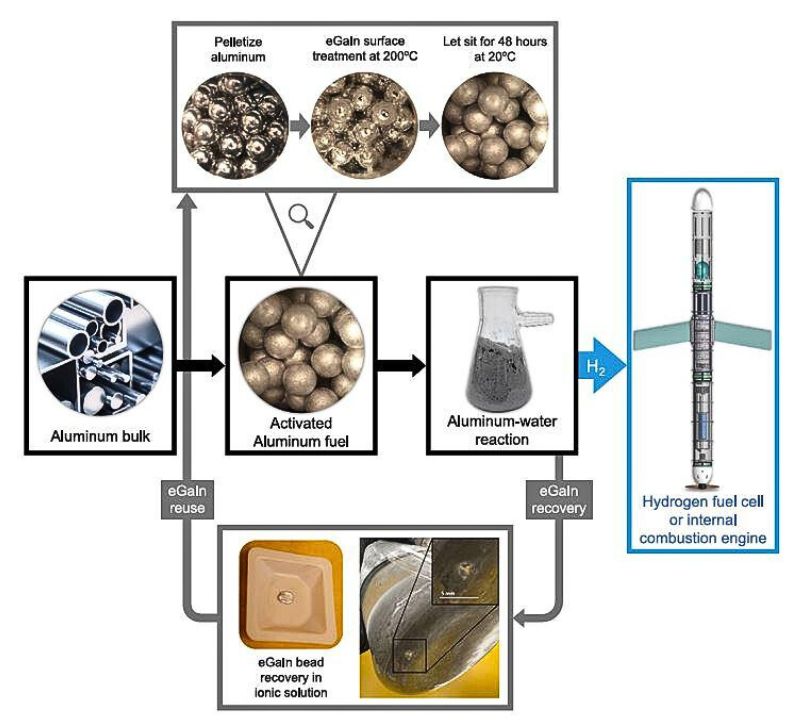
Generating hydrogen from aluminum. Image used courtesy of Kombargi et al.
The resulting system generated 1.3 liters of hydrogen from 1 gram of aluminum pellets in 5 minutes. Additionally, the seawater's ionic solution enables the recovery and reuse of the gallium-indium alloy, making the process sustainable. Overall, the team believes this technology could power marine vessels and underwater vehicles, with a 40-pound aluminum pellet reactor potentially powering a small underwater glider for 30 days.
Advancing Hydrogen
The industry’s recent advancements in hydrogen technology—including AI-enhanced storage, microwave-driven production, and proton conductors—each address current production and storage challenges. With such rapid developments, a broader adoption of hydrogen energy is likely within the next decade, resulting in environmental benefits.