Facebook
 Google
 GitHub
 Linkedin
Can Metal-Organic Frameworks Solve Hydrogen Problems in 2025?
Researchers suggest using metal-organic frameworks could make hydrogen storage safer and more practical.
Hydrogen power has attracted significant attention in recent years as a uniquely efficient and clean energy source. Yet, like all emerging technologies, hydrogen power faces some notable engineering challenges. Among these, storage is one of the biggest roadblocks, as it limits implementing hydrogen in a practical, safe, and widespread way.
Many researchers have considered metal-organic frameworks (MOF) as potential solutions. These materials address many of the challenges of storing hydrogen.
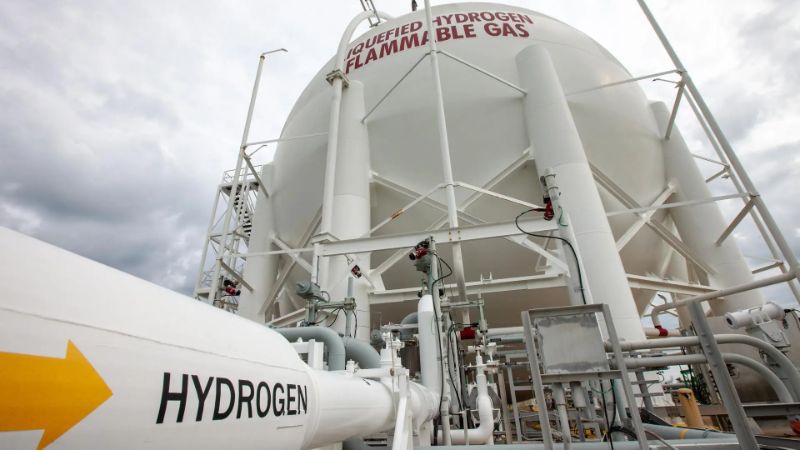
A hydrogen storage tank at Kennedy Space Center. Image used courtesy of NASA/Ben Smegelsky
Hydrogen Storage Challenge
Global fossil fuel consumption is projected to rise by 56% by 2040, yet traditional means of power generation will not suffice to meet the growing energy demands and decarbonization. Alternatively, hydrogen, known for its high calorific value and non-polluting properties, is a hugely promising candidate for a renewable energy source.
Specifically, hydrogen’s power density of 33.3 kW h kg⁻¹ means that a very small amount of the substance can yield massive amounts of usable energy. However, hydrogen's low volumetric density (about 1/10,000th that of water) makes storage challenging, as it necessitates energy-intensive compression or liquefaction for storage and transport. Additionally, hydrogen must be stored at extremely high pressures or cryogenic temperatures due to its low critical temperature (−239.9°C) and high volatility under standard conditions (0°C, 1 atm).
While physical and chemical storage methods, such as high-pressure tanks, cryogenic liquefaction, and solid adsorption, are commonly employed, they remain inefficient, unsafe, and impractical for widespread storage and transport.
Why Use Metal-Organic Frameworks?
A more effective strategy is to develop lightweight materials with high specific surface areas that can rapidly and reversibly adsorb and release hydrogen under near-ambient conditions. The material's density should be comparable to or exceed liquid hydrogen's to ensure efficient hydrogen release and utilization. In theory, hydrogen adsorption occurs on the surface of low-density microporous materials via weak dispersion forces (physical adsorption), making the adsorption capacity directly dependent on the material's specific surface area.
Materials with larger surface areas can accommodate greater amounts of gases like hydrogen. Among potential candidates, MOFs and low-density activated carbons with large surface areas are particularly promising for hydrogen storage applications. However, MOFs are generally more porous than any porous carbon.
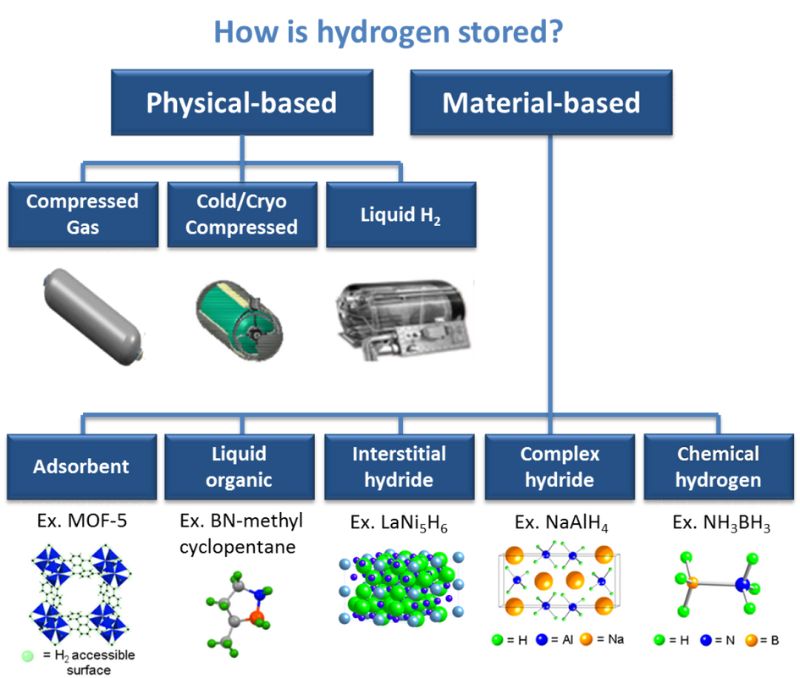
Hydrogen storage methods. Image used courtesy of Department of Energy
MOFs are highly regarded for their exceptional specific surface area and adaptable chemical structures. Comprising metal ions linked by organic ligands, MOFs form numerous micropores that facilitate hydrogen adsorption. They capture and retain hydrogen through various intermolecular attraction mechanisms, including van der Waals forces and electrostatic interactions, enabling selective molecular adsorption within their porous structures. MOFs can also be synthesized through straightforward solvothermal or hydrothermal methods, with tunable structures achieved by modifying their building blocks.
Although many MOFs have been developed for hydrogen storage, their performance remains optimal at low temperatures. Achieving sufficient storage capacity under ambient conditions and moderate pressure remains a significant challenge.
Toward a Cleaner Future
As global energy systems evolve, MOFs are a promising solution for hydrogen storage. The ongoing research and incremental improvements in MOF design indicate a growing pathway toward a future where hydrogen storage's benefits can be realized globally.