Facebook
 Google
 GitHub
 Linkedin
The Future of Transportation is Electric (or Hydrogen)
Strong arguments can be made for both hydrogen fuel cell vehicles and battery-electric vehicles. This article looks at both and how they work together.
Creating a sustainable future in energy production has been the focus of engineers in the vehicle industry in recent years. Sustainable energy will help improve the environment, diversify supply, and reduce dependence on imported fuels. Numerous arguments exist for and against hydrogen fuel cell vehicles (H2FCV) over battery electric vehicles (BEV). Here, we lay out both and look at how they work together.
How do hydrogen fuel cell vehicles work? Video used courtesy of Enginuity Explained [YouTube]
Battery Electric Vehicle Technology
BEVs provide a sustainable alternative to traditional internal combustion engines. They do not produce GHG emissions when in use, which significantly speeds up the decarbonization process in the transportation industry. The core technology of BEVs includes the battery pack, electric motor, power electronics, and charging infrastructure.
Battery Pack
The heart of a BEV is its battery pack, which stores the electrical energy required for propulsion. BEVs mainly use lithium-ion batteries due to their energy density, long cycle life, and low cost per kWh. Battery packs comprise numerous cells arranged into modules, which are then configured into a complete battery pack. The battery management system (BMS) monitors and regulates factors like state of charge, state of health, temperature, and cell balancing. BMS aims to optimize performance, safety, and longevity. It employs algorithms for thermal management and predictive maintenance to prevent overcharging, overheating, and deep discharging.
Electric Motor
BEVs employ one or more electric motors to convert electrical energy from the battery pack into mechanical energy needed to drive the wheels. These can be asynchronous (induction) or permanent magnet synchronous motors (PMSM). PMSMs are preferred over induction motors in most BEVs since they provide higher efficiency and power density, and high torque at low speeds. Delivering instant torque results in superior acceleration and performance. Advanced control algorithms, such as field-oriented and direct torque control, optimize the motor's performance and efficiency.
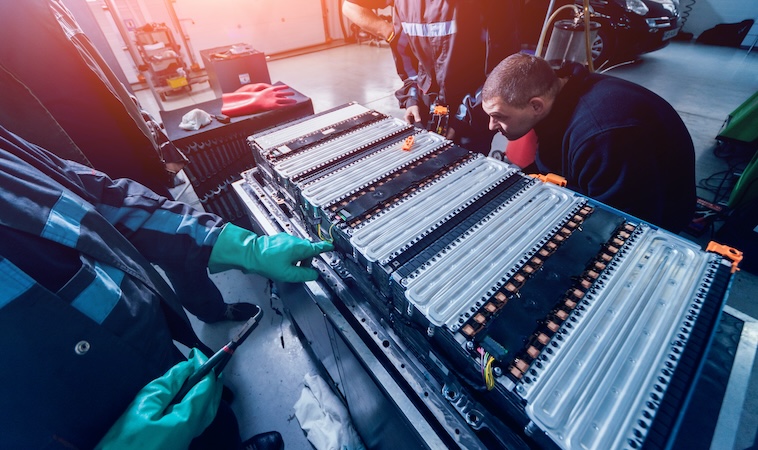
Disassembling the battery of an electric vehicle. Image used courtesy of Adobe Stock
Power Electronics
Power electronics manage the conversion and control of the vehicle’s electrical power. The inverter, a key component, converts DC from the battery into the AC required by the electric motor. This conversion process is essential and involves high-efficiency semiconductor devices like IGBTs or MOSFETs. Moreover, power electronics involve DC-DC converters. They decrease the high-voltage battery output to lower voltages for auxiliary systems and the onboard charger, which manages the charging process from AC mains to the DC battery system. Additionally, regenerative braking systems capture kinetic energy during deceleration and convert it to electrical energy. The battery stores this energy, enhancing the vehicle's overall efficiency.
Charging Infrastructure
The BEV charging infrastructure includes onboard and external components that enable efficient energy transfer to the battery pack. BEVs are compatible with various charging levels:
- Level 1 Charging: standard 120 V household outlets. They provide a slow charge rate of approximately 1.4 kW, suitable for overnight charging.
- Level 2 Charging: 240 V charging stations. They deliver a higher charge rate, typically between 3.7 kW and 22 kW, significantly reducing charging time.
- DC Fast Charging: high-power DC charging stations with outputs from 50 kW to 350 kW. They can recharge a BEV's battery to 80% capacity in 30 minutes or less, facilitating long-distance travel and quick turnarounds.
Hydrogen Fuel Cell Vehicle Technology
H2FCVs represent another alternative, incorporating clean hydrogen as a primary energy source. The core technology revolves around several essential components: the fuel cell stack, hydrogen storage system, power electronics, and balance of plant (BoP) systems.
Fuel Cell Stack
The crucial element of an H2FCV is its fuel cell stack, which generates electricity through an electrochemical reaction between hydrogen and oxygen. It converts hydrogen gas at the anode and oxygen from the air at the cathode into water, producing electricity and heat. Each fuel cell within the stack includes an anode, cathode, electrolyte membrane, and catalyst, facilitating the reactions. This process provides a clean energy source, emitting only water vapor, and powers the vehicle’s electric motor, offering an efficient and zero-emission alternative to traditional engines.
Hydrogen Storage System
Hydrogen storage in H2FCVs is managed through high-pressure tanks. They typically store hydrogen gas at pressures of 300-700 bar (5,000-10,000 psi). These tanks are made from advanced composite materials, such as carbon fiber, to ensure high strength and low weight, and meet rigorous safety standards, including impact resistance and leak prevention. Efficient hydrogen storage is critical for maximizing vehicle range and minimizing refueling frequency.
Electric Motors and Power Electronics
Like BEVs, H2FCVs typically use electric motors, mainly permanent magnet synchronous motors. Power electronics in H2FCVs are crucial for converting and managing electrical energy. The fuel cell stack’s DC output is converted to AC by an inverter to drive the electric motor, like BEVs. The system also includes a DC-DC converter to step down the high voltage for auxiliary systems and to manage energy flow between the fuel cell stack and the battery. The battery, typically a lithium-ion type, serves as a buffer to handle transient loads, provide regenerative braking energy storage, and support peak power demands.
Balance of Plant Systems
BoP systems include all ancillary components that support fuel cell stack operation:
- Air supply systems apply compressors and humidifiers to ensure a consistent supply of oxygen-rich air to the cathode.
- Hydrogen supply systems consist of regulators and injectors that control hydrogen flow to the anode, maintaining optimal pressure and purity.
- Thermal management systems implement heat exchangers and cooling circuits to manage the heat produced during the electrochemical reaction, maintaining optimal operating temperatures for the fuel cell stack.
- The water management system ensures proper hydration of the electrolyte membrane, critical for maintaining proton conductivity and preventing membrane degradation.
Refueling Infrastructure
Hydrogen refueling stations are designed to quickly dispense hydrogen at high pressures, enabling refueling times comparable to traditional vehicles. The infrastructure development includes production facilities (electrolyzers for green hydrogen), storage, and distribution networks (pipelines or tanker trucks). The hydrogen refueling network is being expanded through numerous initiatives across the globe, including a £54 million investment in the Advanced Propulsion Centre in the UK.
BEVs and H2FCVs Working Together
BEVs and H2FCVs complement each other’s strengths and address different transportation needs. With their high efficiency and rapidly expanding charging infrastructure, BEVs are best suited for short to medium-distance travel and urban environments. Their use of direct electricity from renewable sources like solar and wind ensures low emissions and operational costs, making them most efficient for personal vehicles. On the other hand, H2FCVs are advantageous for long-distance travel and heavy-duty applications. These include trucks, buses, and trains, which require high energy density.H2FCVs offer longer ranges and quicker refueling, essential for commercial and industrial transportation.
By implementing both technologies, we can maximize the use of renewable energy, improve energy security, and reduce GHG emissions across various transportation segments. This dual approach puts the best attributes of each technology to use, ensuring an effective transition to sustainable transportation.