Facebook
 Google
 GitHub
 Linkedin
Sodium-Ion Battery Production Scales Up Worldwide
Unigrid, Emerald Battery Labs, and CATL are pushing Na-ion batteries as a less expensive, safer, and commercially viable option to lithium-ion batteries.
Lithium has been a standard battery material for decades, but extracting it is difficult and expensive. In searching for alternative battery chemistries, many engineers are turning to sodium. With a similar battery chemistry to lithium-ion (Li-ion), Na-ion batteries have been attracting attention, especially as demand for stationary storage in data centers and renewable energy storage has grown exponentially and is expected to continue to rise.
Na-ion batteries have been more difficult to commercialize than Li-ion batteries due to the material limitations and the lack of a robust supply chain. However, that could be changing as several companies are now pushing toward large-scale production of Na-ion batteries.
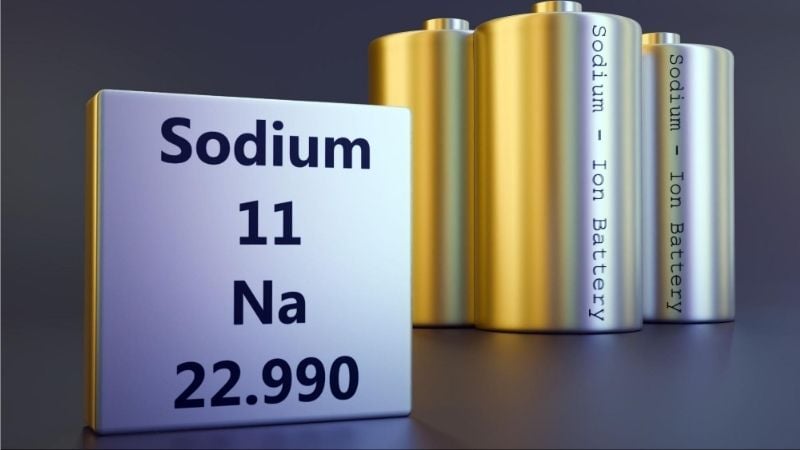
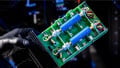
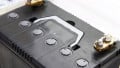
Sodium-ion batteries. Image used courtesy of Adobe Stock
Unigrid Begins Commercial Deliveries
California-based Unigrid has begun commercial-scale international shipments of its NCO Na-ion cells. This is the first company outside China to export Na-ion batteries on a large scale.
Unigrid offers multiple Na-ion cells with capacities ranging from 4 Ah to 210 Ah and charge rates of 0.5 C to 3C. Discharge rates range from 0.5 C to 10 C, and the operating temperature range is -40°C to 60°C, with a cycle life of up to 10,000 cycles.
While China has established a more internal supply chain for Na-ion batteries, large-scale production outside China has typically been held back by a comparatively lacking supply chain, high costs, material availability issues, and the absence of dedicated manufacturing spaces.
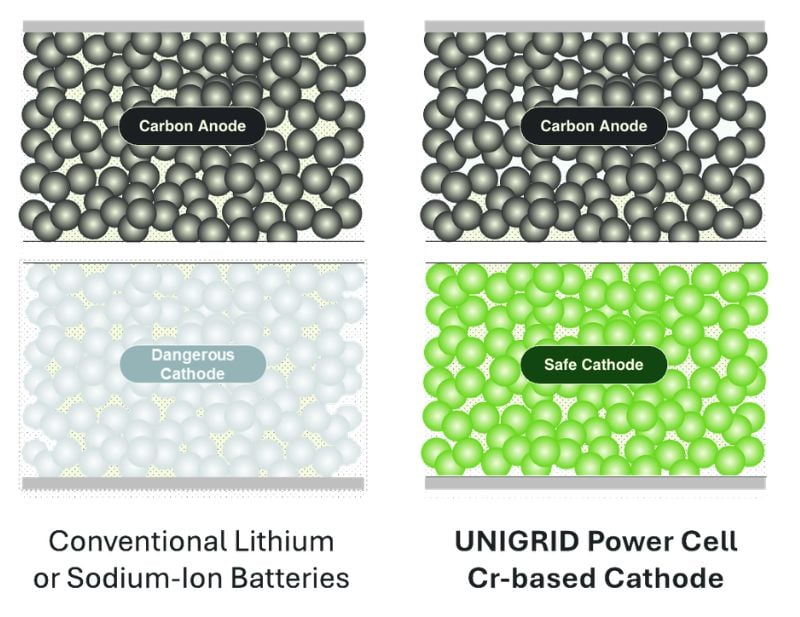
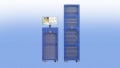
Unigrid’s technology. Image used courtesy of Unigrid
However, Unigrid has circumvented this by operating on a fabless, foundry-subscription model. This has allowed the company to scale its Na-ion cells through manufacturing partners rather than investing time and money in building gigafactories. Cells can be shipped directly from the foundries to customers.
Unigrid can export large quantities of Na-ion cells worldwide after successfully obtaining UN38.3 transport certification. This shipment approach has already landed the Na-ion cells at several ports around the world that were previously equipped to handle only Li-ion batteries.
Emerald Battery Labs Raise Money to Scale Na-ion Production
Emerald Battery Labs, a Seattle-based startup, has just raised around $1.1 million in pre-seed funding to scale its Na-ion batteries to the next technology readiness level.
The company is currently working at the University of Washington and using the university's clean energy testbeds for battery fabrication. Emerald Battery Labs is scaling up its Na-ion batteries, and while it is not yet at commercial scale, it is looking to pilot-test them with various partners.
Emerald Battery Labs is developing two technology platforms. The first focuses on improving existing Na-ion anode technology using proprietary anode materials, aiming to develop sodium anodes with high energy density that can operate in both cold and high-temperature environments.
The second technology platform aims to develop 200 Wh/kg Na-ion batteries at less than $30/kWh. The company plans to market the batteries in a range of applications, including data centers, utility-scale storage, industrial microgrids, commercial ships and vehicles, e-bikes, and electric vehicles.
CATL Mass Produces Na-Ion Batteries for LCVs
Contemporary Amperex Technology Co. Limited (CATL) remains the world’s leading producer of NA-ion batteries. The company has already unveiled several Na-ion batteries across a range of applications, including the recent Tianxing II light commercial vehicle battery series, which powers micro vans and light trucks.
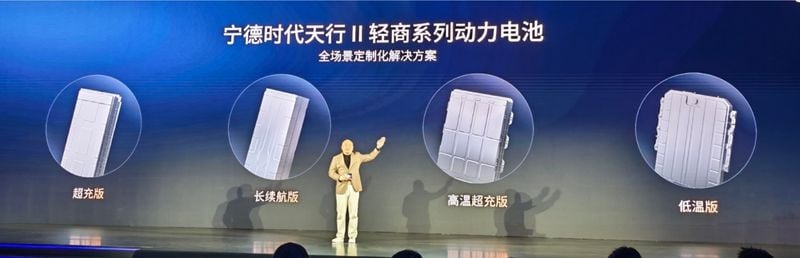
The Tianxing II series. Image used courtesy of CarNewsChina
The Tianxing II series includes several batteries. The highlight is the mass production of the low-temperature 45 kWh Na-ion battery. This battery has an energy density of 175 Wh/kg and a cycle life of over 10,000 cycles.
It is also the world’s first battery to receive the new GB 38031-2025 national standard. The battery has been designed to operate in extreme environments, helping address the winter operation challenges faced by commercial vehicles in cold regions. In testing, the battery maintains 90% of its capacity at -40°C and can be charged immediately after freezing at -30°C.
The Tianxing II series also contains 3 Li-ion batteries:
- Fast-charging battery that can charge from 20% to 80% in 18 minutes, adding 150 km of range to 100 kWh EVs.
- Long-range version with a 253-kWh capacity and a maximum range of 800 km, designed for long-distance logistics.
- High-temperature fast-charging battery that maintains performance and battery life in high-temperature environments and is designed for short-delivery operations such as supermarket deliveries.