Facebook
 Google
 GitHub
 Linkedin
Briefs: Developments in Data Centers, Storage, and Nuclear
NextEra Energy, Dominion Energy, EnerVenue, National Laboratory of the Rockies, and many other energy companies are focusing on AI data centers, energy storage, and nuclear energy.
As the energy industry evolves to meet rapidly growing demands, especially those posed by AI data centers, tech companies, and utilities are accelerating the development of solutions. NextEra Energy and Dominion Energy have agreed to accelerate grid technology development in Virginia. The National Laboratory of the Rockies has launched a test platform for data center developers, utilities, and tech providers.
In China, EnerVenue will pilot its aqueous metal cell storage system for Hong Kong’s largest utility. Meanwhile, the U.S. Department of Energy has awarded $94 million to U.S. companies working on small modular reactor technologies.
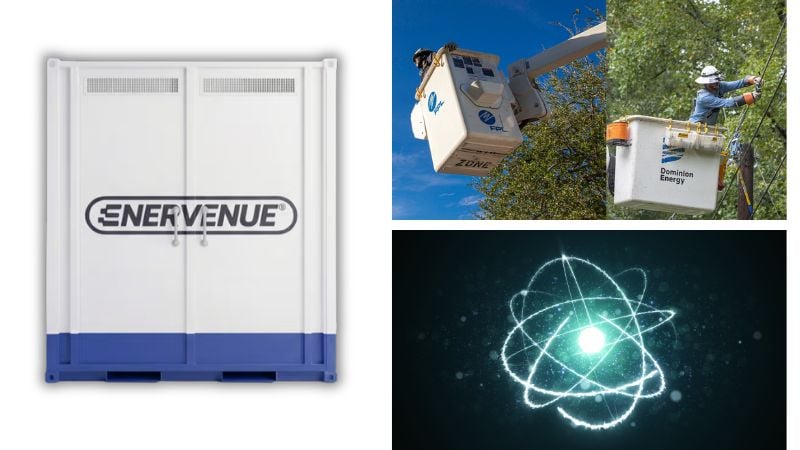
Data center energy, energy storage, and SMRs.
NextEra Energy To Buy Dominion as AI Data Center Power Race Intensifies
NextEra Energy, the largest renewable energy developer in the U.S., will buy Dominion Energy in an all-stock agreement valued at nearly $67 billion. Dominion is a Virginia-based utility that supplies power to the largest concentration of data centers in the U.S.
The merger creates the world’s largest regulated electric utility, with 110 GW of generation. The combined company will serve about 10 million customers across Virginia, Florida, North Carolina, and South Carolina. The deal also proposes a $2.25 billion bill credit for Dominion’s customers in those states over two years.
NextEra states the combined company will bring opportunities for growth, construction and technology capabilities, and supply chain expertise. They added that improvements in generation, transmission, and grid investments will support economic growth, meet power demands, and keep costs affordable.
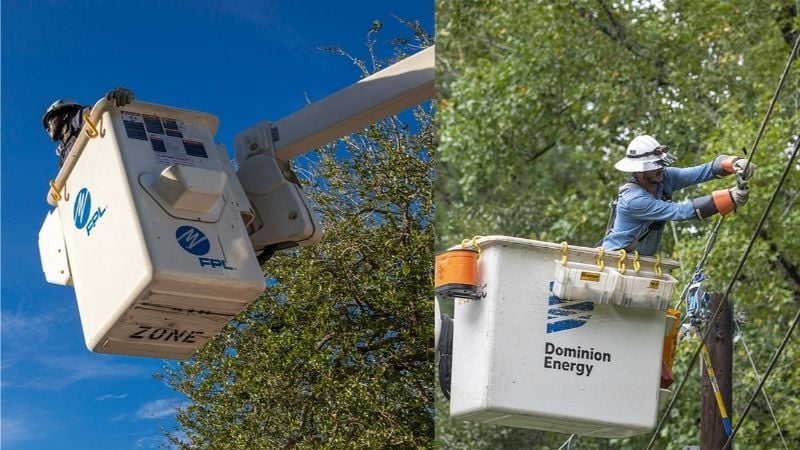
NextEra Energy and Dominion Energy. Image used courtesy of NextEra Energy
Virginia hosts nearly 200 data centers across the state, with over 3,000 MW of power capacity. That number is expected to double in the coming years.
NLR Creates Large-Load Grid Integration Test Bed for Data Center Planners
The National Laboratory of the Rockies (NLR) has launched a large-load test bed to help data center planners with grid interconnection and reliability. Agora, the first-of-its-kind with national capability, replicates the technical complexities of large-scale data center grid interconnection.
The test bed brings together utilities, data center developers, technology providers, and researchers to study grid interactions with large loads under real-world conditions. Major industry partners include Schneider Electric, Compass Datacenters, and Verrus, all of which are already using Agora.
Agora will be continually updated as more partners join and grid situations change. The name is derived from the ancient Greek Agora, a public space for gathering and commerce. The DOE funded the project, which is part of the Advanced Research Integrated Systems platform aimed at advancing reliable, secure, and affordable energy.
EnerVenue’s 4th-Gen Aqueous Metal Cell To Pilot in China
California-based EnerVenue will pilot its fourth-generation aqueous metal cell storage system in Changzhou, China, for the China Gas Company, Ltd. (Towngas), Hong Kong’s first public utility and one of China’s largest energy suppliers. EnerVenue’s technology will be used in Towngas’ electric bus charging stations, integrated with on-site renewable energy generation sources.
The pilot uses EnerVenue’s modular Energy Rack within an outdoor-rated enclosure that houses 50 packaged aqueous metal cells (AMCs). The system includes an inverter and battery management system. Storage capacity is 150 kWh.
The AMC cells contain a nickel hydroxide cathode and nickel alloy anode in an alkaline electrolyte. When charging, it produces hydrogen gas, which is stored inside a sealed, large-format cell. On discharge, the hydrogen reaction is reversed. The system is hermetically sealed to prevent spillage, venting, and thermal cascade.
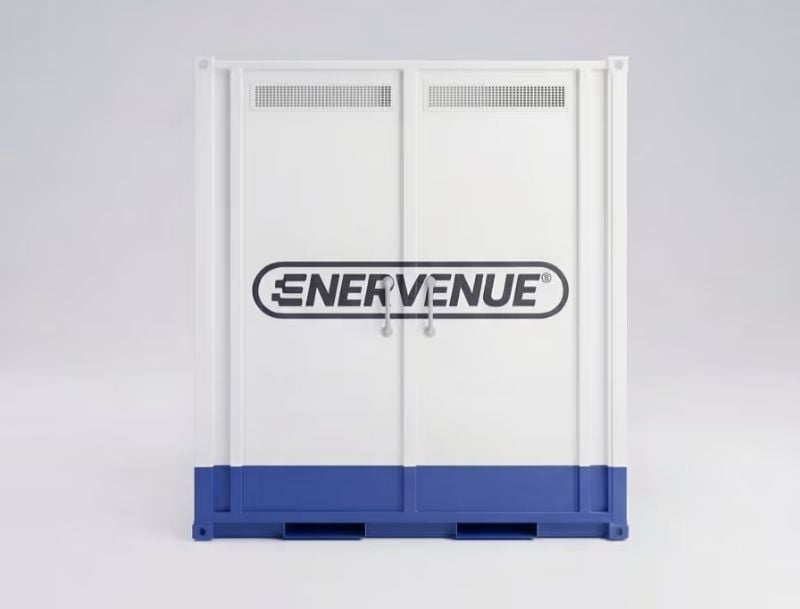
The EnerVenue energy rack, compatible with 1500 V and 1000 V systems. Image used courtesy of EnerVenue
The AMC system can charge and discharge continuously over 2- to 4-hour periods to adjust to load demand and reduce energy consumption, an advantage over most lithium-ion batteries, which require rest between cycles. It has a 30,000-cycle design life, compared to lithium-ion’s 6,000-8,000 cycles. The AMCs are lab-tested to temperatures ranging from -20°C to 60°C.
Department of Energy Awards $94 Million in Grants To Speed Up SMR Deployment
The U.S. Department of Energy has awarded $94 million to eight companies involved in near-term deployment of light-water small modular reactors (SMRs). The awards are intended to boost the domestic nuclear industry and address licensing, supply chain, and site preparation.
Companies chosen in SMR site selection and preparation include:
- Constellation SMR Development, $17,264,292 for an early site permit for a New York location. The Nuclear Regulatory Commission has already approved the site.
- Nebraska Public Power District, $27,864,860, to obtain an NRC-approved early site permit in Nebraska.
For supply chain development, the DOE selected:
- BWXT Nuclear Energy, $21,423,305 to procure equipment for an existing facility in Indiana that the company requires for final assembly of reactor pressure vessels and other components.
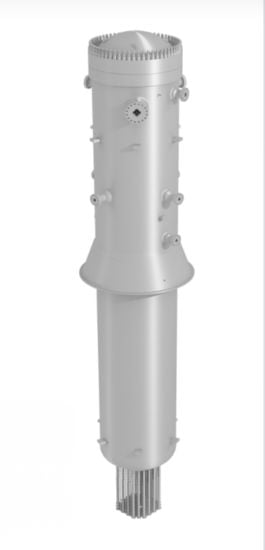
Nuclear pressure vessel. Image used courtesy of BWXT
- Container Technologies, $547,900 to expand the company’s nuclear quality assurance certifications for its Tennessee-based facility, enabling steel production.
- Framatome U.S. Government Solutions, $8.8 million to expand a fuel fabrication facility in Washington. The company plans to increase the number of ceramic pellet production lines, adding about 200 metric tons of uranium annually.
- Global Nuclear Fuel Americas, $3 million for a second production line for fuel rod fabrication, to obtain equipment to automate the pellet inspection process, and implement storage and handling for pellets at its North Carolina facility.
- American Forgemasters, $2.9 million for a new furnace to facilitate domestic production of large component forgings for SMRs at its Pennsylvania facility.
- Scot Forge, $12,267,000, for a large vertical turning lathe and a gantry-style milling machine to produce large components for SMRs. The facility is in Illinois.
In December 2025, the DOE awarded $800 million to the Tennessee Valley Authority and Holtec Government Services to build next-generation small modular nuclear reactors in Tennessee and Michigan. This funding is part of a larger $900 million initiative launched in March 2025 to boost America's nuclear energy capacity and strengthen its supply chain. A second round of funding may follow if more money becomes available.