Facebook
 Google
 GitHub
 Linkedin
Can Repurposed Jet Engines Solve AI Data Center Power Problems?
ProEnergy is converting jet aircraft engines into gas-powered turbines to meet AI data centers’ power demands.
Data center developers are building bigger and more powerful data centers to keep up with demands for artificial intelligence. However, securing a connection to the local grid can take years. While they wait, some developers are building on-site power plants, but obtaining gas turbines from OEMs also takes time.
Another approach is also possible. ProEnergy, a natural gas power provider, is repurposing aviation engines to create its PE6000 gas turbines. These smaller and more mobile turbines are helping to provide power to data centers during their construction and first few years of operation, when they don’t have access to more conventional power options.
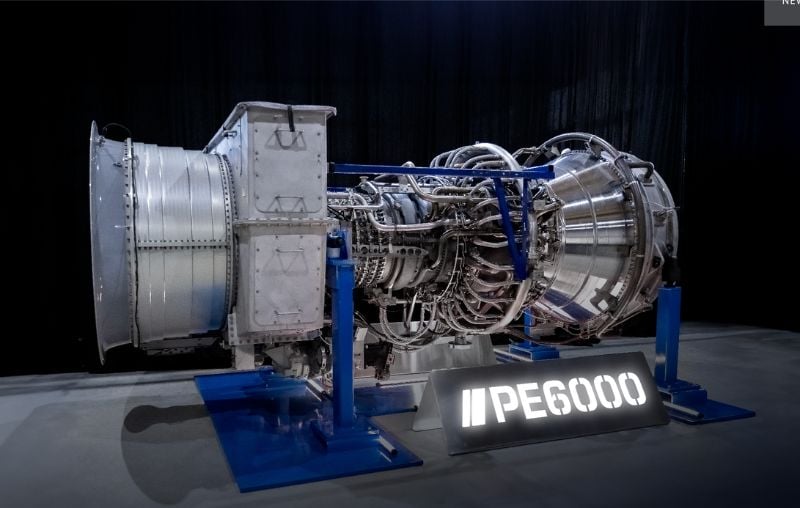
The PE6000. Image used courtesy of ProEnergy
Repurposing Aircraft Engines for Stationary Storage Applications
For many years, gas turbine OEMs, such as GE Vernova and Siemens Energy, have successfully converted aircraft engines into stationary storage and power generation applications. These are known as aeroderivative gas turbines.
Aeroderivative gas turbines offer many benefits over large industrial turbines, including being smaller, lighter, easier to maintain, easier to deploy, and faster to start. They also have high efficiency and can be used with various fuels, including those with a significant hydrogen content, to reduce turbine emissions.
ProEnergy’s approach differs from other aeroderivative developers. It directly repurposes used aircraft turbines, giving them a second life. ProEnergy takes CF6-80C2 engine cores from Boeing 747 engines, the same engine core GE Vernova uses in its LM6000 turbines. However, ProEnergy pairs the engines with newly manufactured aeroderivative parts.
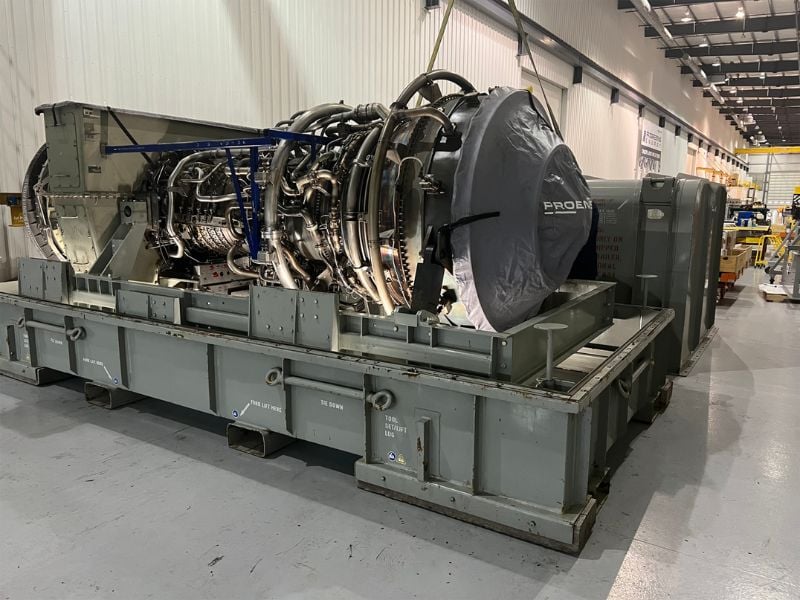
The LM6000 aeroderivative engine. Image used courtesy of ProEnergy
While developing more traditional aeroderivative gas turbines can take anywhere from three to five years, ProEnergy claims it can deliver repurposed turbines by 2027. The engine cores are easy to procure, as around 1,000 aircraft engines could be retired over the next 10 years.
ProEnergy takes a large portion of a Boeing 747 engine and adapts it for use on the ground, rather than in the air. This involves switching the turbine’s output from producing thrust (used to lift the airplane) to generating electricity, requiring numerous adaptations, such as:
- Expanding the turbine section to convert thrust to shaft power
- Integrating a steel frame, concrete deck, struts, and supports to mount the turbine
- Installing fuel nozzles, allowing the turbine to run on natural gas and other fuels instead of aviation fuel
- Using a combustor to reduce nitrogen oxide emissions
ProEnergy’s Repurposing Process
The PE6000 repurposed turbines undergo a complete overhaul, in which thousands of components are disassembled, cleaned, inspected, and either repaired or replaced. The PE6000 is, therefore, a new custom machine designed for long operational cycles. It can provide up to 48 MW of power, sufficient to power a small or medium-sized data center or approximately 40,000 homes. This is slightly lower than GE Vernova’s LM6000 turbines, which produce up to 58 MW, but ProEnergy’s turbines deploy more quickly to meet power needs.
ProEnergy sells a two-turbine block consisting of gas turbines, generators, water-spray injection technology, cooling systems for improved performance, catalytic reduction systems to lower emissions, and multiple electrical systems. ProEnergy has focused on repurposing only one type of engine core to simplify engineering and maintenance.
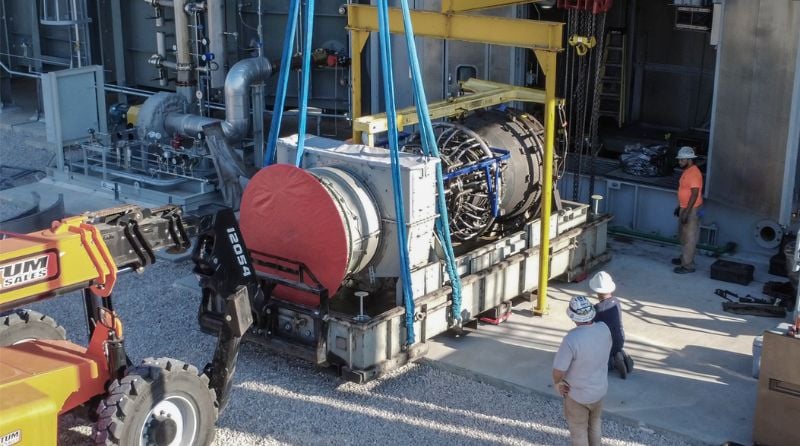
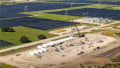
Gas turbine installation at a power plant. Image used courtesy of ProEnergy
The PE6000 turbine runs on natural gas but can use a fuel mix. It reaches full operation in only five minutes. The turbine’s simpler and smaller nature also means that parts can be swapped out within 72 hours if anything breaks. In emissions, the turbines average 2.5 ppm of nitrogen oxide, which is less than the Environmental Protection Agency’s 10-25 ppm threshold.
Repurposed Turbines as a Short-Term Solution for AI Data Centers
ProEnergy has already fabricated 75 PE6000 packages, with another 52 currently being assembled or ordered. The original plan for the repurposed turbines was to help utility companies meet peak power demands.
However, the turbine’s most significant market is data centers, which face delays for grid connections due to approval processes across various states and municipalities. These delays can last up to 10 years. Data centers can use the turbines until they are grid-connected and retain them for backup or power supplement.
ProEnergy has sold 21 gas turbines to two data center projects, totaling more than 1 GW, enough for an AI data center. These are expected to provide bridging power for the next five to seven years.