Facebook
 Google
 GitHub
 Linkedin
Australian Researchers Find Natural Hydrogen in the Rocks
Researchers from Edith Cowan University have found a source of naturally occurring hydrogen gas in Australia’s iron ore formations.
Western Australia is known for its rust-colored earth and the iron ore mining that has powered the country’s economy for more than a century. Researchers say that same landscape could produce a naturally renewing source of clean hydrogen fuel.
A team from Edith Cowan University’s (ECU) School of Engineering has discovered that magnetite, an iron-bearing mineral found throughout the Pilbara region’s massive banded iron formations, can generate hydrogen gas when it comes into contact with hot water deep underground.
The researchers also found that they could increase hydrogen production by injecting a solution into the rock formations. This ability to enhance the natural process could have major implications for the future development of geological hydrogen as a large-scale energy resource.
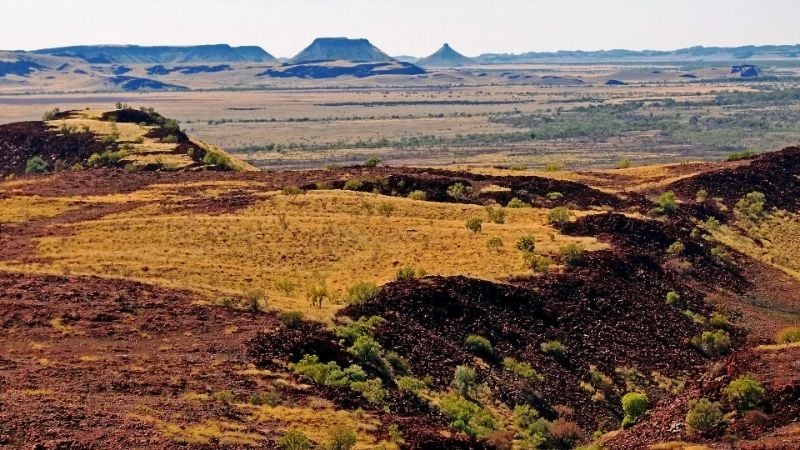
The Pilbara region of Australia. Image used courtesy of Wikimedia Commons
How Natural Hydrogen Production Works
According to the researchers, natural hydrogen generation relies on an oxidation-reduction (redox) reaction triggered when water encounters reactive, iron-bearing minerals like magnetite deep within the Earth's crust under hydrothermal conditions of high pressure and temperatures around 200°C.
During the process, some iron in the magnetite oxidizes, loses electrons, and transitions to a higher oxidation state. At the same time, water molecules act as electron acceptors and are chemically reduced, breaking their chemical bonds to release free molecular hydrogen gas.
Because this electron exchange occurs directly at the physical boundary where liquid meets mineral, the reaction's efficiency is heavily constrained by surface area and fluid contact. As a result, continuous hydrogen production would need active hydrothermal fluid circulation through subterranean fractures and permeable rock to ensure hot subterranean water repeatedly exposes and reacts with fresh magnetite surfaces.
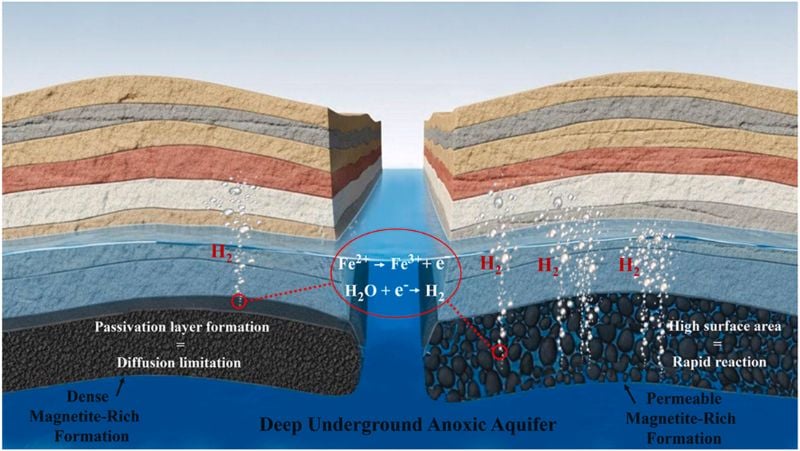
Underground hydrogen production. Image used courtesy of Moghanirahami et al.
Discovering Hydrogen Gas in Australian Rocks
In a laboratory, the team submerged magnetite samples in water heated to 200°C and held under high pressure for 60 days, mimicking the extreme temperature and pressure found deep within the Earth’s crust. The reaction between the mineral and water produced hydrogen gas.
The results not only confirmed that the reaction occurs, but also revealed what controls hydrogen production. Output depends on more than the amount of magnetite present; it also depends on the physical structure of the surrounding rock and whether water can penetrate fractures, pores, and other pathways to reach fresh, unreacted mineral surfaces. This could explain why some deposits may be more productive than others, while giving researchers potential indicators for identifying the most promising sites.
The ECU study is among the most detailed efforts to date to connect laboratory-scale chemistry with the complex realities of hydrogen production within large, underground rock formations.
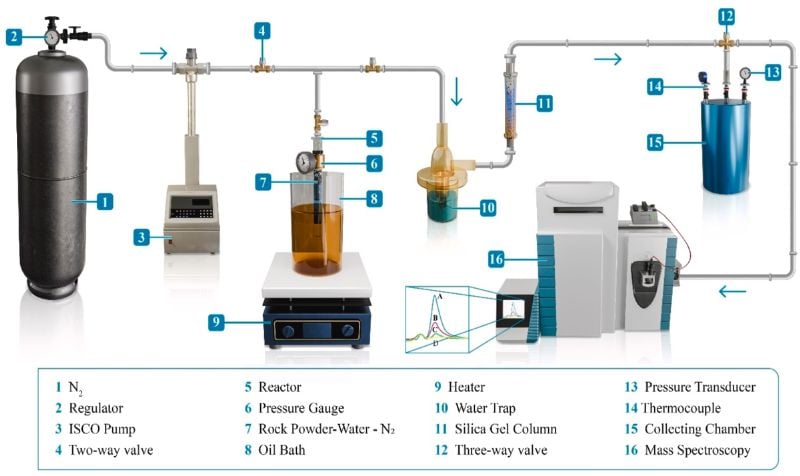
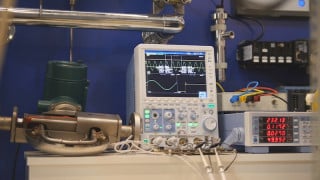
The experimental set-up. Image used courtesy of Moghanirahami et al.
Why This Matters for Clean Energy
Hydrogen is a promising alternative energy source. It can fuel heavy industry, power long-haul transportation, and store renewable energy for later use, producing no carbon dioxide at the point of use.
However, most hydrogen is made using fossil fuels, particularly natural gas, which can generate significant greenhouse gas emissions during production. Hydrogen produced using renewable electricity, called green hydrogen, avoids these direct emissions but remains energy-intensive and costly to produce at scale.
That’s why Australia’s naturally occurring hydrogen could offer a fundamentally different approach. Researchers could tap into hydrogen already generated through natural geological processes deep underground. The challenge then becomes identifying viable deposits and developing safe, economically feasible extraction methods.
If researchers can determine where hydrogen is being generated, how quickly it can be replenished, and whether it can be extracted at commercially useful rates, naturally occurring hydrogen could eventually become a piece of the low-carbon energy landscape.
A Possible Export Industry
For Western Australia, the implications could extend well beyond domestic energy supply. The Pilbara is home to some of the world’s largest banded iron formations, and the scale of these geological resources could potentially support both local energy needs and future exports. If geologic hydrogen can be recovered safely and sustainably, it could strengthen the state’s energy security while reducing reliance on imported fuels.
The findings are still early, and determining whether the process can be scaled will require further field testing, geological assessment, and engineering development. But by identifying the geological conditions that drive natural hydrogen formation, the ECU team has taken an important step toward understanding how Australia’s vast iron ore formations could support a new energy resource.
The study appeared in Hydrogen Energy.