Facebook
 Google
 GitHub
 Linkedin
ABB Launches MW Charging Fleets and High-Demand Needs
The OM X-Series coordinates charging and replaces isolated clusters to manage high-demand power distribution from 800 kW to over 10 MW.
p> As industries transition to electric fleets, transportation corridors and logistics hubs both share the same technical challenge: large fleets need charging, but it’s not as easy as adding more capacity. Simply adding more charging infrastructure creates isolated clusters that cause operational friction under high loads.
ABB’s OM X-Series replaces isolated clusters with coordinated site architecture. The charging system can be implemented on scales from 800 kW to 10 MW, with more than 100 charging points possible.
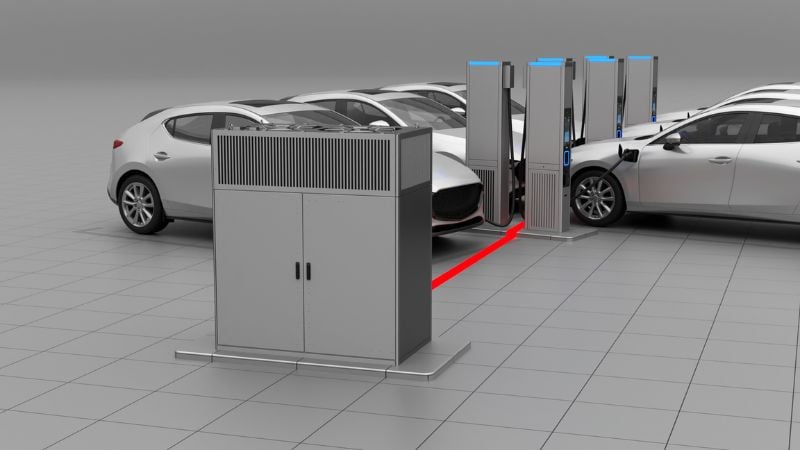
Fleet charging. Image used courtesy of ABB E-Mobility
Evolution of OM X-Series
The OM X-Series is ABB’s third architectural progression in electric mobility. The first was the A-Series in 2024, its first high-power charging system. The OM-M Series, launched in April 2026, extends those charging capabilities into site-level split systems.
The OM X-Series targets the highest performance applications. This distributed charging system is designed to replace the traditional clusters of charging points on a large site, as a large number of individual chargers are inefficient and cause grid and load issues.
ABB designed the X-Series to perform MW-scale charging over long durations, aiming to improve efficient load management for large numbers of charging vehicles.
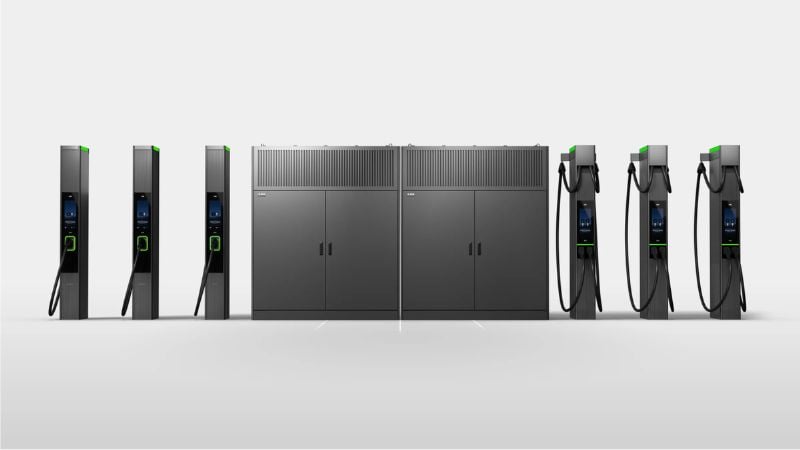
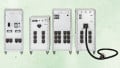
The OM X-Series. Image used courtesy of ABB E-Mobility
The X-Series Specifications
The X-Series has an expandable architecture from 800 kW up to at least 10 MW. Charging capacity is added by installing additional cabinets (each cabinet is 800 kW). Each cabinet can charge up to 12 vehicles, with a charging granularity of 66.5 kW (the amount of power distributed in blocks to different vehicles).
The X-Series has an output current of 2160 A, AC/DC-rated power of 750 kW, DC/DC-rated power of 800 kW, an output voltage of 200-950 VDC, and a DC bus-rated current of 1000 A. With liquid cooling technology, the system has a conversion efficiency of 98% and an operating temperature range of -30°C to 55°C (-22°F to 131°F).
The system was built for longevity, with a 100k+ charge cycle capability and an operational life of at least 15 years, and it can withstand harsh environments. According to ABB, the X-series operates at altitudes up to 2000 m (6562 ft) and at 95% humidity. It has an ingress protection (IP) rating of IP65 to protect against extreme weather conditions, including high heat and coastal conditions.
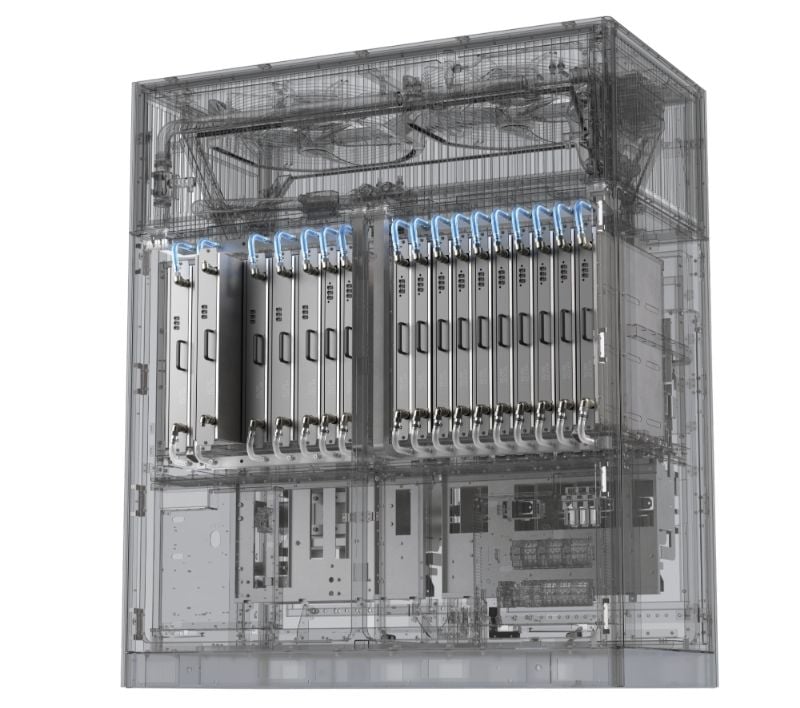
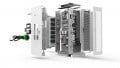
Inside the OM X-series cabinet. Image used courtesy of ABB E-Mobility
Charger Operations
The charging system is a DC-coupled architecture with three main elements:
- A site-level exposed DC bus and shared power spine that coordinates cabinets and storage. This allows capacity to move to demand areas in real time.
- Liquid-cooled silicon carbide modules to handle power conversion.
- Battery energy storage that connects directly to the DC bus.
The exposed DC bus acts as a backbone for site-wide power and enables power cabinets and distributed energy resources (DERs) to be dynamically coupled to it. This allows installation of multiple 800 kW cabinet units on the site at MW levels without changing the infrastructure or its siting. The approach not only allows adding more charging capacity as a site scales up, but also enables installation of more charging points without creating EV charging clusters that can affect local voltage stability and grid performance.
With an exposed DC bus, the architecture allows direct connection of the energy storage system. ABB stated that this improves the round-trip efficiency by 5% compared to AC-coupled systems. The direct connection to the DC bus eliminates the need for multiple AC-DC and DC-DC power conversions typically found in AC coupling and some other DC coupling co-location sites. As a result, it can perform peak shaving and demand management without additional conversion stages. The architecture can also support vehicle-to-grid operations.
The liquid-cooled power modules ensure the system delivers high current output without thermal derating, and the internal energy management systems dynamically share power from one cabinet across 12 outlets based on demand, making charging more efficient. As more cabinets are added, each one handles 12 charging outlets, allowing capacity to grow. The system also has a built-in redundancy that enables the chargers to keep working during planned and unplanned maintenance.
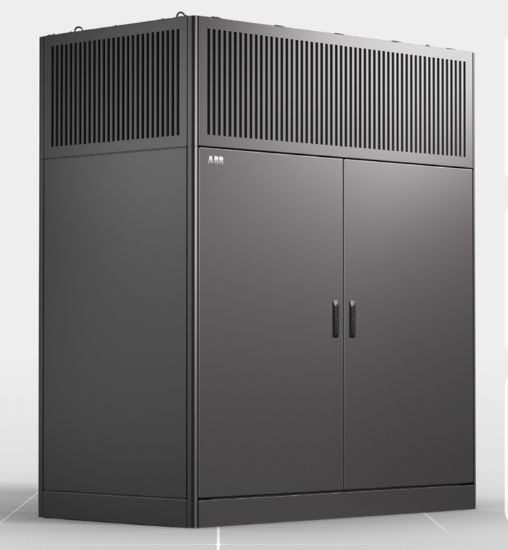
The X-series cabinet. Image used courtesy of ABB E-Mobility
Overall, the system shares power where needed and redistributes energy to meet demand, addressing issues of clustered demand. Large numbers of charging stations drawing energy from the grid simultaneously can cause instability issues.
Instead, the OM X-Series dynamically distributes power where it is needed most without putting as much strain on the grid. It’s an approach that aligns more closely with how utility companies distribute and manage power.
Thermal Management Is Critical
Efficient thermal management is critical to ensuring that MW charging sites are operational for years. Efficient cooling can safeguard high conversion efficiencies and reliability.
To facilitate efficient thermal management, the X-Series uses an end-to-end liquid-cooled power path. This is an integrated cooling unit inside the power cabinet that contains liquid-cooled power modules and liquid-cooled cables. This approach has been designed to deliver cooling and thermal management through every power conversion stage during charging.
Interchangeable With Other OM Series Systems
Both the OM M-Series and the OM X-Series share the same dispenser portfolio. The M-Series has an output of 200-1200 kW and a granularity of 50 kW, with up to 1.2 MW shared among 24 charging outlets. It may be a good starting point for companies not ready to invest in the X-Series. Charging sites can start with the M-Series and easily transition to the X-Series with minimal disruption if future needs require larger charging capabilities.