Facebook
 Google
 GitHub
 Linkedin
Magma for Power Plants? Harvesting Earth’s Molten Underworld
Could Earth’s vast magma formations be tapped for renewable energy? Scientists aim to find out by drilling into a volcano in northern Iceland.
A research effort is underway to validate deep hydrothermal systems that could generate electricity from molten rock in Iceland’s Krafla volcanic caldera.
The Krafla Magma Testbed (KMT) Project will observe and sample the hydrothermal zone where rock transitions to magma. At around 700 to 1,300°C (1,292–2,372°F), underground rock formations become partially melted magma in Earth’s lower crust and mantle. Drilling and injecting water into these boundaries can produce steam to spin turbines and generate power, similar to conventional geothermal plants.
KMT’s first drilling mission is expected to begin in 2026, followed by another in 2028. The project returns to the site where scientists unexpectedly encountered 1,000°C magma in 2009 when drilling 1.3 miles below Krafla’s surface. Targeting the same zone, KMT will install boreholes to collect samples and monitor subsurface activities.
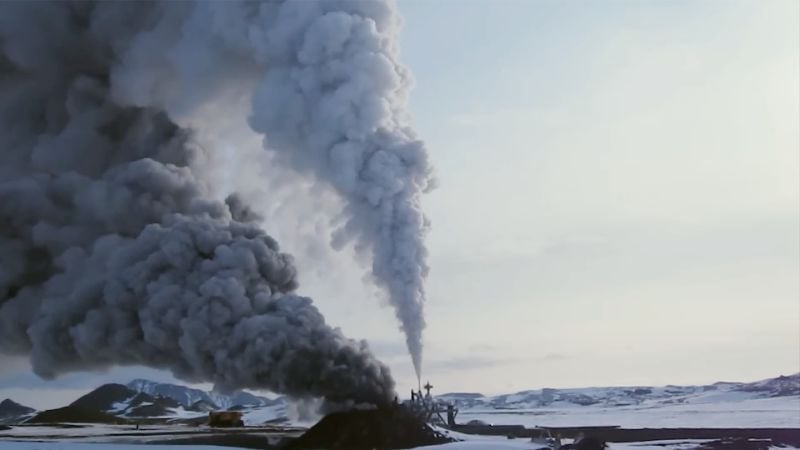
View from the surface of the Iceland Deep Drilling Project in the early-2000s. Image used courtesy of Landsvirkjun
The project will establish an open-access underground facility by 2030, where researchers can observe magma dynamics and, ultimately, test geothermal energy production systems.

Concept for the Krafla Magma Testbed. Image used courtesy of the study’s authors
Volcanoes: Next-Level Geothermal Energy
About 9% of the world’s population (over 800 million people) lives within 62 miles of active volcanoes spanning 86 countries. Harnessing supercritical temperatures beneath the Earth’s surface could provide baseload energy to balance the intermittency of wind and solar plants. Further, the geothermal process is free of greenhouse gas emissions.
The concept builds on the longtime efficacy of geothermal power generation, drawing from hot water or steam in natural reservoirs. The International Renewable Energy Agency states more than 15 GW of geothermal capacity has been installed worldwide, with countries in Asia and Oceania leading the way, followed by North America and Europe.
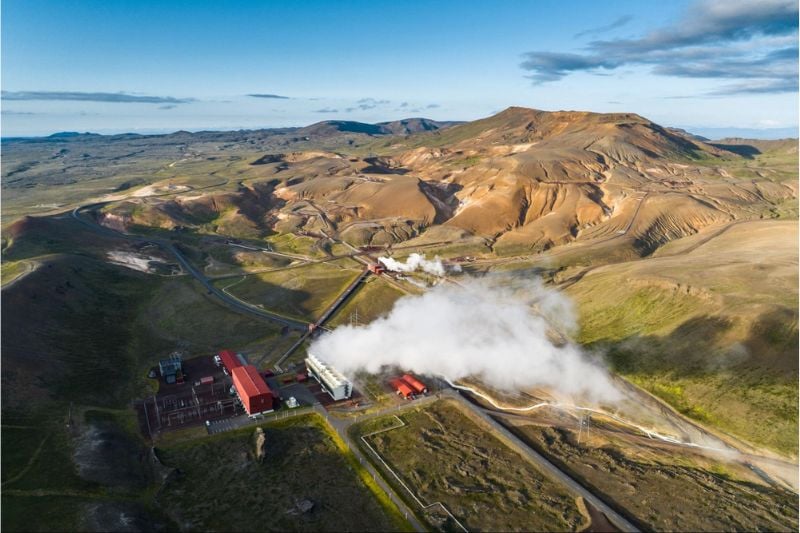
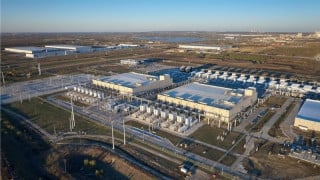
The Krafla Geothermal Power Station in northern Iceland. Image used courtesy of Landsvirkjun
Geothermal outputs depend on the reservoir type and generation method, whether steam or lower-temperature binary cycles. Steam-based systems—which use dry or flash techniques—typically operate in 200 to 343°C reservoirs 3,000 to 10,000 feet deep. Flash steam plants vaporize water in low-pressure tanks and then direct the resulting steam to turbines. Dry steam plants produce steam at the well’s surface, where a turbine’s blades turn to generate power. The steam is then reinjected into the reservoir as water after cooling.
Many geothermal plants harness medium enthalpy resources ranging from 80 to 180°C, corresponding to about 10 MW. Higher enthalpy operations at 180 to 390°C can generate 10 to 100 MW of power.
Next-generation geothermal energy systems could move the bounds even higher, targeting supercritical 390 to 600 °C resources such as high-enthalpy fluids emanating from magma bodies. Iceland is among the only regions where this underground heat can be pushed to the surface via a nationwide volcanic zone, bringing energy from the Earth’s core.
Learning From the Iceland Deep Drilling Project
In 2009, the Iceland Deep Drilling Project (IDDP) set out to sample liquid magma 2.4 miles below the existing 60 MW Krafla Geothermal Power Station operated by Landsvirkjun, Iceland’s largest power company. IDDP planned to flow-test the well to bring fluid to the surface as superheated 450°C steam at subcritical pressures. The researchers believed this could unlock 50 MW of energy, 10 times higher than the average output of high enthalpy geothermal wells.
About 1.3 miles into boring below the surface, the drillbit hit an unexpected pocket of magma. Temperature readings indicated three feed zones between 1.2 and 1.6 miles, then rising to 385.6°C at 1.7 miles deep. Later, the IDDP team found that the lowermost units of the detached drillbit contained 30% quenched volcanic glass, indicating the presence of 1,000°C rhyolitic magma.
Tests at different wellhead pressures revealed that the site could produce up to 36 MW at 45°C temperatures, depending on the turbine system design. As such, this meant two wells would be sufficient to replace the 60 MW Krafla plant.
The site was later plugged to avoid damage from acidic fluid and pressure. The well and its surface equipment experienced extreme corrosion from acid gasses, silica scaling, and erosion, highlighting the need for more durable components.
While IDDP validated the concept of controlled drilling into the magma, KMT will go further by taking core samples and measurements.
Drawing Energy from Magma Chambers
Krafla’s reservoir contains rhyolitic magma, a highly viscous volcanic rock material. KMT will target a relatively thin magma body that scientists expect is the ideal site for setting up an observatory to instrument, sample, and manipulate rhyolitic content. The project will construct monitoring facilities and underground magma portals for experimentation.
Experiments will focus on the rock-magma hydrothermal interface, studying its properties and dynamics in response to geothermal drilling and fluid injection. Researchers will also test novel precision techniques to locate and characterize magma bodies.
_and_basaltic_body_(blue).jpg)
A 3D rendering of Krafla’s rhyolitic magma body (in red) and basaltic body (blue). Image used courtesy of the study’s authors
The first well, KMT-1, involves drilling a single hole about 1.3 miles deep to sample and instrument the rock-magma interface. Advanced sensors will provide direct measurements for the gas content, temperature fluctuations, crystallization, and pressure in the volcano. KMT-2 will conduct on-site experiments to validate near-magma energy production.
Corrosion- and temperature-resistant instrumentation devices will line the wells to the magma. The project will also add a multi-parametric monitoring network on the surface.