Facebook
 Google
 GitHub
 Linkedin
AI Battery Tester Finds Faults in Seconds
Monolith AI combines self-learning algorithms and physics-based modeling to optimize EV battery performance.
NIO Europe has partnered with U.K.-based Monolith AI to leverage artificial intelligence to analyze field-generated data from the car giant’s power swap program, a battery-as-a-service (BaaS) allowing drivers to exchange their electric vehicle batteries with fully charged units in under three minutes.
What is anomaly detection? Here’s a demonstration. Video used courtesy of Monolith AI
The partners will develop a machine-learning model to understand how daily battery use impacts performance, comparing field data from NIO’s swap stations to test-bench data assembled by engineers. Monolith AI’s Anomaly Detector augments manual data cleaning and resampling, speeding up critical testing tasks.
In addition to streamlining EV battery development, Monolith AI’s algorithms will guide next-generation updates to NIO’s power swap technology. It’s quickly gaining traction in Europe, with 98% of users in five regional markets preferring the charging service. According to CnEVPost data, the company has over 50 European swap stations as of mid-2024, primarily in Norway and Germany.

This NIO power swap station opened in Emsbüren, Germany, in November 2023. The company plans to leverage machine learning algorithms to support its European battery development. Image used courtesy of NIO
AI-Based Automation Tool for Battery Test Engineers
EV manufacturers are increasingly adopting AI-enabled simulations and digital twins to predict technical faults early in the development process. Machine learning tools allow test engineers to quickly validate large volumes of measurement data generated by battery management systems (BMS), software that monitors power distribution serving the drivetrain. Developers can further leverage advanced battery models and interchangeable physics libraries to optimize their algorithms.
Monolith’s AI simulations cover thousands of virtual tests, including common battery performance issues like capacity degradation and internal resistance—two factors causing diminished energy storage capacity and efficiency. For example, users can model capacity fade with 99% accuracy and identify 75% of redundant cell testing repetitions to develop improved charging protocols maximizing battery life.
Monolith claims its Anomaly Detector software can identify more than 95% of known errors, sweeping multiple measurement types across hundreds of channels in seconds. The company’s website mentions that NIO has used its simulation platform to accelerate component development and cut manual testing needs in half.

Monolith AI testing display. Image used courtesy of Monolith AI
Monolith’s self-learning algorithms automate raw data inspection to spot errors across hundreds of test channels in seconds. Users can start with clean test data to customize a model for their battery system. Then, they can train the detector algorithm to rank issues based on priority. For instance, models predicting thermal runaway and spontaneous discharge can help engineers integrate advanced cooling features to optimize battery life and performance.
Monolith AI’s algorithms can be more accurate than conventional equivalent circuit models that simulate voltage dynamics and cycling in BMS software. They’re also simpler than pseudo-two-dimensional (P2D) models, which measure electrochemical transport and thermodynamics in lithium-ion batteries.
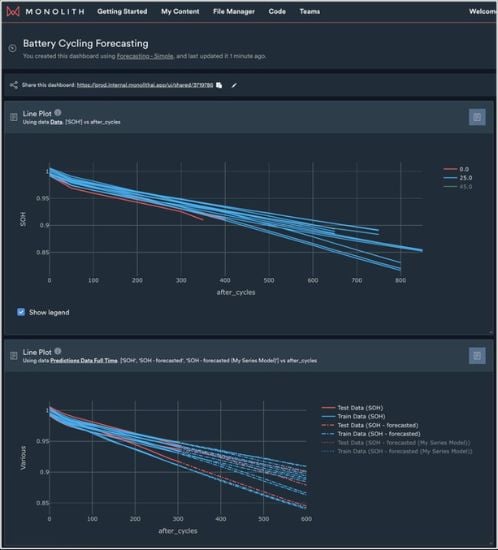
Monolith’s battery cycling forecasting tool. Image used courtesy of Monolith AI
NIO’s Battery Performance Improvements
NIO will use battery performance data from Monolith AI’s Anomaly Detector to compare test benchmarks and inform future verification-related activities for its battery development. The software allows NIO’s engineers to quickly spot abnormalities in cross-channel results.
The partnership will also help NIO improve its power swap stations, which check EVs’ battery health and electric drive system performance. NIO is now rolling out its third-generation power swap stations to several markets, adding faster and higher-capacity swapping and more efficient vehicle-station compatibility.
The service entered Europe in late 2021 and has grown to dozens of sites. The company is scaling up deployment to meet demand among the estimated 40% of European EV drivers without home charging access. NIO is launching initiatives in the Netherlands, Sweden, Germany, and Denmark to employ power swap stations as grid-stabilizing resources. It also plans to launch its first bidirectional station to feed power to Europe’s grid.