
 Facebook
 Google
 GitHub
 Linkedin
The Nuclear Push: Fusion and Microreactors Leap Ahead
Funding fuels fusion magnet manufacturing, microreactor technology, and nuclear reactor innovation.
Momentum is building in advanced nuclear in three areas: fusion manufacturing, military microreactors, and AI-assisted reactor development. Recent developments focus on turning promising reactor concepts into commercial systems by expanding manufacturing capacity, advancing deployment, and slashing the massive time and cost it takes to design and license new nuclear plants.
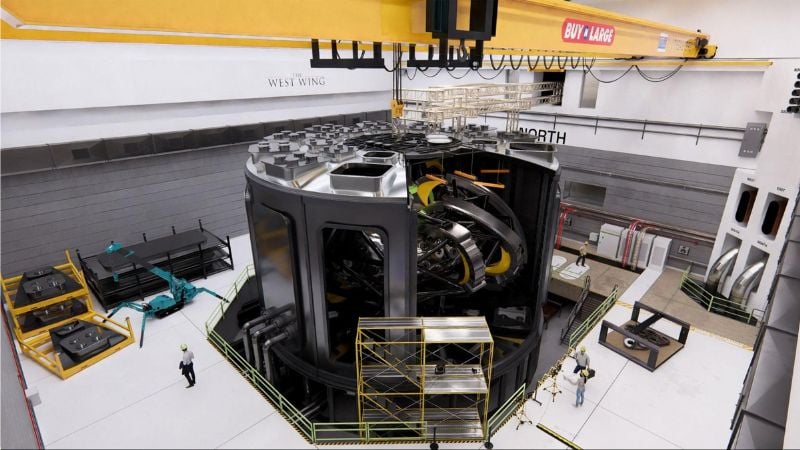
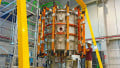
Thea Energy's Eos fusion power stellarator demonstration system. Image used courtesy of Thea Energy
Fusion Magnet Manufacturing Scales Up
Thea Energy has secured a $20 million ARPA-E grant to launch its first manufacturing line for high-temperature superconducting (HTS) magnets used in fusion reactors.
High-temperature superconducting magnets are a key enabling technology for many fusion concepts because they generate the powerful magnetic fields needed to confine plasma while reducing energy consumption and system size.
,_breeding_blanket_(blue_and_black),_shaping_coils_(orange),_encircling_coils_(gray),_and_surrounding_cryostat.jpg)
Cutaway view of Thea Energy's Helios stellarator architecture showing the plasma (in green), breeding blanket (blue and black), shaping coils (orange), encircling coils (gray), and surrounding cryostat. Image used courtesy of Thea Energy
The funding will support Thea Energy's plans to scale up the production of modular magnets for its planar coil stellarator power plants, including Eos, the company's first large-scale integrated system.
Eos is designed to demonstrate steady-state fusion as a key milestone toward the company's Helios power plant. Helios will use a deuterium-tritium plasma and is designed to generate 960 MW of fusion power. Thea has also partnered with NVIDIA and Synopsys to build a digital twin of the stellarator.
Thea Energy reported that it remains on track to bring Helios into operation in the 2030s.
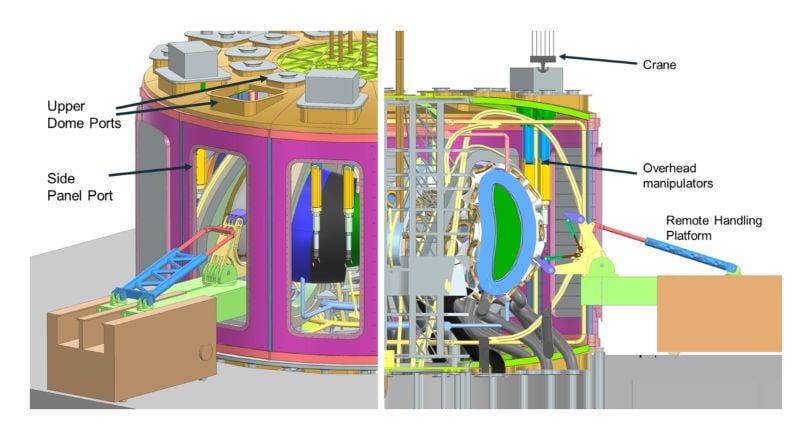
Two views of Helios's remote handling system. Image used courtesy of Thea Energy
Military Microreactors Move Closer to Deployment
Antares has raised $470 million to build nuclear microreactors for the U.S. military. The funding will help the company deploy its reactors in the field, beginning with its 100-kW Mark-1 reactor in 2027, followed by initial U.S. Air Force deployments in 2028.
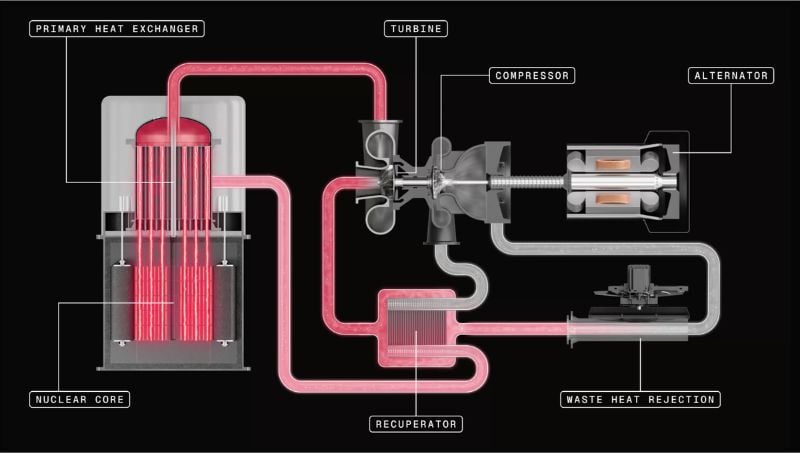
An overview of Antares's microreactor design. Image used courtesy of Antares
The company first brought its Mark-0 microreactor to criticality earlier this summer at Idaho National Laboratory using a full-scale core fueled with TRISO-coated particles. The zero-power test confirmed the reactivity controls and system-level safety performance, providing a technical foundation for the upcoming electricity-producing Mark-1 reactor set for 2027. According to the company, its reactors are designed to operate for over six years without refueling.
Microreactors are gaining interest for defense applications that require reliable, uninterrupted power for military installations, particularly at remote military outposts. Their small footprint and long operating life also make them attractive for locations where fuel deliveries are difficult, or grid infrastructure is unavailable, reducing the logistical burden of supplying remote installations.
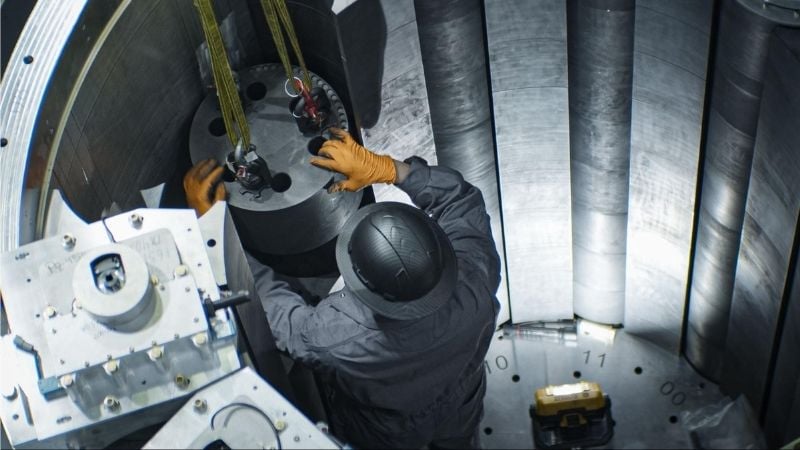
Antares's Mark-0 reactor reached criticality in June 2026. Image used courtesy of Antares
AI Workflows to Shorten Reactor Development Schedules
The U.S. Department of Energy selected the Prometheus project for a three-year, $60 million grant to apply AI across the reactor development lifecycle, from engineering and regulatory documentation to construction planning and plant operations.
The project brings together 32 partners to develop specialized AI workflows to speed up reactor design, licensing, construction, operation, fuel fabrication, and document management. Prometheus draws on technologies from multiple national laboratories, AI giants like NVIDIA and Microsoft, and leading advanced nuclear players including X-energy, Westinghouse, TerraPower, and Oklo.
Prometheus aims to reduce overall reactor deployment timelines and operating costs by 50%, while achieving a tenfold reduction in design and licensing time and a threefold reduction in manufacturing cycle time.
Learn more about the Genesis Mission. Video used courtesy of Argonne National Laboratory
An initial platform prototype has already been developed. Under Phase II, the project will expand the prototype into the production-ready Genesis Mission Platform, with initial deployment targeted for March 2027. Broader commercial and DOE adoption is planned later that year, according to Idaho National Laboratory's website.








All forms of energy used by mankind are finally converted on heat, so that taking into account also the continuously increase of world population, the planet temperature is increasing up to a limit where a dramatic transition will occur at 2035+/-3 when over 80% of population will disappears.
Ask for details @ .(JavaScript must be enabled to view this email address)