Facebook
 Google
 GitHub
 Linkedin
Briefs: New Tech Debuts for EVs, Batteries, and Power Grids
Tesla, Nissan, Lightyear, Toshiba, Electrified Thermal Systems, Ampacimon, and AP Sensing have made recent technical advancements.
Electric vehicles are leading the way in technical advancements in batteries, renewable energy use, and power components. Tesla is producing its 4680 batteries with dry electrode coating, and Nissan is collaborating with Lightyear for a solar-powered EV. Toshiba has focused on internal automotive aspects with a new IC gate driver.
In other developments, Electrified Thermal Systems is launching its first commercial-scale thermal battery, and Ampacimon and AP sensing are teaming up for a transmission line monitoring system.
Tesla, Nissan, and Toshiba are among the companies advancing EV tech.
Tesla Says It Has Solved the 4680 Dry Electrode Issue
Tesla has conquered the dry electrode process in the 4680 battery cell, according to company reports. In its Q4 update, Tesla stated that the 4680 is in production, using dry coating for both the anode and the cathode.
The dry electrode process in 4680s has been particularly elusive for cathodes. While graphite is used for the anode, the cathode uses hard metals such as nickel and cobalt, which are difficult to compress to the thinness necessary for dry coating. The mechanical strain made scaling up difficult.
Tesla resolved the problem by mixing the active anode and cathode powders with a binder first, and then adding the dry binder. The method allows the carbon to distribute evenly around the active particles before the binder “fibrillates,” or turns into sticky threads that cause lumps. Tesla also uses a low binder content of about 2%.
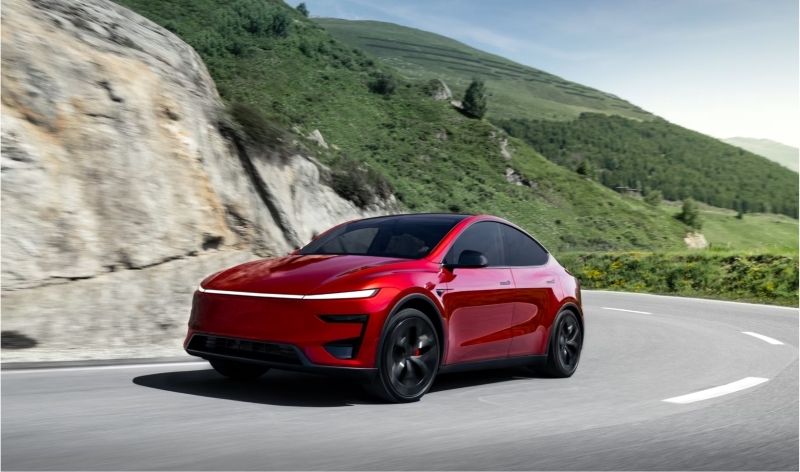
Tesla Model Y. Image used courtesy of Tesla
The method creates a thin, even film, allows multi-stage calendering, and prevents the strain that previously caused mechanical failures.
Dry coating has significant improvements over the traditional wet process, which uses toxic chemicals and requires drying ovens.
The Tesla Model Y vehicles now in production will use the new 4680 batteries.
Can Solar-Powered EV Increase Range and Reduce Charging Needs?
Nissan claims its solar-powered concept electric vehicle, the Ariya, can add up to 23 km to its range and reduce charging frequency by 65%, depending on sunlight and local conditions.
Nissan is collaborating with Dutch company Lightyear, a solar mobility specialist, to develop and test the EV, which is equipped with 3.8 square meters of photovoltaic cells in the hood, roof, and tailgate. The Ariya’s integrated PV panels supplement the EV’s standard battery pack.
In tests, regional differences affected driving range gains. In London, the range increase was only 10.2 km, while 21.2 km were added in Dubai. Charging frequency also spanned from 35-65%, depending on location. Nissan stated that a commuter traveling 6,000 km per year could reduce annual charging visits from 23 to just 8.
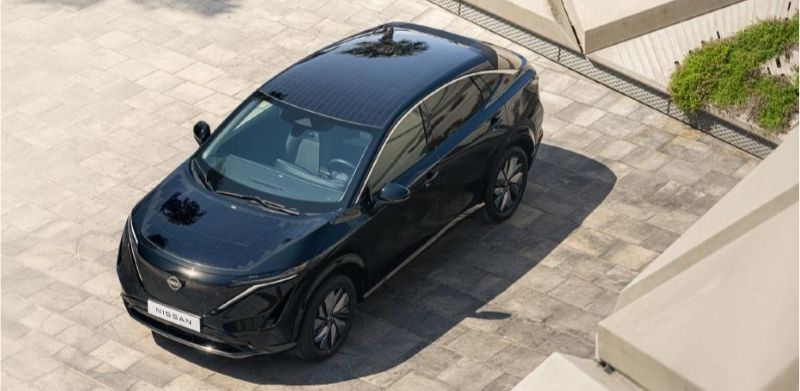
The solar-powered Nissan Ariya. Image used courtesy of Nissan
The solar-powered model is a demonstration car only and not available for purchase. Nissan offers a standard (non-PV) Ariya model in Europe, Japan, and Canada.
Toshiba Samples Gate Drive IC for Automotive DC Motors
Toshiba Electronics Europe is shipping engineering samples of its new gate drive IC for high-current brushed DC motors. The TB9104FTG is suitable for applications such as sliding doors, powered tailgates, and seat adjusters.
The TB9104FTG uses an intelligent serial peripheral interface (SPI) that can initiate motor drive and reduce microcontroller processing load. The SPI reduces the need for complex wiring harnesses.
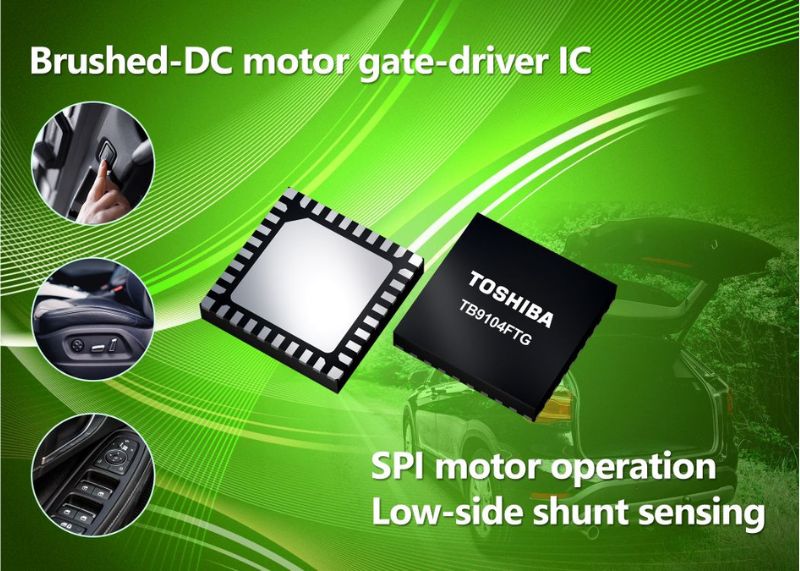
The TB9104FTG. Image used courtesy of Toshiba
The IC, housed in a 5 x 5 mm VQFN32 package, can drive a single high-current motor or run two DC motors together in half-bridge mode. An exposed pad enhances thermal dissipation.
Also integrated is a high-precision current sense amplifier that monitors for overheating, low voltage, and other anomalies. The AEC-Q100 (Grade 1) qualification ensures reliability between -40°C and +125°C.
ETS To Launch Its Thermal Brick Battery at Texas Facility
Electrified Thermal Solutions (ETS), a Massachusetts-based startup, will commission its first commercial-scale thermal brick battery at the Southwest Research Institute in San Antonio, Texas.
The Joule Hive Thermal Battery uses electrically conductive firebricks as both a heating element and a storage medium. It can store 20 MWh of heat at peak temperatures from 1,500°C to 1,800°C (3,275°F) to supply on-demand hot gas for industrial equipment such as kilns and boilers.
The battery uses 13.2 kV of AC power from the power grid and does not require step-down transformers. The modular units can be scaled to meet site and use needs.
The Joule Hive Battery system. Video used courtesy of ETS
Initially developed at MIT, the firebricks have a 20-year lifespan and can withstand “near-flame” temperatures exceeding those of lava.
ETS plans full commercial deployments in 2026 with industry partners, including ArcelorMittal (steel), Holcim (cement), and Vale (mining).
Ampacimon Partners with AP Sensing for Line Monitoring and Grid Optimization
Ampacimon and AP Sensing are collaborating to provide solutions for overhead line monitoring and grid optimization using dynamic line rating and distributed fiber-optic sensing (DFOS).
With the strategic partnership, Ampacimon and AP Sensing aim to integrate optical fiber within the ground wires of overhead transmission and distribution lines. This method can provide grid operators with real-time data without using additional sensors on conductors.
According to Ampacimon, DFOS systems can deliver precise insights into temperature, vibration, and strain. It can cover long distances without signal degradation and is resistant to electromagnetic interference.