Facebook
 Google
 GitHub
 Linkedin
Coating Silicon Anodes Before Calendering Increases Battery Life
Scientists found that a PVDF–MgO coating applied before calendering reduces swelling and lithium plating in silicon-graphite anodes, extending cycle life in laboratory cells.
Battery makers have long considered silicon a promising anode material for next-gen lithium-ion batteries because it can store far more lithium than graphite, but these ambitions have been tempered somewhat by a fundamental mechanical problem. Over repeated cycles, the silicon-anode alloy expands and contracts, fracturing particles, breaking internal electrical contact, destabilizing the solid electrolyte interphase, and accelerating capacity loss.
However, National Taiwan University researchers have proposed a relatively modest intervention that addresses silicon’s failure modes. They discovered that using a composite of polyvinylidene difluoride (PVDF) and magnesium oxide (MgO) during manufacturing can significantly extend the lifespan of high-capacity silicon-graphite batteries without needing expensive new materials.
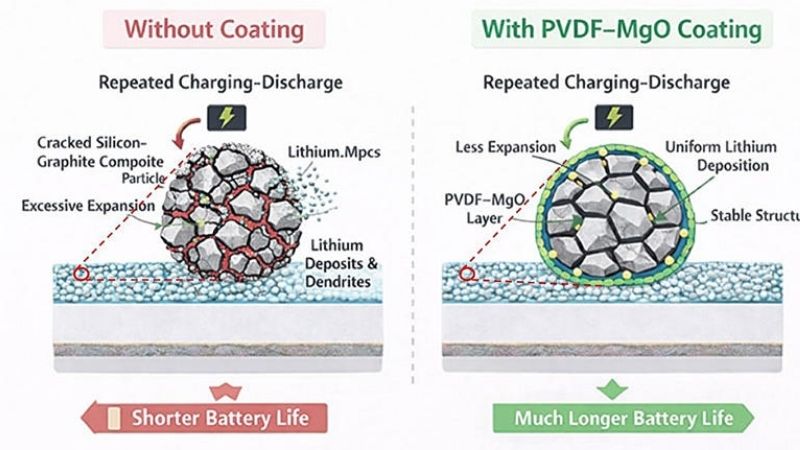
Anode without coating vs. with coating. Image used courtesy of Asia Research News/National University of Taiwan
Designed for Manufacturing
The researchers found the composite coating made from polyvinylidene difluoride and magnesium oxide nanoparticles could significantly extend the lifetime of silicon-graphite anodes when applied at the right stage of electrode manufacturing. Rather than redesigning the anode chemistry, they focused on interfacial stabilization and process sequencing, both of which are familiar concerns in battery manufacturing.
In the base formulation, they combined the active material with conductive carbon and a lithium polyacrylate binder, with the active fraction accounting for the vast majority of the electrode mass. This reflected the direction many developers have taken in recent years, using silicon as an additive to raise energy density while relying on graphite to moderate mechanical stress.
The protective layer consisted of PVDF as a polymer matrix with dispersed MgO nanoparticles. Both components are widely used or well understood in the context of batteries, with PVDF already established as a standard binder and coating material, and with metal oxides under exploration as interfacial modifiers to improve stability and ion transport. The novelty in this research, however, lies in how the researchers integrated the coating into the electrode.
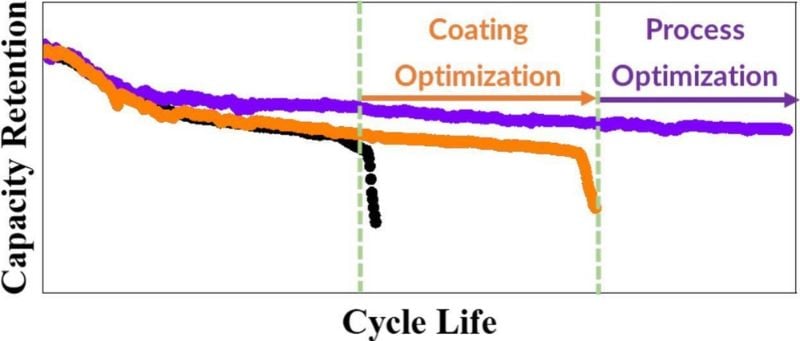
Sequential optimization of coating composition and processing helps to enhance the cycling stability and capacity retention of silicon-graphite anodes. Image used courtesy of Lin et al.
In conventional electrode fabrication, calendering is used to compress the coated electrode to a target thickness and porosity, improving particle contact and adhesion to the current collector. In this work, the PVDF-MgO coating was applied before calendering, while the electrode structure was still relatively porous. The electrode was then calendered to achieve roughly 30% thickness reduction.
Applying the coating before densification allows it to penetrate the porous network and remain continuous after compression. The study’s authors compared this approach with coatings applied after calendering and found that post-calendered coatings are more prone to cracking and delamination during cycling. In effect, the sequence determines whether the coating becomes part of the electrode structure or remains a fragile surface layer.
Measured Gains in Stability and Cycle Life
Both electrochemical performance and physical measurements reflected the impact of this process change. In half-cell testing against lithium metal, the best-performing pre-calendered PVDF-MgO electrodes were cycled at 0.3C for more than 760 cycles, retaining about 77% of their initial capacity. Coulombic efficiency during stable operation exceeded 99.9%, suggesting that parasitic reactions were largely suppressed once the interphase stabilized.
_and_Coulombic_efficiency_(right).jpg)
Capacity retention (left) and Coulombic efficiency (right). Image used courtesy of Lin et al.
Mechanical measurements supported this finding, with cross-sectional analysis showing that uncoated silicon-graphite electrodes expanded from roughly 49 µm to 116 µm after cycling, corresponding to about 137% thickness growth. Electrodes treated with the optimized PVDF-MgO coating expanded from around 53 µm to 79 µm, or about 49%. Reducing electrode swelling by that margin has direct implications for maintaining internal contact and limiting crack formation over long cycling periods.
The researchers also probed lithium plating behavior under deliberately aggressive conditions. In high-rate and over-lithiation tests, uncoated electrodes and those coated with PVDF alone develop needle-like lithium deposits on the surface. Electrodes coated with the PVDF-MgO composite show much more uniform lithium deposition, with far fewer dendritic structures. The authors attributed this to a more stable interfacial environment that promotes even lithium-ion flux and nucleation during charging.
Interpreting Failure Modes and Next Steps
One particularly prominent aspect of this research is the authors' interpretation of end-of-life behavior. Even in the best-performing cells, capacity eventually drops sharply. To understand whether this reflects irreversible anode damage, the team rebuilt cycled electrodes into new coin cells with fresh lithium and electrolyte. In those rebuilt cells, a significant fraction of the original capacity is recovered for hundreds of additional cycles.
That observation suggests that electrolyte depletion or lithium counter-electrode degradation plays a substantial role in the observed failure, at least in the half-cell configuration used for testing. It also highlights the importance of validating the approach in full cells, where lithium inventory is fixed, and failure mechanisms can differ from those seen in laboratory half cells.
Practically, the approach’s appeal lies in its compatibility with existing manufacturing practices. Calendering is already a standard step in lithium-ion electrode production, and both PVDF and MgO are established materials. Introducing a coating step before calendering adds some process complexity, but it does not require anything major, like new active materials or unconventional equipment. The reported areal capacity of about 2 mAh per square centimeter is appropriate for laboratory studies, though higher loadings will need to be demonstrated to assess relevance for commercial cells.
The study appeared in the Chemical Engineering Journal.