
 Facebook
 Google
 GitHub
 Linkedin
Ampera 3D-Prints First Nuclear Reactor Module
The full-scale subcritical thorium reactor module is designed for portable, container-based energy generation.
As competition heats up in developing advanced nuclear reactors, Florida-based startup Ampera aims to stand out in the field with a 3D-printed thorium reactor module.
While others have created proofs of concept and full-scale mock-ups of 3D-printed nuclear reactors, Ampera has now completed production of its first full-scale reactor module. The module contains the core and pressure vessel and was recently unveiled at Ampera's innovation center.
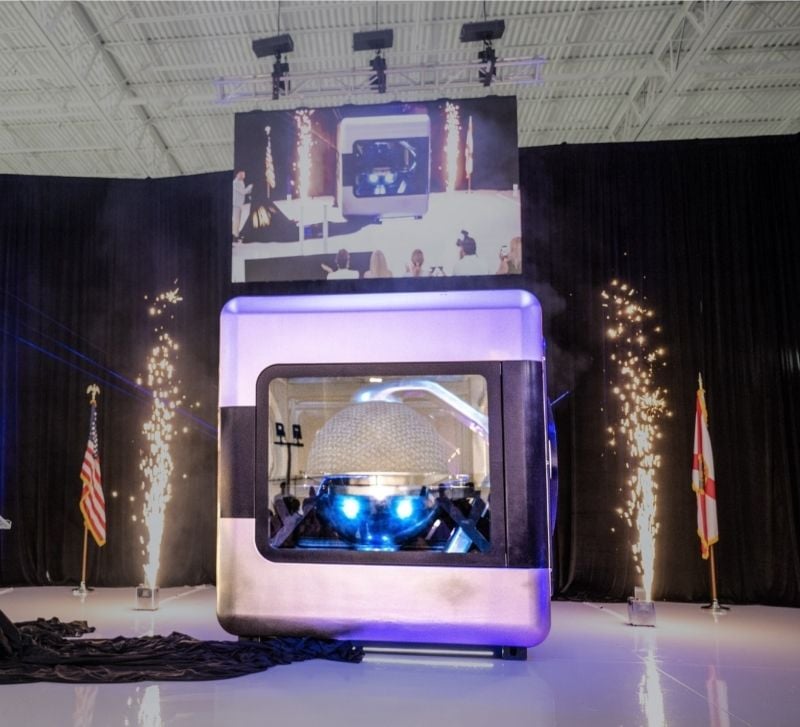
The 3D-printed nuclear reactor core. Image used courtesy of Ampera
Ampera’s Thorium Nuclear Reactor
Ampera’s thorium nuclear reactor is classified as a “subcritical thorium breeder microreactor.” These are intended to be small nuclear systems that will fit inside a shipping container and run for up to 30 years without refueling. Ampera aims to use container-based reactors in various industries, from AI and cloud data centers to defense and maritime shipping, where the containers can be installed onsite.
The reactor uses Thorium (number 90 in the periodic table), a weakly radioactive actinide that is three times more abundant than uranium and can be converted into reactor fuel. While most reactors are critical systems where a fission chain reaction becomes self-sustaining once initiated, the Ampera thorium reactor is different.
The reactor operates in the subcritical regime and does not self-sustain the fission chain reaction once initiated. Therefore, the reactor relies on external neutron generators to continually supply the neutron flux sufficient to convert the thorium into uranium-233 and sustain fission within the core. The initial conversion of thorium to Uranium-233 takes 20-30 days, but once the reactor has reached that state, it can sustain the fission process for the life of the reactor.
Once these neutron generators are turned off, the reactor shuts down, making it safer as it can’t go out of control via chain reaction. After shutdown, restarting the reactor doesn’t require a long wait because an extended cool-down isn’t necessary. The reactor can be shut on and off immediately with stable ramp rates, a key design feature.
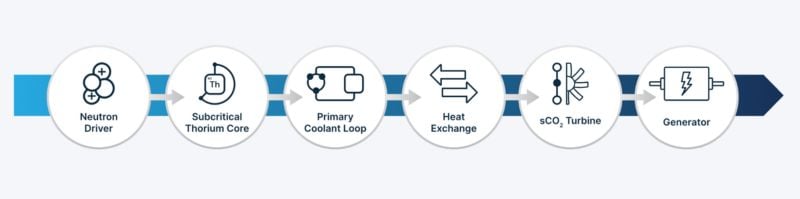
Ampera’s process. Image used courtesy of Ampera
This approach to nuclear reaction generation also provides more power. Because the external generators create a neutron flux that governs the reactor, if more power is required, they can be set to a higher neutron output.
The reactor core is designed as a spherical gyroid shape because it has been determined to offer the best neutron efficiency and thermal performance. It’s about 2 m in diameter and will have channels in the gyroid lattice roughly 2 mm wide. These channels cannot be machined with conventional manufacturing technologies, but 3D printing offers much greater design freedom, especially for complex geometries and channel structures.
The 3D Printer
While Ampera had not previously 3D printed the gyroid reactor core, they had already produced proof-of-concept cores from plastic and silicon carbide (the materials of choice for the core) on a smaller scale. Silicon carbide has been chosen for its high-temperature stability, as it can withstand temperatures up to 3000°C, which is within the reactor's operating temperature range.
Ampera’s 3D printer measures roughly 10 x 10 ft. Because the reactors are in standard container sizes and are delivered via global freight transport, they can be shipped by truck, rail, ship, or military cargo aircraft to the installation site, much like battery energy storage systems.
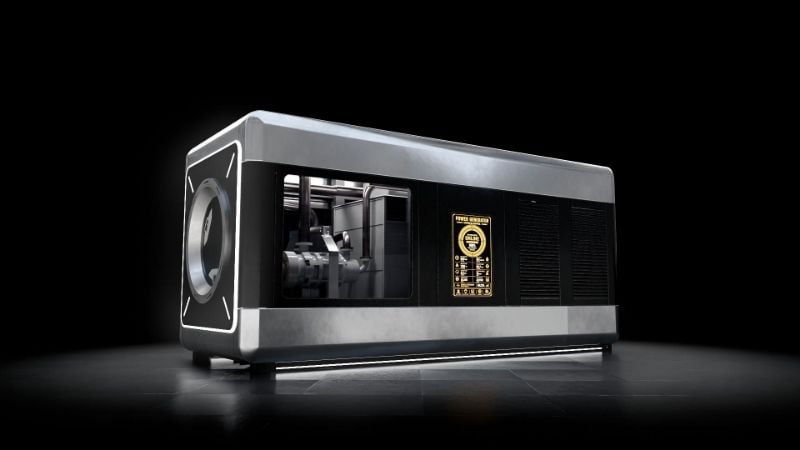
The reactor module. Image used courtesy of Ampera
The 3D-printed cores are expected to provide up to 30 MWe of power (roughly 15 MW electrical output) within the 40-foot containers in current designs. Larger power configurations are also planned for the future. To reach 30 MWe, two reactor cores operate in tandem. The reactor core is expected to have a conversion efficiency of around 50%.
The 3D-printed reactor cores are not the only critical part of the installation. Multilayered shielding, a heat exchanger, a turbine, and a generator surround the cores. Helium is used as a coolant to carry the heat generated by the 3D-printed reactor core and transfer it to supercritical carbon dioxide. This drives a closed-loop Brayton-cycle turbine to generate electricity.
Once thorium fuel is added to the core and sealed, the reactor core will run continuously for 30 years at full capacity without refueling. The ability to 3D-print the full-size core is a key stepping stone toward the commercial viability of these container reactors.
The company states that it eventually wants to produce 300 units per year and is evaluating the possibility of operating from a 300,000-square-foot facility for its first production line.
The Secured Thorium Supply
While the reactor is a novel approach compared to other reactors, it would be nothing without available fuel. Before demonstrating that the reactor core could be 3D-printed, Ampera had already secured the raw thorium material from Australia. Using raw thorium, Ampera plans to manufacture thorium tri-structural isotropic (TRISO) fuel in the U.S> using a proprietary liquid-metal jetting process.








yeah,the thermonuclear energy is the future!