Facebook
 Google
 GitHub
 Linkedin
New Life for Old Batteries: EV Power Becomes Energy Storage
Toyota, Mazda, and Voltfang are developing energy storage technologies with used electric vehicle batteries.
Automakers are putting retired electric vehicle batteries to work in stationary storage, bringing second-life applications from pilot projects and into operation.
In Japan, Toyota and Mazda are testing an energy storage system that integrates used EV packs into Mazda’s in-house power plant, while in Germany, startup Voltfang is expanding the production of commercial and grid-scale systems built from used or overproduced EV batteries.
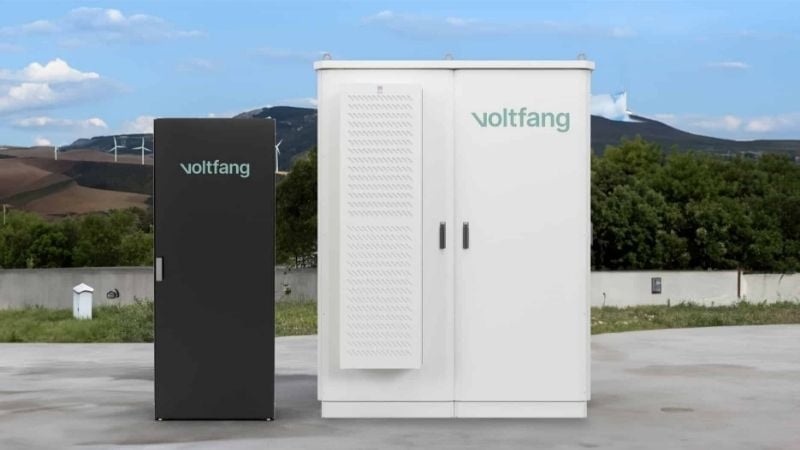
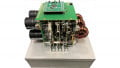
Voltfang 2 commercial battery storage system. Image used courtesy of Voltfang
Field Tests: Toyota and Mazda Team Up on Energy Storage
Toyota is conducting field tests on energy storage technology at Mazda's headquarters in Hiroshima Prefecture, Japan, home to the only power generation system currently operated by a Japanese automaker.
The system integrates used EV batteries with Toyota’s Sweep Energy Storage System, which controls charging and discharging across multiple battery types. It can switch each battery’s power flow on and off in microseconds, even when connecting batteries with different capacities or degradation levels. Toyota first demonstrated its Sweep technology in 2022 at a grid-scale facility, proving it could handle batteries from hybrids, battery-electric vehicles, and fuel cell vehicles in the same array. This approach avoids the need for identical modules, a limitation that has slowed other second-life projects.
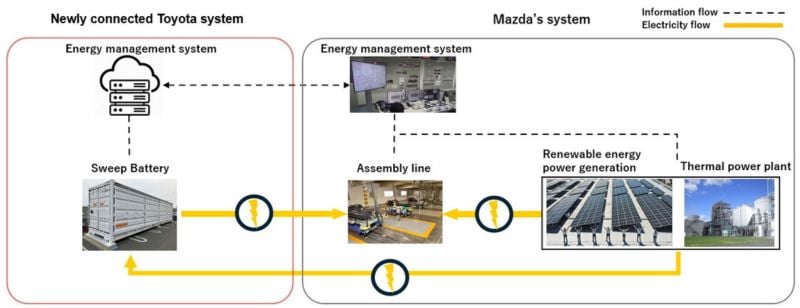
Energy storage system concept utilizing Toyota and Mazda technologies. Image used courtesy of Toyota
The test aims to evaluate how such systems can stabilize fluctuating renewable power generation and demand. An infographic released by the companies shows Toyota’s system regulating energy flow in connection with Mazda’s separate energy management platform. Together, they oversee the exchange of power and information across solar and thermal generation, assembly-line operations, and other end-applications.
The partnership is part of a broader effort to build a circular EV battery supply chain in Japan, where EV adoption remains low, with only 2% of car sales, while hybrid vehicles account for more than half. Toyota mentioned the Japan Automobile Manufacturers Association's broader priorities to address seven industry challenges, from material sourcing to charging infrastructure. Last year, Toyota President Koji Sato said the company would focus on stabilizing critical resource procurement and trade, including securing reliable semiconductor supply routes.
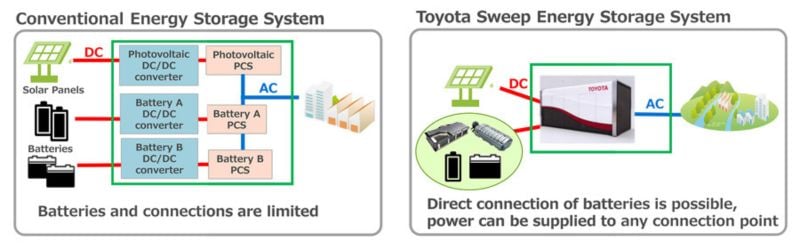
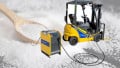
Toyota's Sweep Energy Storage System launched in 2022 with a grid-connected project. Image used courtesy of Toyota
Voltfang Second-Life Gigafactory
Voltfang, a German startup specializing in second-life EV battery storage, has launched a 6,000-square-meter production facility called the Voltfang Future Lab. The site, previously an EV production plant for Next.e.GO, will manufacture storage systems with repurposed EV batteries from European automakers, either used or from overproduction. The facility is expected to reach 250 MWh of annual production capacity by late next year, and then expand to 1 GWh by 2030.
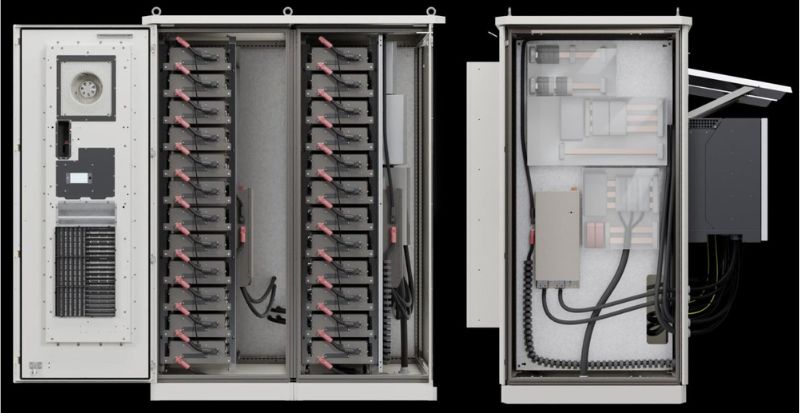
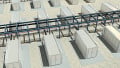
Voltfang 2 energy storage system. Images used courtesy of Voltfang
The company offers its Voltfang 2 modular storage unit for commercial and industrial users, with each rack integrating an inverter and energy management system, and capacity starting at 90 kWh, using standard NMC lithium-ion cells. Another product is the grid-scale Voltfang 2 Plus GS battery storage system designed for neighborhoods and utility infrastructure, starting at 3.2 MWh of capacity and 1.2 MW of power.
Voltfang claims that reusing 10 kWh of repurposed batteries saves up to 3 MWh of energy, 1 metric ton of carbon dioxide, and 50 kilograms of raw materials compared to producing new batteries. The company's production has increased fivefold in the last year. According to its Impact Report, its installed systems delivered 360.3 MWh of storage capacity in 2024.
Demand for energy storage systems remains high, and IDTechEx projects that over 6 million EV battery packs will retire annually by 2030.