Facebook
 Google
 GitHub
 Linkedin
Cancelation Looms as Tesla Pushes 4680D Dry Coating
Despite significant hurdles, Elon Musk and Tesla are committed to making dry coating technology work.
Tesla has made advances in self-driving cars, human-like robots, robotaxis, and artificial intelligence, but the company’s bread and butter remains electric vehicles powered by lithium-ion batteries. Tesla has worked closely with partners like Panasonic in Japan, China’s CATL, and South Korea’s LG Energy Solution to supply its battery needs.
However, Tesla’s long-term goal is to vertically integrate its vehicle production by producing its own lithium-ion batteries. Producing 4680 battery cells will allow the company to reduce costs and produce more affordable EVs.
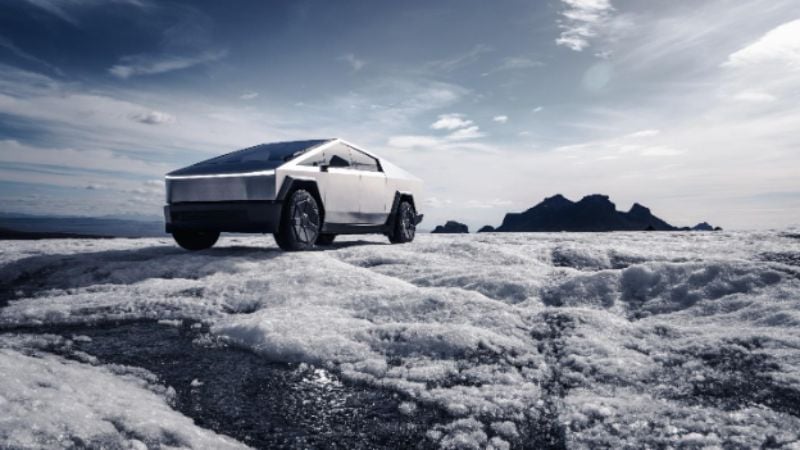
Tesla Cybertruck. Image used courtesy of Tesla
4680 Battery Cells
The 4680 battery cell is named for its 46 mm diameter and 80 mm length. Tesla unveiled the 4680 cells at its Battery Day event in September 2020, marking a departure from the smaller 21700 and 18650 cells Tesla had previously used in its vehicles. Currently, 4680 cells are powering both the Cybertruck and Model Y.
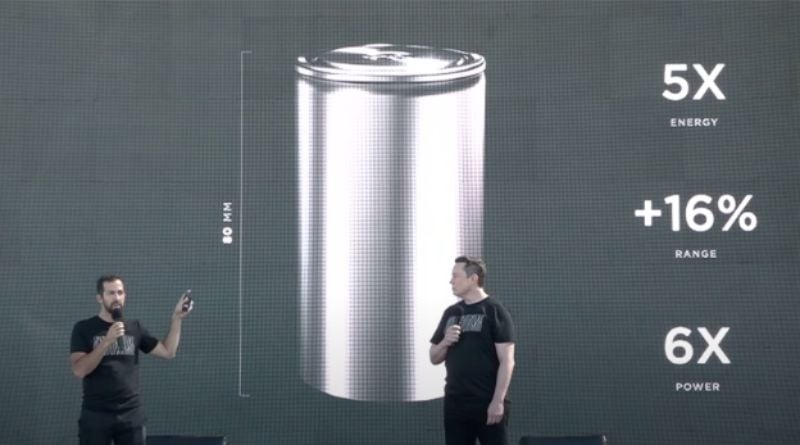
Tesla engineer and Elon Musk introducing the 4680 battery in 2020. Image used courtesy of Tesla
Beyond the larger form factor that increases energy density by allowing for more active material in each cell, the 4680 cells introduced several groundbreaking features. These include a tabless design, which reduces electrical resistance and improves thermal management. The 4680 also has greater structural integrity as it has been designed for eventual integration into the vehicle structure, eliminating battery boxes to improve rigidity and reduce weight and cost.
Dry Electrode Technology
Tesla intends to include a dry coating process for its electrodes in the 4680 cells. The use is expected to reduce manufacturing time and costs by eliminating the need for solvents and drying ovens from the production line. A dry-coated cathode, for example, offers to potentially lower costs by over 18 percent and equipment investment by 41 percent compared to the wet process.
Tesla acquired Maxwell Technologies, a company that produces capacitors made with a dry coating process, in 2019. The company’s goal was to leverage the dry coating technology to more efficiently and cost-effectively produce its 4680 cells. Although Tesla sold Maxwell Technologies in 2021, it kept the dry coating process to apply to its 4680 production line.
The 4680 dry coating process has presented several significant challenges for Tesla. The company has found that mixing the cathode (positive electrode) materials with a binder and attaching them to metallic foil without using a liquid is difficult, especially to achieve the required coating thickness precision within 0.1 millimeters or less of deviation. The process also generates excessive heat when scaled up, making it difficult to produce at the mass scale needed to reduce costs.
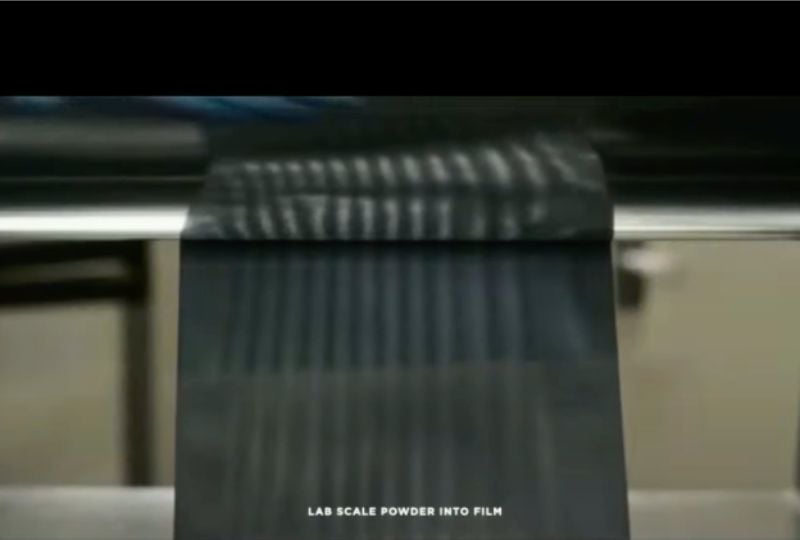
Dry electrode process in the lab. Image used courtesy of Tesla
The hard cathode materials (which contain nickel and cobalt) have been found to damage the roller equipment used in the calendaring process—damage that can take up to 45 days to repair.
The prototype production line for the Tesla 4680D (dry electrode) cells has not been successful. The cathode losses for a typical battery production line are around 2 percent. Tesla has lost 70 to 80 percent of its cathodes during its production tests. While high scrap rates (30-50 percent) are not unusual during the startup of a battery production line, the problems with the dry electrode process have significantly delayed the mass production of the 4680D cells, forcing Tesla to use a hybrid approach (dry-coated anode, wet-coated cathode) for current Cybertruck batteries. The company has also apparently struggled with achieving the desired first-cycle efficiency, with early samples reaching only 88 percent compared to the industry standard of over 92 percent.
Moving Forward
Tesla produces half a million 4680 cells per day using traditional wet electrode coating processes. More than 100 million 4680 cells have been produced across all of Tesla’s factories. The 4680D dry process cells are at a much lower production rate. Capacity is at a rate that will only support about 24,000 Cybertrucks per year, far lower than the 250,000 vehicle per year targets for 2025.
The dry coating electrode process remains an important cost-cutting goal for Tesla, despite reports that CEO Elon Musk has warned the production team they will need to solve its problems by the end of the year or risk having the project canceled. Moving forward along the cost reduction curve requires perfecting new technologies, and Tesla isn’t the only company working on the process.
After working on it for about a decade, LG Energy Solution has started piloting its dry coating technology. LG's process can be applied to both cathodes and anodes, and full-scale production is targeted for 2028. Samsung SDI is also developing dry coating technology for its new 46-series cylindrical batteries, while Volkswagen, through its subsidiary PowerCo, is also exploring dry coating technology. Chinese battery giants CATL and BYD are investing heavily in new technologies, including dry coating. All these companies view dry coating technology as a way to reduce energy consumption and production costs significantly.
Tesla remains committed to vertically integrating its EV production and manufacturing its own batteries, which is an obvious way to reach this goal. Making the dry coating of electrode technology work is an important step, and it seems just a matter of time before Tesla’s manufacturing engineers get it right.