Facebook
 Google
 GitHub
 Linkedin
Toshiba Unwraps Small 80 V eFuse IC for Industrial Gears
The eFuse IC brings multi-function circuit protection for 48 V industrial power lines into an industry-leading small package.
Toshiba Electronic Devices & Storage Corporation has begun shipping the TCKE1401NM, an 80 V-rated eFuse IC that packs overcurrent protection, overvoltage shutdown, true reverse-current blocking, and reverse-polarity protection into a 4.0 × 4.0 mm VQFN24D package.
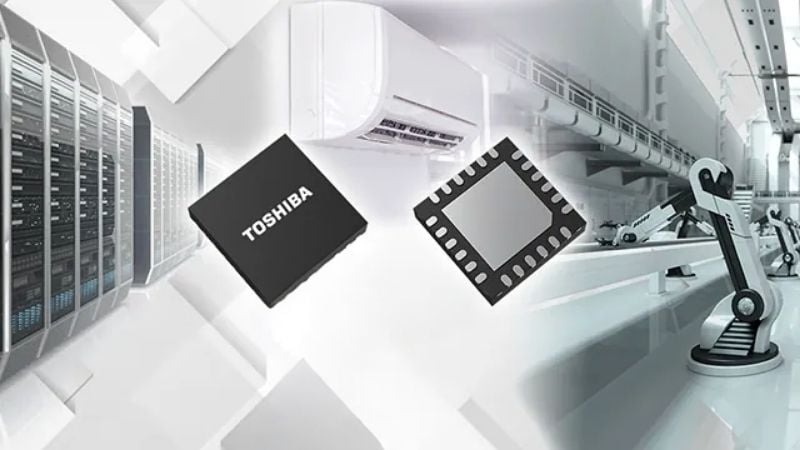
The TCKE1401NM eFuse IC has multiple applications, including servers and industrial robots. Image used courtesy of Toshiba
The Push Toward 48 V Power Architectures
For decades, 12 V has been the default DC bus voltage inside servers and industrial systems. But as processors, GPUs, and motor-driven equipment demand more power, that architecture is running into a wall: delivering more watts at 12 V means pushing more current through the same cables and PCB traces, and resistive losses scale with the square of current.
The Open Compute Project has been pushing the industry toward 48 V rack architectures as a way around this problem. By quadrupling the bus voltage, engineers can cut the current required for the same power delivery to a quarter, thereby reducing resistive losses by roughly 16x. That translates to thinner cables, smaller connectors, less wasted heat, and simpler cooling.
The catch is that 48 V (and adjacent 24 V/54 V rails, which allow for voltage headroom and battery-backup tolerances) demands protection components built for the higher voltage swing. A 12 V-era eFuse or fuse simply doesn't have the voltage margin to survive on a 48 V rail without risking damage during transients or fault conditions. That gap is exactly where Toshiba's part is aimed.
Inside the TCKE1401NM: Specs and Protection Features
The TCKE1401NM is built around a single-input, single-output eFuse topology rated for an absolute maximum input voltage of 80 V, with a recommended operating range of 4.7 V to 75 V. This is wide enough to cover 24 V, 48 V, and 54 V industrial rails with headroom to spare. A low 44.5 mΩ on-resistance keeps conduction losses down, which matters for system efficiency.
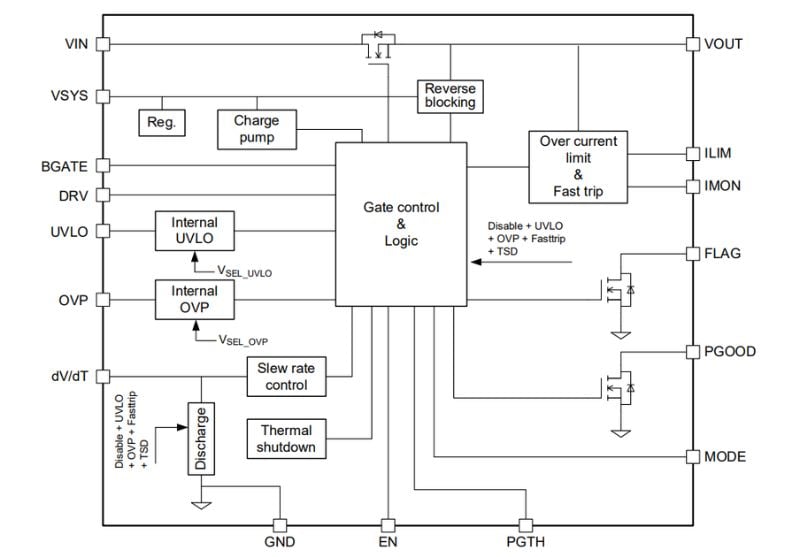
Internal block diagram of the TCKE1401NM. Image used courtesy of Toshiba
Unlike conventional physical fuses, which only protect against short circuits, the TCKE1401NM integrates overcurrent, overvoltage, undervoltage, reverse-current, and reverse-polarity protection along with inrush-current control, all in a single chip.
Rather than hard-coding trip points, Toshiba made most of the protection thresholds adjustable via external resistors, so the same part can be tuned across different equipment designs, eliminating the need for separate SKUs.
Overcurrent limiting can be tuned from 0.82 A to 6.43 A, depending on the resistor value at the ILIM pin, while separate dividers set the overvoltage and undervoltage lockout thresholds. A capacitor at the dV/dT pin governs slew-rate control, tempering inrush current during hot-plug events, a detail that matters when boards are added or replaced without powering down the system.
The device also blocks current from flowing backward through the circuit and guards against reverse-polarity connections, both handled via external MOSFETs. This shielding protects not just the eFuse IC itself but the downstream circuitry it's protecting.
_and_resistor_dividers.jpg)
Application circuit for the TCKE1401NM showing the external MOSFETs (Q1, Q2) and resistor dividers. Image used courtesy of Toshiba
Status Monitoring and a Compact Footprint
Beyond fault protection, the device reports status through a FLAG output (signaling abnormal conditions), a power-good output (confirming valid output voltage), and a current-monitor pin. This gives host systems visibility into the power line's health, not just a hard shutdown when something fails. Fault recovery is selectable between two modes: automatic retry or latch-off, requiring an external reset signal.
All of this is packed into a VQFN24D package measuring just 4.0 × 4.0 mm (0.9 mm thick), the smallest footprint available for any 80 V-rated eFuse IC, according to Toshiba.
Toshiba lists servers, network equipment, factory automation gear, robots, and multifunction printers as target applications for the TCKE1401NM. Full electrical characteristics, application circuit examples, and design guidance are available in Toshiba's datasheet for the part.
What's Next for Toshiba's eFuse Lineup
Toshiba states it will continue developing eFuse ICs that enhance safety and reliability in power line protection and plans to further expand the lineup. That signals the part isn't a one-off release.
The bigger question is how quickly eFuse ICs displace traditional fuses and discrete protection circuits across these markets. As equipment manufacturers standardize around 48 V and 54 V rails, demand for compact, multi-function protection components rated for that voltage range is likely to intensify, pressuring competitors offering their own high-voltage eFuse families to match both the feature set and the shrinking package sizes this generation of parts is chasing.